Reply To:
Name - Reply Comment
 On the third and final night of the run of ‘Dancing for the Gods’ (a re-staging of the Kohomba Yak Kankāriya tradition) at the Lionel Wendt in October 2011, Upeka, then sixty, told her niece Heshma minutes before going on stage that this would be her last performance. The announcement was made to the audience, and she danced the Kuveni Asne - the dance of the betrayal of Queen Kuveni, in mythical terms the source of Sri Lanka’s political ills - clad entirely in black, with her niece Thaji as her counterpart on stage in a kind of generational hand-over, through the only ritual, and rite of passage known to both. Renuka Sadanandan, writing in The Sunday Times of 16 October 2011, described the performance as “powered by deep feeling and all the strength she brings to her dancing,” and reported that audience members streamed onto the stage to garland her as the curtain fell. Upeka later said the decision was “spontaneous,” “the right thing to do at the right time,” and that she preferred to retire while still able to “perform everything I loved, rather than do what I could just physically manage.”
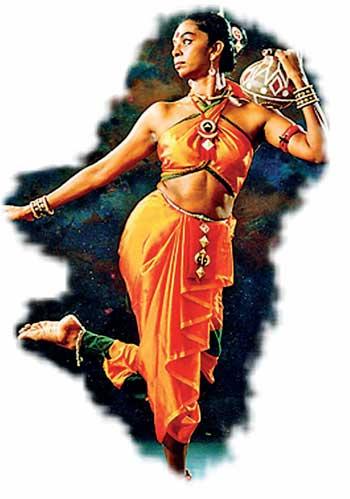 She has not returned to the stage in any public performance since, and is pointedly unsentimental about it. In a 2021 interview with Mirak Raheem published on Groundviews, Upeka said simply, “I have never thought ‘oh I wish I could be back on stage.’ … I really can’t think of a life without dance”. In another interview published in The Island she insisted, “I had had it all … I have absolutely no regrets.”
Upeka is the eldest of the three children of Chitrasena, and Vajira – the famed duo who effectively created the modern Sri Lankan dance theatre tradition, and presented it to the world. Upeka’s paternal grandfather was Seebert Dias, the actor-producer of the 1920s and 1930s and a founder of the Colombo Dramatic Club; her maternal grandmother, Lilian, was a teacher at Kalutara Mahā Vidyālaya whose insistence first brought Vajira into dance. Upeka is at the centre of a four-generation dance dynasty, unique in the country. She came to the stage at seven playing a flower, in her mother’s children’s ballet ‘Vanaja’, and had her first lead at thirteen in ‘Rankikili’. The 1971 European tour over three months, and 56 performances was, by her own account, the experience that made her a professional. In 1975 she took the Sisi role in ‘Karadiya’ opposite her own father, the role her mother had defined. ‘Kinkini Kolama’ in 1978 was created on her; the mad scene remained her favourite role to the end. ‘Nritta Tharanga’ followed in 1981 for Queen Elizabeth II’s state visit, then ‘Bera Nada Chalana’, Sati in ‘Shiva Ranga’, the Kuveni she would close with three decades later.
Upeka’s artistic signature, to my mind, lies in three things that braid together rather than sit in sequence. She internalised her parents’ dance idiom so deeply that critics repeatedly described her as both continuous with it, and distinct within it. As she told Raheem about bearing the legacy of her parents, “I wanted to be recognised in my own right, and not just to be seen as their daughter.” She became unusually fluent across Kandyan, and Low Country vocabularies, even though she says she came to study Low Country relatively late. And she turned live drumming into a visibly dialogic part of performance, rather than a merely supportive accompaniment - the point I want to come back to.
For such a world renowned, and fêted life though, the biographical record on Upeka is somewhat thin. The Sri Lankan state honours that should track an illustrious career like hers, from Kala Suri, Kala Bhushana, Kala Keerthi, to Deshamanya flowed to Chitrasena and to Vajira but not yet for Upeka, so far as I have been able to discover. The Padma Shri bestowed by India was given to her mother. An honorary doctorate came to her father. Upeka’s recognition has come almost entirely through audience rapture, critical appreciation, veneration by devotees of dance, and professional regard - never official. That is entirely consistent with her own dislike of pandering, and of competition for plaudit. It is also, more bluntly, consistent with the long-standing, and pathetic pathology of a country that struggles to celebrate its greatest living artistes until they are no longer living.
 Mesmeric Moves on the dance floor
Amma, and Archchi were part of the Chitrasena dance ensemble at Kollupitiya in the 1960s. The many stories I grew up with - of Amaradeva, of Punchi Gura, of the politics of performance behind the scenes of Karadiya in 1961 - were stories of Chitrasena and Vajira. Upeka entered my own life much later, and in an entirely unexpected manner – on the dance floor of the legendary Blue Elephant disco in the early 2000s. The sheer disconnect between all the stories of a traditional Kandyan dancer I had grown up with, contrasted with Upeka’s mesmeric moves on the dance floor was so confusing, I recall asking Amma, and Archchi for details about how Upeka actually looked like to make sure I wasn’t imagining things after too many vodka shots. I subsequently started to write about her dance, and the school productions from 2006 onwards, starting with the memorial for her father. By then, Upeka had already been carrying the Chitrasena Dance Company on her back for two decades. It is the part of her life that the public record least understands, and the part I want to dwell on here.
In 1984, the Urban Development Authority acquired, and razed the original Kalayathanaya at Kollupitiya. The school had been gifted to the family by Sir Ernest Fernando in 1944. It was, by Archchi’s reckoning, the ground on which our national anthem was first sung. After the demolition the Company spent years rehearsing in rented spaces. The Black July riots in ‘83, the JVP insurrection in the late ‘80s, the war of three decades - none of these helped. By the mid-80s Chitrasena and Vajira could no longer tour as they had once toured. There was, between the founders’ retirement and the consolidation of the third generation, a gap of more than a decade. Upeka filled it.
She assumed the role of Principal Dancer in 1986. From that point until her retirement in 2011, she was effectively the Company’s leader: choreographer’s instrument, lead dancer, tour manager, public face, fundraiser and disciplinarian-in-chief. Her first international tour in charge was to the Middle East. She would later lead the Company to Singapore, Japan, India, Sadler’s Wells in London, Bangladesh, the United States and to France, where she would work three times with Ariane Mnouchkine and the Théâtre du Soleil at the Cartoucherie in Paris - a relationship she has called “a real highlight of my career.” She was also one of the architects of the relationship with the famed Bangalore-based Nrityagram Dance Ensemble that, under the next generation, would produce Saṃhāra and Āhuti.
Upeka’s ethereality
The other under-told story is Upeka as guru. She began teaching at the Kalayathanaya in her late teens at her mother’s insistence: “I didn’t like teaching at the beginning,” she told Mirak Raheem in 2021, “but my mother insisted.” After 2011, it became her work. It is impossible to talk about Thaji’s sublime, preternatural authority on stage today without talking about Upeka’s ethereality. Thaji began learning Kandyan dance from her aunt when she was seven. At 12 she was on tour in Paris with her. The dancer now described as the embodiment of an entire tradition, and whom I have written about for close to two decades, was shaped, daily and unsentimentally, by someone who described herself to Raheem with characteristic flatness as “a tough teacher because I am very tough on myself.” Her pedagogy moved consciously over time from the silent watch-and-follow model of her parents, toward something more discursive: she talks more to her students now, she said, than she once did. Upeka supervised the school’s scholarship programme, and was also the central organising figure behind the extraordinary Guru Gedara Festival in 2018, designed to bring out the stories of the surviving traditional ritual masters whose knowledge - particularly of the rituals from which the stage forms derive - is rapidly being lost.
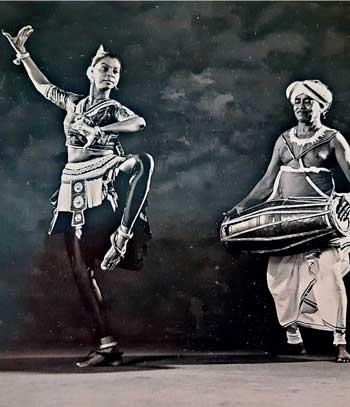
There is no separating Upeka the dancer from Upeka the partner of drummers. “It’s like a marriage,” she told Raheem, “one can’t do without the other.” Her father broke convention by moving the drummers from the rear of the stage to flank her; she danced solos in conversation with them. She has spoken of drawing energy from them when her own strength flagged mid-piece, looking across the stage and hearing them respond with greater weight in turn. This is the rhythmic intelligence - visible as symbiotic relationship, not as accompaniment - that Bera Nada Chalana depended on, and that Kinkini Kolama’s mad scene, Karadiya’s Sisi (which she took from her mother in 1975, opposite her own father), and the final Kuveni at the Wendt drew on for their dramatic charge. The drum, she has said, was “like my heart beat.” The harder questions flow from this. The Chitrasena Dance Company today rests on a vanishingly small number of shoulders: Heshma’s choreographic vision, Thaji’s body, Upeka’s pedagogy and Anjalika’s institutional memory. The school’s reliance on family is at once a structural vulnerability and a creative strength. The drummers, the singers, the non-family dancers, the seamstresses, the prop-makers and so many more who give the school more than the school can pay them for: all of this is real, and all of it depends on a chain whose load-bearing links can be counted on one hand. What happens without a Thaji, and a Heshma is the question my review of the amazing ‘Paramparā’ production raised earlier this year, and did not quite confront. What happens without an Upeka is a question we have not yet had to ask. Long may that continue.
Over the past two decades, I’ve learnt through association, and observation that what looks from outside like inheritance is in practice the daily, unglamorous work of refusing to let something disappear. Every Thaji, every Heshma, and every drummer who knows his place beside the dancer rather than behind her, owes something to Upeka’s work. It is an astonishing legacy, and life. She told Raheem she retired when she did because she wanted to “perform everything I loved” rather than do what she could just physically manage. It is the same instinct, perhaps, that animates her teaching now. “When you are dancing,” she said, “it’s like a meditation.”
On 21 May, Upeka turns 75.
Sri Lanka, as ever, owes her more than it will ever recognise, and give.