 KELUM BANDARA
 Reply To:
Name - Reply Comment
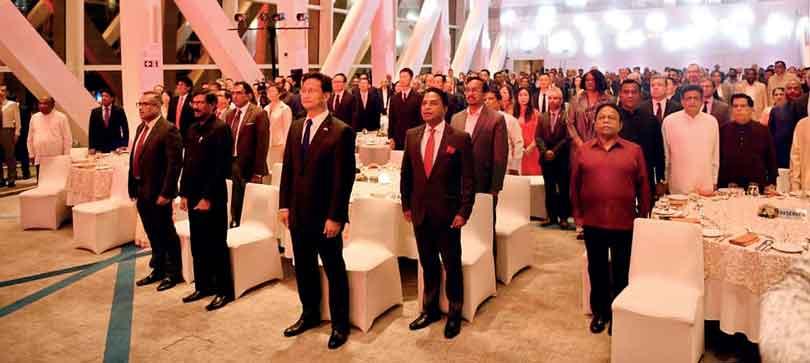
Several members of major political parties, civil society representatives, government officials, and media personnel at the event in Colombo
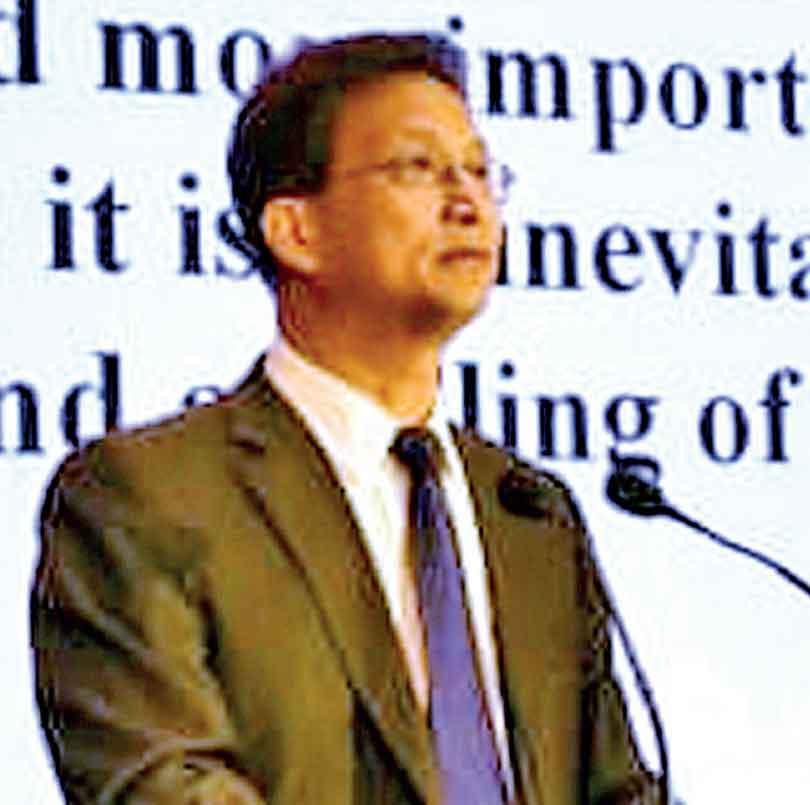
Chinese Ambassador Qi Zhenhong
By the time the Communist Party of China (CPC) marked its 105th anniversary, it had significantly expanded its engagement with political parties of all hues across the globe—and Sri Lanka is no exception. Since taking charge of China, the CPC has elevated the country from a poverty-stricken, semi-colonial, and feudal state into a modestly prosperous nation.
Today, global political dynamics are shifting rapidly. In democratic societies like Sri Lanka, a change in government often triggers a complete reversal of policies. This chronic lack of policy continuity has consistently hampered long-term national progress. Against this backdrop, China serves as a classic example of a nation that has succeeded through unwavering policy consistency coupled with gradual reforms.
In its bilateral engagement with Sri Lanka, these democratic changes in government have frequently resulted in inordinate delays or outright cancellations of key projects. In other instances, vital initiatives have progressed at a lackadaisical pace. Bearing these underlying realities in mind, the CPC has adopted a pragmatic approach: it is now actively maintaining close ties with political parties across the entire Sri Lankan political divide. \
A gathering celebrating the 105th founding anniversary of the CPC was held at the Great Hall of the People in Beijing. Addressing the assembly, as reported by the *Global Times*—the official newspaper of the party—Chinese President Xi Jinping, who is also the General Secretary of the CPC Central Committee, called for the continuous building of a community with a shared future for humanity. He emphasised holding high the banner of peace, development, cooperation, and mutual benefit, while upholding the common values of humanity. Furthermore, President Xi urged the robust implementation of the Global Development Initiative, the Global Security Initiative, the Global Civilisation Initiative, and the Global Governance Initiative to inject more positive energy into world peace and development.
In tandem with the celebrations in Beijing, the Chinese Embassy in Colombo hosted a high-profile reception attended by major political parties, civil society representatives, government officials, and media personnel to mark the historic milestone. The event drew leaders from across the political spectrum, including Janatha Vimukthi Peramuna (JVP) General Secretary Tilvin Silva, the Leader of the Opposition, Sri Lanka Podujana Peramuna (SLPP) General Secretary Sagara Kariyawasam, Communist Party of Sri Lanka General Secretary Dr G. Weerasinghe, and United National Party (UNP) Chairman Wajira Abeywardana.
Delivering the opening remarks, Chinese Ambassador Qi Zhenhong stated that a constantly modernising China will provide expanding opportunities for the world, inject fresh momentum into international cooperation, and make greater contributions to human progress.
“Born at a time of national peril, the CPC grew through arduous struggles and thrived during the era of reform and opening-up,” Ambassador Qi noted. “From Shikumen, where the Party was founded, to Tiananmen, where the New China was proclaimed; and from Xingye Road, the home of the Party’s birthplace, to Fuxing Road, a symbol of the great journey toward national rejuvenation, our Party has always breathed the same breath, shared the same destiny, and linked its heart with the people. History has demonstrated a profound truth: the leadership of the CPC is the choice of history, and more importantly, the choice of the people; it is an inevitable outcome of practice and a calling of the times.”
He further highlighted China’s socio-economic triumphs: “Seeking happiness for the people, we have won the battle against absolute poverty and completed the building of a moderately prosperous society in all respects. Our achievements in poverty reduction have drawn worldwide attention, and improvements in livelihoods are shared by all. With education, medical care, and social security systems fully covering both urban and rural areas, the 1.4 billion Chinese people enjoy a profound sense of gain, happiness, and security.”
Ambassador Qi asserted that Chinese modernisation is advancing with steady and rapid strides. China’s total economic output has exceeded 140 trillion CNY, and its status as the world’s largest trading nation remains undisputed. From the “Chang’e” lunar exploration to the “Fendouzhe” deep-sea submersible, and from high-speed rail networks to global leadership in 5G, China’s major strategic equipment continues to achieve new milestones.
On global governance, the Ambassador highlighted that President Xi Jinping’s proposal to build a community with a shared future for humanity has been integrated into UN resolutions and has become a global consensus. The Belt and Road Initiative (BRI) continues to connect oceans and continents, while the China-Europe Railway Express injects strong momentum into global development. Together, China’s four major global initiatives systematically respond to the challenges of the modern era, offering Chinese wisdom and solutions that nearly 160 countries and international organisations have embraced.
Asserting that the friendship between China and Sri Lanka dates back to ancient times, the Ambassador noted that party-to-party exchanges have forged a deep bond rooted in mutual respect and equality.
“We exchange views on state governance and seek ways for common development. The successful meeting between President Xi Jinping and President Anura Kumara Dissanayake has mapped out a new blueprint for China-Sri Lanka relations,” he said.
He emphasised that inter-party relations are a vital component of the broader bilateral relationship. Guided by the principles of independence, complete equality, mutual respect, and non-interference in internal affairs, the CPC stands ready to strengthen the exchange of governance experience with all Sri Lankan political parties. This includes advancing pragmatic cooperation in poverty alleviation and digital city infrastructure, as well as promoting people-to-people bonds.
“Facing the grand questions of ‘What has happened to the world and how should we respond?’ the CPC is willing to join hands with all countries to promote the construction of a clean and beautiful world of lasting peace, universal security, common prosperity, openness, and inclusiveness,” the Ambassador added.
Signalling this institutional depth, the CPC has signed a Memorandum of Understanding (MoU) with Sri Lanka’s ruling party. Addressing the function, Mr Tilvin Silva acknowledged and thanked the CPC for the training opportunities afforded to his party members over the years.
The rise of China signifies the rise of a different civilisation, bringing with it an alternative governing model and value system that is bound to reshape the global order. International relations are rapidly adapting to this new reality. For instance, even the United States has sought a new equation for ties with China, balancing geopolitical rivalry with the reality of coexisting as the world’s two superpowers.
Founded in 1921, the CPC currently boasts more than 101 million members—meaning roughly one in every 14 Chinese citizens is a member. Globally, it is second in size only to India’s Bharatiya Janata Party (BJP), which has roughly 140 million members. The CPC is now positioning itself to steer China through the complex challenges of its global ascent. Ultimately, the sheer size of China’s market share has compelled the world to cooperate, looking past political and geopolitical rivalries. In modern international relations, economic cooperation has taken centre stage, serving as a powerful deterrent to military conflict. For decades, China has sought deep cooperation with Sri Lanka—and while the relationship has seen its historical ups and downs, Beijing’s strategy ensures it remains built to last.