 KELUM BANDARA
 Reply To:
Name - Reply Comment
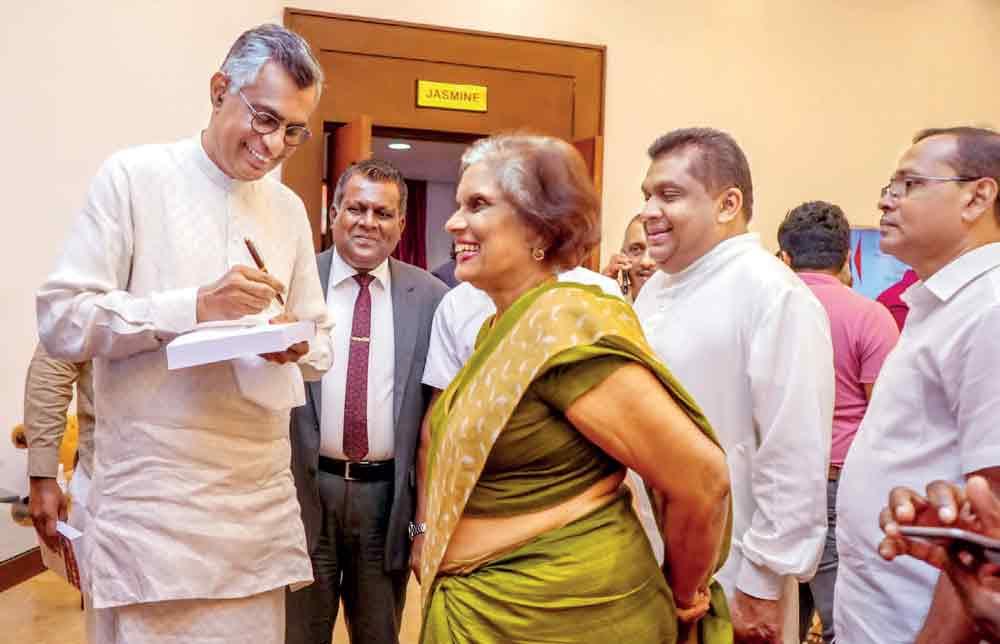
All smiles at the book launch...
The famous maxim, “We have no eternal allies, and we have no perpetual enemies. Our interests are eternal and perpetual,” originated from a speech by Lord Palmerston, who served as Foreign Secretary of the British Empire in 1848.
Its relevance in international relations still holds validity today, and the quotation was once again invoked by former External Affairs Minister G.L. Peiris to underline the point at a function marking the launch of the latest book “Ekata Getuma”, authored by United Republican Front (URF) leader and former Minister Patali Champika Ranawaka.
The book was launched at a time when international relations have become increasingly complex in a multipolar world. Major powers pursue their national interests even at the expense of universal values and international law. Sri Lanka, being a relatively small country but with a strategic position in the Indian Ocean—the most important region in today’s interconnected world—is naturally caught in a struggle to advance its national interests amid the growing and competing interests of global powers, namely the United States, India, China, and Japan.
Prof. Peiris said that anyone who has served as Sri Lanka’s Foreign Minister would agree that balancing relations with the US, China, and India is among the most challenging tasks in foreign policy.
Non-alignment has long been a trademark of Sri Lanka’s foreign policy. However, its meaning is often misconceived. Asserting that it remains a valid concept, Prof. Peiris said non-alignment essentially means making objective, impartial, and dispassionate assessments in foreign policy decisions, without aligning with any power bloc.
 Non-alignment essentially means making objective, impartial, and dispassionate assessments in foreign policy decisions, without aligning with any power bloc... It was never a sitting-on-the-fence policy
He said Sri Lanka’s foreign policy positioning was held in high esteem in the past, when leaders stood firm on principle. He noted that former Prime Minister Sirimavo Bandaranaike even played a mediating role during the 1962 Indo-China war.
“At that time, my father was the Director-General of the External Affairs Ministry. Mrs. Bandaranaike delivered letters with her proposals to then Indian Prime Minister Jawaharlal Nehru through my father,” he said.
Sri Lanka, as a small country, maintained such a diplomatic posture in those days.
“It was never a sitting-on-the-fence policy,” he said.
In contrast, he argued that the current leadership has been unable to take firm positions in line with the concept of non-alignment. He referred to the failure of the Sri Lankan government to clearly articulate its stance when the Iranian vessel IRIS Dena sank in Sri Lanka’s Exclusive Economic Zone after being allegedly attacked by a US submarine.
He said that rejecting requests from both the US and Iran for access to the Mattala airport cannot automatically be interpreted as non-alignment.
Reflecting on his experience as Foreign Minister dealing with the UNHRC resolutions, he said China stood by Sri Lanka as a genuine partner during those difficult times. He noted that Chinese Foreign Ministers were accessible at any time Sri Lanka required assistance, and that Foreign Minister Wang Yi had even instructed Chinese embassies in Africa to lobby in support of Sri Lanka.
He also recalled that the Chinese leadership had consistently argued that Western countries were using human rights as a tool to interfere in Sri Lanka’s internal affairs.
On global geopolitics, he observed that world leaders—including Chinese President Xi Jinping, Russian President Vladimir Putin, and Indian Prime Minister Narendra Modi—have increasingly explored alternatives to the US dollar in international trade, particularly following tariff measures introduced by US President Donald Trump. He said discussions on currency diversification, including the use of the RMB, gained momentum at the BRICS and Shanghai Cooperation Organisation summits.
Former Foreign Minister Ali Sabry, who served in the Ranil Wickremesinghe government, said Sri Lanka’s foreign policy today appears to be an extension of another country’s foreign policy. He noted that Nepal, which once expressed support for Sri Lanka, later changed its position following pressure from a major power.
He said that in a multipolar world, non-alignment may even be better described as “multi-alignment,” where strategic autonomy is exercised rather than rigid alignment with any one bloc.
“It is a multipolar world. We should not align with any single country. We must exercise our strategic autonomy,” he said.
He also stressed that managing geopolitics remains one of the most critical challenges for Sri Lanka.
Referring to the book, Sabry said it is a well-researched work published at a time when evidence-based policy thinking is increasingly necessary.
Author Patali Champika Ranawaka said that the 21st century belongs to Asia and argued that Trincomalee should be developed as Sri Lanka’s strategic hub to engage more effectively with the East. He added that if Sri Lanka had prioritised developing Trincomalee over Hambantota, the country’s economic dividends could have been significantly different today.
He also spoke at length about his personal journey as an artist, writer, and student activist.
“Many people ask me whether I aspire to be the President. In fact, I once dreamed of becoming an artist,” he said.