Reply To:
Name - Reply Comment
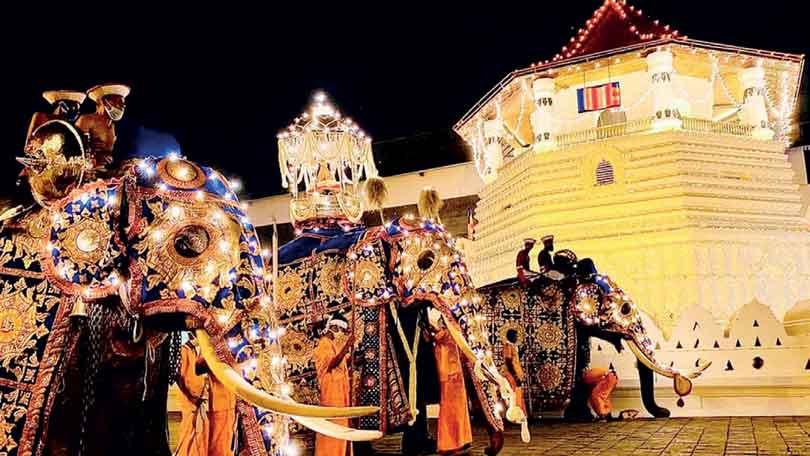
This ceremony features a dance in front of the elephant’s head, tail, and trunk, which carries the “Ran Aayudhaya” of the deity at Maha Vishnu Devalaya. FILE PHOTO
The melodious music produced with the combination of the deep and bustling sound of the large drum (Daula), bipartite sound of the double drum (Thammattama) and the hissing sound of the trumpet (Horanewa) invariably brings the Esala perahera of Sri Dalada Maligawa in Kandy to our mind
 As recorded in the Parinibbana Sutta, Buddha Himself has sanctioned the worship of His corporal remains. This is one of the most important sanctions the Enlightened One has made on the verge of His passing away. According to the Digha Nikaya, the bodily remains of the Buddha enshrined in stupas are being worshipped. Four canine teeth of the Enlightened One have been separately enshrined and worshipped. One canine tooth is enshrined in Sakra Bhavana, the abode of the king of gods. The second and third sacred canine teeth are enshrined in Gandhara and Nagadeepa, respectively. The fourth canine tooth relic was removed from the funeral ashes and was handed over to the king of Kalinga. In this manner, the sacred tooth relic came to be considered an important symbol of veneration. The last Indian ruler to possess the sacred tooth relic was King Guhasiva of Kalinga.
Arrival Of The Sacred Tooth Relic In Sri Lanka
King Guhasiva, who was at war with the neighbouring state, decided to send the sacred tooth relic to Sri Lanka. It was brought to Sri Lanka by King Guhasiva’s daughter, Hemamala, hidden in her knot of hair. She was accompanied by her husband, Prince Danta. This happened during the reign of King Kithsiri Mewan in the fourth century B.C. According to the Mahawansa Sri Dalada Perahera had been conducted in a noble way during the reign of King Parakramabahu the Great and King Pandita Parakramabahu.
Festivities And Opportunities To Worship The Sacred Tooth Relic
The melodious music produced with the combination of the deep and bustling sound of the large drum (Daula), bipartite sound of the double drum (Thammattama) and the hissing sound of the trumpet (Horanewa) invariably brings the Esala perahera of Sri Dalada Maligawa in Kandy to our mind. This is the most colourful and attractive Buddhist cultural festival—The pageant in the hill capital, which has drawn the attention of not only the Sri Lankans but also those in all parts of the world. Esala Perahera is held during the month of Esala (July/August) in addition to Vesak Mangalya, Poson Mangalya, Bak Maha Ulela, Aluth Sahal Mangalya (new Rice festival) and Karthika Mangalya held in October to distribute the Coconut oil of Sri Dalada Maligawa among temples and devalayas in the area. In addition to these festivals, opportunities are made available for the devotees to see the sacred tooth relic with their own eyes. A special exposition of the sacred Tooth Relic was held from April 16 to 27, in which a large number of devotees thronged the hill capital to see and worship the precious relic.
According to the information available, Esala Perahera, as we know it today, with four Hindu devalaya peraheras participating in it, had its origin in 175 A.D. under the reign of King Keerthi Sri Rajasinghe. The perahera he inaugurated was confined at first to four devalaya peraheras because by then, Hindu practices and rituals had crept into Theravada Buddhism owing to the influence of Mahayanism, as well as the King’s consorts, who were Hindu princesses from India. However, on the advice of Siamese priests who came for the restoration of Upasampada, the King ordered a procession with the sacred Tooth Relic to head the four devalaya perahera. Since then, the Esala perahera, followed by the perahera of four devalayas, Natha, Saman, Kataragama and Pattini, paraded the streets of Kandy. The Sri Dalada Perahera is immediately followed by the Natha Devalaya Perahera. Natha Devalaya is given preference over the other Devalaya because, according to tradition, the deity of this Devalaya is the Buddha to come. Maha Vishnu Devalaya Perahera comes next. According to the traditional history of Lanka, Sakra, the chief of celestial beings, has entrusted the custody of Buddhism in Lanka to the God Vishnu. The Perahera of Kataragama Devalaya follows. Last comes the perahera of Pattini Devalaya. The procession of the Tooth Relic, including the peraheras of the four devalayas, embodies all the traditional forms of music and dancing. The pageant is splendid and attractive, especially because it is conducted at night in the glare of lamps, both electric and oil, with the participation of elephants led by tuskers and various kinds of dancers and drummers. Religious rites and rituals are followed to the letter in the conduct of Esala perahera in the hill capital amidst various problems, such as the absence of enough elephants and most of the available elephants, especially the tuskers, being very old.
Kap Situweema
At the auspicious moment recommended by the astrologer of Sri Dalada Maligawa known as “Neketh Rala”, the Kap erection ceremony is performed by Natha, Vishnu, Kataragama and Pattini Devalayas. This is the first ceremony performed in connection with the Esala perahera in which Sri Dalada Maligawa does not participate.
The Highlight Of The Perahera
The Dalada Maligawa tusker carrying the golden casket containing the Sacred Relic is the highlight of the Perahera. A canopy is held over the casket. Every day of the Perahera the tusker is taken to Sri Dalada Maligawa Maha Wahalkada. Diyawadana Nilame places the casket reverently in the Ransivige (Howdah) on the back of the tusker. The tusker goes down the steps to the streets and is hailed by the cries of “Sadhu”. He realises the solemnity of the occasion and the reverence attached to it. The tusker is followed by two lines of dancers facing each other on either side of the road with drummers in the centre. At the end of the retinue walks the Diyawadana Nilame. He is attended by lance-bearers, umbrella bearers and minor heads of temples. Sri Dalada Maligawa perahera is followed by Satara devalaya perahera.
Memorandum To The Head Of State
At the end of the ritual performances Diyawadana Nilame, Basnayake Nilames and all those who are responsible for the Conduct of Esala Perahera go to the President’s House in Kandy to inform the President that the Esala perahera had been conducted successfully. The Head of the State invites them for a Tea party, addresses them and suggests solutions to problems, if any, at Sri Dalada Maligawa and Devalayas.
Waliyak Mangallya
The last ritual relating to the Esala perahera is the seven-day-long Waliyak Mangalya (Waliyakum ceremony) held at Vishnu Devalaya. This is to bless all those who participated in the perahera, including the Nilames and elephants, and to counteract the effects of the “evil eye”
This ceremony consists of a dance which is performed before the head and tail, and the trunk of the elephant who carries the “Ran Aayudhaya” of the deity in Maha Vishnu Devalaya. Pirith is chanted, and Dana is offered so that the gods might acquire merit.
This Perahera is conducted under the direction of Diyawadana Nilame of Sri Dalada Maligawa, who is the lay incumbent of Sri Dalada Maligawa and under the patronage of Maha Nayaka Theras of Asgiriya and Malwatta Chapters.