Reply To:
Name - Reply Comment
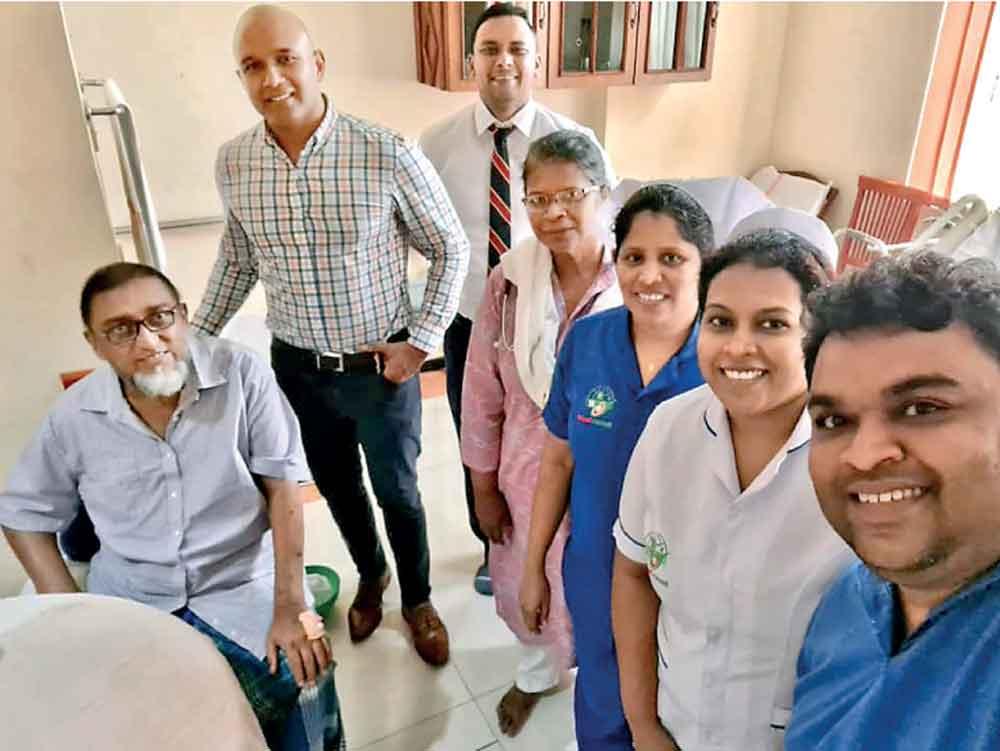
On 5th Oct 1985, Prof. Rezvi Sheriff (seated) spearheaded the first kidney transplant in
Sri Lankan and changed the course medical science in this island
 Sri Lanka lost one of its most distinguished medical pioneers when Prof. Mohamed Hussain Rezvi Sheriff, the country’s foremost nephrologist in the field of kidney transplantation, passed away in Colombo on March 30, 2026 at the age of 77. I had the privilege of meeting him at his Quiet, beautiful house in the bustling city of Borella, nearly a decade ago, where he spoke with warmth, humility, and conviction about his life’s mission. That conversation now stands as a treasured memory — an interview that revealed not only his professional brilliance but also his deep humanity.
When asked what inspired his journey, Prof. Sheriff leaned back with a gentle smile and related his story: “Our Prophet taught us that if society has a deficiency, we must go and learn how to fill it. That is a great meritorious act,” he said. “I was fortunate to be a good student, and a devout believer. That combination gave me strength.”
Born into a devout Muslim family, he grew up in Galle where his father, a businessman, ensured he learned Sinhala literature despite attending Zahira and Royal College. Sheriff recalled with fondness:
“I spoke Sinhala well, but I had never sat for a Sinhala exam. My father wanted me to learn properly, so he arranged for a teacher to come home. That’s how I studied Subhashithya and Kumarodaya. It was a tradition in our house to learn Sinhala language and culture.”
This grounding in Sinhala literature, he explained, helped him connect deeply with patients across communities. “I loved this country too much to leave,” he told me. “Even when I had opportunities abroad, my heart wanted to serve here.”
Prof Sheriff’s academic brilliance was evident very early. He topped his classes throughout school and graduated from the Colombo Medical Faculty as the country’s number one student. Later, at the University of Southampton in the UK, he specialised in nephrology — a field virtually unknown in Sri Lanka at the time.
“At that time, there was no separate subject for kidney diseases in Sri Lanka,” he explained adding, “We didn’t even have the technology to purify blood through dialysis. I was fortunate to be the first to introduce these practices here.”
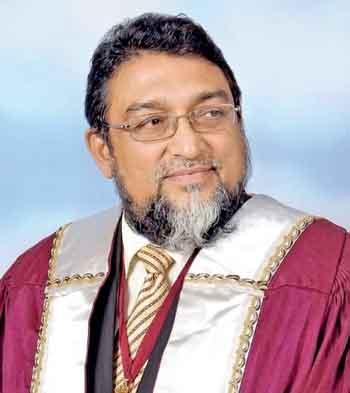 |
| Prof. M.H. Rezvi Sheriff trained generations of Sri Lankan nephrologists. Nearly every specialist in the field at present traces their knowledge back to him |
The first kidney transplant in Sri Lanka
He recalled with vivid detail the pioneering transplant of 1985.
“We faced enormous pressure. People said we didn’t have the technology. But my heart told me — if we can give someone a chance to live, we must try.”
The surgery involved both a father and a son; Charles and Cleetus Thirimanne, both healthcare workers. “We never took money for the first ten transplants,” he said firmly. “That was our duty.”
This landmark operation opened the door to thousands of successful transplants in the decades that followed. It also paved the way for the establishment of the National Institute of Nephrology in Maligawatta, one of Sheriff’s proudest achievements.
Champion of ethics
Prof. Sheriff was outspoken about the ethical challenges surrounding organ transplantation. He warned against the commercialisation of human organs and insisted on strict legal and medical protocols.
“Health tourism may be timely,” he cautioned, “but selling human organs abroad is unacceptable.”
Organ donation and transplantation is a humanitarian act. Although it may seem like a good deed, such as giving someone a chance to live, there are times when that good deed can be turned into a means of earning money or satisfying one’s own insignificant human or physical needs, the professor pointed out to us, recalling one of many own unpleasant experiences.
He told a story that underscore the fragile balance between medical necessity, human relationships, and moral responsibility.
Once, a man came for a kidney transplant with his wife and someone he himself introduced as a brother. This brother agreed to donate a kidney. Accordingly, the transplant was performed.
However, the person who donated the kidney fell ill few months later. He was admitted to the hospital for treatment, and his wife, who had been abroad until then, came to see the doctors. She asked why his kidneys were obtained.
She said that the people who had taken his kidneys had abandoned her husband after he fell ill.
Prof. Sheriff said that because of this development, he had to call the patient and his wife who had performed the transplant again. There, in private conversation the patient’s wife revealed the true, dark story behind this seemingly charitable donation. It revealed an abuse that took advantage of their helplessness.
“People are sometimes driven by money or other needs,” Prof. Sheriff explained. “We must be vigilant.”
Service beyond Nephrology
Prof. Sheriff’s contributions were not limited to kidney medicine. He developed antidotes for snake venom and kaneru seed poisoning, saving countless rural lives. “Many young children in villages died after eating kaneru seeds. I was able to produce a medicine that is still used today,” he said with quiet satisfaction.
He also spearheaded research into chronic kidney disease in Sri Lanka’s Rajarata region, supported by the World Health Organization, creating a repository of studies that continues to guide policy.
Prof. Sheriff was decorated with the Vidyajyothi title, Commonwealth honors, and awards from JICA and WHO. Yet he valued most the gratitude of patients whose lives he saved. He authored over 200 research papers and served as advisor to international nephrology organizations. His leadership ensured that Sri Lanka’s medical community remained connected to the latest research and practices worldwide.
Over 43 years, Prof. Sheriff trained generations of Sri Lankan nephrologists. Nearly every specialist in the field at present traces their knowledge back to him. He was also the founding President of the Sri Lanka Society of Nephrology and introduced specialised curricula on kidney diseases at the Colombo Medical Faculty. His vision extended beyond nephrology; he directed institutes dedicated to biochemistry, molecular biology, and biotechnology, opening doors to cutting-edge research in Sri Lanka. His students remember him not only as a brilliant teacher, but as a humble mentor. “He taught us that medicine is not just science — it is service,” one former student told me.
Life beyond medicine
Sheriff believed in giving patients a sense of normalcy after transplantation. He founded a sports association for transplant patients, enabling Sri Lankans to compete internationally. “In Australia, there is an Olympics for transplant patients. I sent our team there. They even won medals,” he recalled proudly. For him, this was proof that life after transplantation could be vibrant and full of possibility.
“My service was for Sinhala, Tamil, Muslim-everyone. Patients came to me as friends and brothers,” he said during our interview. Despite opportunities abroad, he chose to remain in Sri Lanka. “I loved this country too much to leave,” he explained. His students and colleagues remember him as a man of humility, always approachable, always ready to help.
Prof. Rezvi Sheriff’s life was a testament to vision, perseverance, and compassion. He pioneered dialysis and transplantation, built institutions, mentored generations, and safeguarded ethics in medicine. He developed antidotes, advanced research, and gave hope to thousands.
Above all, he remained a humble servant of humanity. His legacy will endure in every life saved, every student inspired, and every institution he built.
Sri Lanka’s medical community, and indeed the nation, will remember him not only as a pioneer, but as a healer whose smile, faith, and dedication transformed lives.