Reply To:
Name - Reply Comment
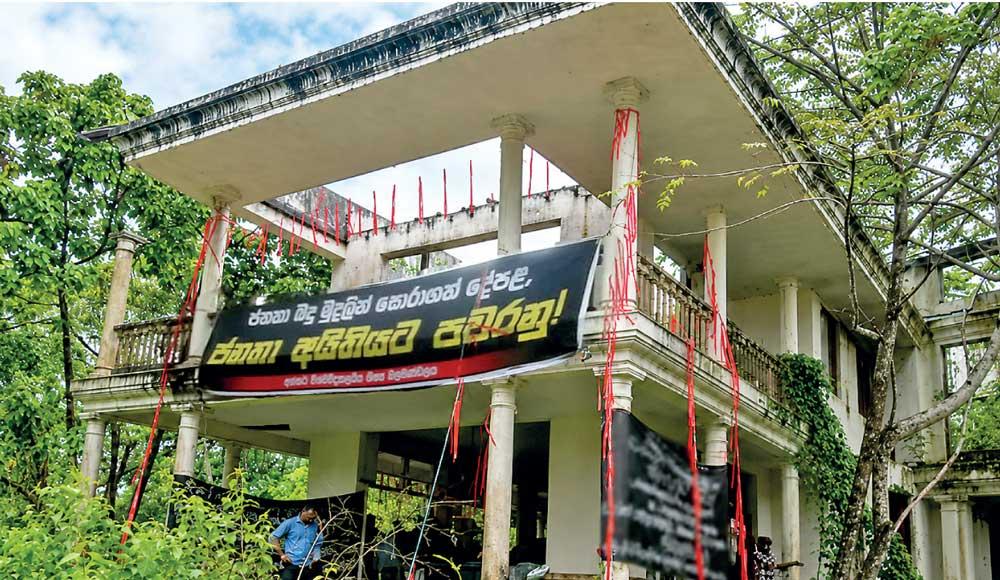
 The recent occupation of a property in Malwana by a group of student activists does not bode well for Sri Lanka’s already fragile investment climate. Beyond the immediate question of law and order, it raises a deeper concern: whether property, contracts and institutional processes will be protected at a moment when the country is trying to rebuild economic confidence.
Regardless of the political undercurrents or the disputed pedigree associated with the property, the central issue is straightforward. A property under state protection and administration was forcefully occupied by an organised group asserting political and social demands. If such actions are tolerated or normalised, the implications could extend well beyond this particular case.
Property rights form one of the foundations of a modern economy. Investors — local or foreign — make long-term commitments only when they believe that assets, contracts and lawful ownership will be protected through institutions rather than challenged through pressure, intimidation or political mobilisation. The Legacy of Expropriation and State Control.
Sri Lanka’s post-independence economic history contains many episodes that weakened this confidence. During the 1960s and 1970s, successive waves of nationalisation and state acquisition transformed the structure of the economy. Tea, rubber and coconut estates were taken over under land reform. State ownership expanded into banking, insurance, transport, manufacturing and other sectors. In 1962, the petroleum distribution sector was expropriated, including the assets of American oil companies. In 1963, the United States suspended assistance to Ceylon under the Hickenlooper Amendment to the Foreign Assistance Act, making the country one of the first outside Cuba to face such measures under this U.S. provision.
At the time, Sri Lanka — then Ceylon — still possessed important export industries, including graphite, plantations and related commercial networks. Yet repeated interventions, expropriations and politicisation weakened the entrepreneurial and industrial classes that had emerged during the late colonial and early post-independence period. Local capital formation suffered. Many business families migrated, contracted their operations or became increasingly dependent on political patronage for survival.
The legacy remains visible. Nearly 80 percent of Sri Lankan land is estimated to be under state ownership, much of it underutilised or locked within bureaucratic systems that inhibit productivity. While the state has an important role in regulation, redistribution and social protection, excessive concentration of ownership and control has often produced inefficiency and politicisation rather than broad-based prosperity.
The opening of the economy in 1977 was an effort to reverse this trajectory by encouraging private enterprise and liberalising trade. It also introduced constitutional protection, under Article 157, for foreign investment agreements approved by Parliament. Yet the transition away from the interventionist framework of the preceding decades was gradual and incomplete. Significantly, the Business Acquisitions Act of 1971 — which gave the state draconian powers to expropriate private enterprise — remained in force until the final phase of President J.R. Jayewardene’s tenure nearly a decade later.
This illustrated how difficult it becomes to unwind measures that place coercive economic power in the hands of government once they become embedded in political culture. Powers introduced as shortcuts for political purposes are rarely surrendered willingly by succeeding administrations; instead, they remain suspended over private enterprise like a sword of Damocles, conditioning business to stay close to power rather than operate with confidence within a predictable legal framework.
The war years further conditioned both the state and the private sector toward short-term survival rather than long-term transformation. Over the last three and a half decades, Sri Lanka’s record has remained mixed. Important privatisation, deregulation and private-sector participation measures were introduced, with sectors such as telecommunications, ports, plantations, apparel, tourism and financial services benefiting from varying degrees of liberalisation and private initiative. Yet reversals, arbitrary interventions, retrospective measures and periodic state reassertion over private enterprise also persisted. The result has been a business culture often marked by caution, short-termism and proximity to political power rather than innovation, scale and long-term productive risk.
That is why the Malwana incident matters.
The Present Confidence Test
Foreign investors usually take their cues from domestic business confidence. If local entrepreneurs themselves remain uncertain about policy consistency, property protection and the predictability of the legal system, foreign investors naturally become cautious as well. Upon assuming office, the current administration initially generated concern among sections of the business and investment community because of its ideological origins and left-wing political associations. However, its decision to continue with the economic stabilisation programme, cautiously pursue reforms in key sectors, deepen international economic engagement and explore the attraction of large-scale foreign investment led many observers to adopt a cautious wait-and-see approach.
Sri Lanka today needs investment, technology, export growth and employment generation. It requires confidence not only from foreign investors but also from domestic entrepreneurs willing to take long-term risks in manufacturing, infrastructure, energy, logistics and agriculture. Economic stabilisation alone will not produce growth unless confidence gradually returns.
When Extra-Legal Action Becomes Precedent
In this context, any occupation of property by activist groups outside the framework of the law — regardless of the background of the owners involved — sends a troubling signal to investors. It raises questions about the state’s willingness or ability to uphold institutional order. Investors do not examine only economic statistics or policy speeches; they observe behaviour, precedent and the consistency with which governments enforce the rule of law.
What becomes particularly damaging is the perception that informal or extra-legal action may be tolerated, encouraged or selectively overlooked for broader political purposes. Once societies drift toward forms of “frontier justice” — where organised groups begin asserting claims outside established legal processes — institutional credibility begins to erode. Even when initially viewed as politically useful or symbolic, such actions can create precedents that become difficult to contain. This risk is especially serious at a time of economic hardship. Sri Lanka remains socially fragile after years of crisis, inflation, reduced living standards and declining public trust. Movements tolerated for tactical reasons can evolve into broader challenges to institutional authority.
A Fragile Recovery
Sri Lanka has long had a left-leaning political culture, and many within the political class have historically viewed private capital with suspicion. Yet no modern economy can function effectively without respect for lawful ownership, enforceable contracts and confidence in institutions. These are practical requirements for economic organisation in any advanced society. Capitalism itself is rarely elegant to observe in practice. Markets can appear unequal, disruptive and uncomfortable. But no country has achieved sustained prosperity without creating conditions where enterprise, investment and productive risk-taking are protected within a stable legal framework.
Sri Lanka has achieved a degree of macroeconomic stabilisation after its worst post-independence economic crisis. But stabilisation is only the beginning. If property rights appear conditional, if the rule of law appears uncertain, or if organised groups are allowed to assert authority outside legal institutions, capital — domestic and foreign alike — will remain cautious.
The sooner Sri Lanka recognises this reality, the better its chances of achieving durable economic recovery and long-term prosperity.
Milinda Moragoda is the Founder of the Pathfinder Foundation.