Reply To:
Name - Reply Comment

“The Corporation has reduced the 3% profit margin paid to petroleum distributors. This has been done in violation of the existing pricing formula. The pricing formula in place had been approved by the Cabinet and upheld by the courts. This is completely wrong”
- Ananda Palitha, Samagi Joint Trade Union Alliance Convenor and Media Spokesperson
“This 3% paid by the Corporation was granted following Cabinet approval. However, the current administration has cut our 3% margin and transferred that money to the government. After doing so, the Petroleum Corporation is being presented to the country as profitable”
- A Spokesperson for the Petroleum Distributors’ Association
 By Prageeth Sampath Karunathilaka
According to the recently released Central Bank report, the Ceylon Petroleum Corporation (CPC) recorded its highest profit in the year 2025. According to the report, the Corporation earned a profit of LKR 36.4 billion. However, the Petroleum Distributors Association (PDA) pointed out that this reported profit has been generated from money allegedly earned unlawfully from fuel distributors during 2025. The Association further stated that the government is attempting to portray the CPC as profitable by unlawfully deducting a portion of the 3% margin. It also claimed that the government is presenting these profits by unlawfully withholding payments and discounts that are rightfully due to them, without making the required payments.
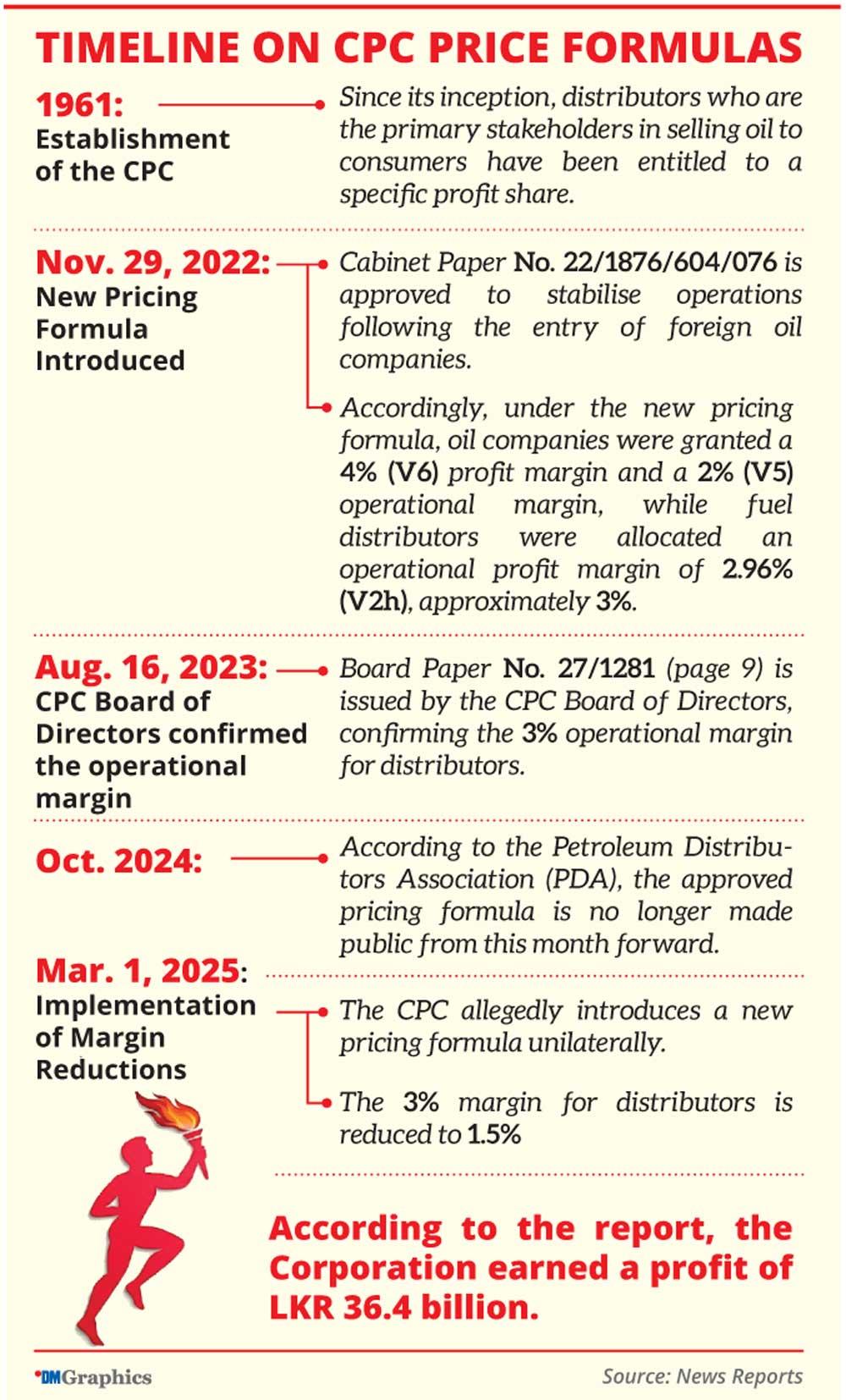
The CPC was established in 1961. Since its inception, distributors who are the primary stakeholders in selling oil to consumers have been entitled to a specific profit share. While these payments were made correctly and on time in the past, the Distributors Association pointed out that payments have been defaulted since March 1, 2025. They claimed the Corporation has arbitrarily seized more than half of their designated profit share.
Difficult to maintain businesses
As a result, CPC distributors are finding it extremely difficult to maintain their business operations. There are nearly 200 cooperative filling stations that serve as exclusive dealers for the CPC and these 200 stations are currently at a high risk. Many of these stations, particularly those located in rural areas, are on the verge of closing down. The Association further noted that they have informed the President of this situation in writing, but are yet to receive a positive response.
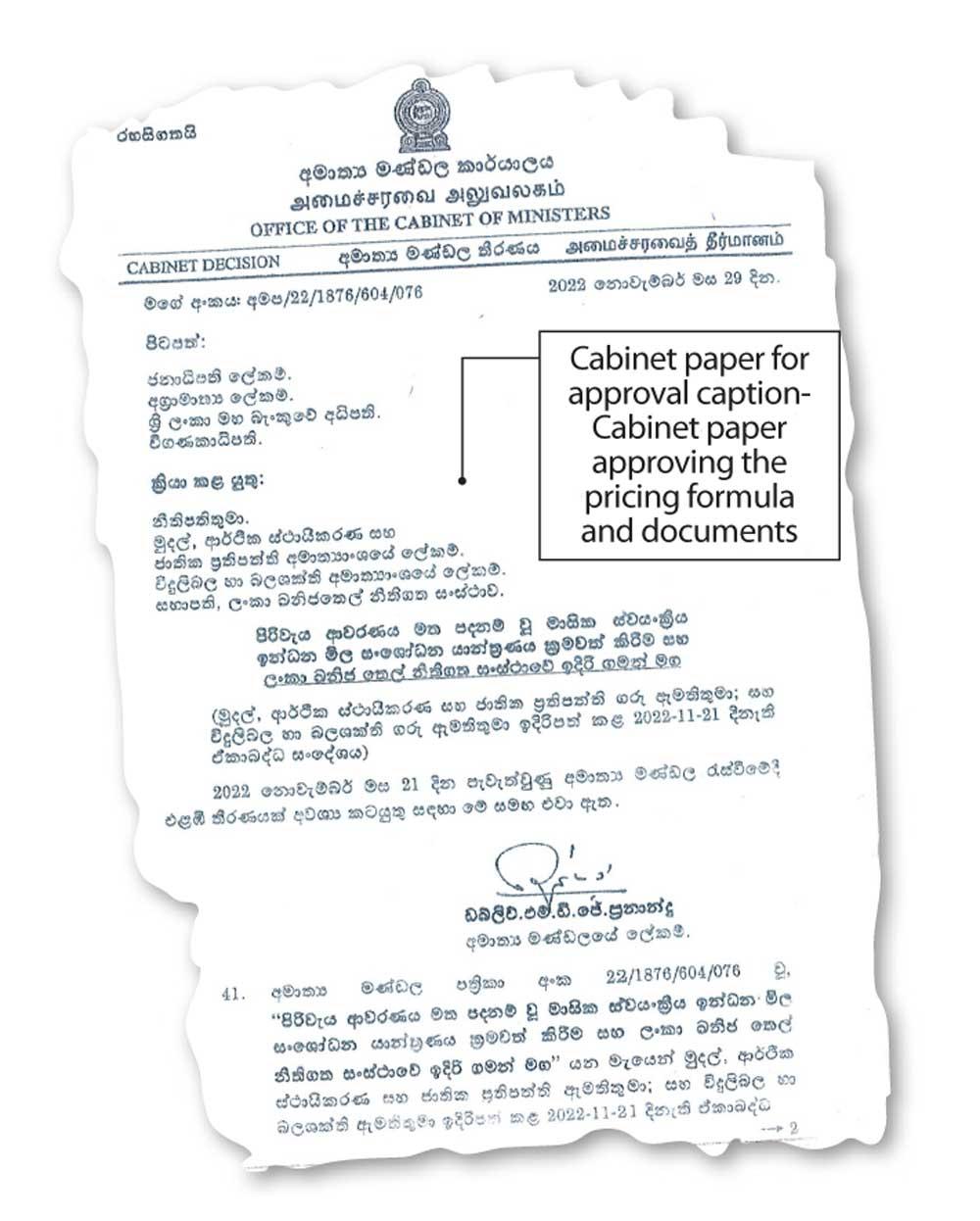
Following the transfer of filling stations belonging to the CPC to foreign oil companies, the latter entered the local market. To stabilise their business operations upon entry, a new fuel pricing formula was introduced via Cabinet Paper No. 22/1876/604/076, dated November 29, 2022. This has been approved through pages 7 and 8 of the relevant Cabinet paper. Accordingly, under the new pricing formula, oil companies were granted a 4% (V6) profit margin and a 2% (V5) operational margin, while fuel distributors were allocated an operational profit margin of 2.96% (V2h), approximately 3%.
Based on this Cabinet Paper, the CPC Board of Directors confirmed the 3% operational margin for distributors through Board Paper No. 27/1281 (page 9), dated August 16, 2023. Accordingly, foreign companies grant a 3% profit margin to their dealers, as stipulated in the commercial agreements signed between the two parties. However, the CPC has now reduced this 3% dividend to 1.5%. The Association stated that the 3% profit margin granted in this manner covers pump maintenance, water and electricity bill payments, employee salaries, and other expenses, as well as the maintenance of filling stations and the profit earned from their businesses. However, it further claimed that the current government has unlawfully appropriated this profit margin allocated to fuel distributors, thereby creating numerous issues.
Filling stations engaged in fuel distribution jointly with foreign companies are also bound by contractual agreements. Under these agreements, foreign companies provide their dealers with a 3% margin based on the Maximum Retail Price (MRP). However, the Petroleum Corporation has reduced the 3% profit margin provided to the filling stations under its management to less than 1.5%. When the fuel pricing formula was introduced, it received Cabinet approval. The formula had been properly structured to include the payment of this 3% profit margin and was also granted court approval. Accordingly, the Petroleum Corporation is obligated to pay this profit margin to its distributors properly, on time, and in accordance with the agreed terms. Under this pricing formula, there had been no issues arising from fuel price fluctuations, and there was no reduction in the revenue received by the government.
New pricing formula
However, the new management authority of the Petroleum Corporation has unilaterally introduced a new pricing formula in place of the previous one. Prior to changing the pricing formula, Cabinet approval is required, and the Petroleum Corporation is obligated to publish the formula. However, the current management has introduced a new pricing formula at its own discretion and has so far failed to take steps to make it public. According to this formula, the profit margin provided to petroleum distributors has been reduced from 3% to 1.5%, effective from 01.03.2025. As a result, the Association pointed out that the reduction in the distributors’ operational profit margin (V2h) has led to numerous issues.
This has resulted in an imbalance in the legally established pricing formula. Any formula remains proportionate only if its stipulated conditions are properly implemented. Under the previous pricing formula, fuel prices were revised monthly in keeping with those conditions, and there were no issues. However, the existing pricing formula has become imbalanced due to the newly introduced formula. By reducing the payment to petroleum distributors from the entitled 3% to 1.5%, the Ceylon Petroleum Corporation retains the remaining profit margin. In other words, this money ultimately goes to the Treasury.
As a result, it has been presented to the country that the Petroleum Corporation is earning record profits. Under the new pricing formula, the government continues to gain increased profits when fuel prices are revised, as prices are calculated based on an imbalanced formula. Accordingly, it raises concerns as to whether fuel price increases introduced under the pretext of the pricing formula are fair and justified.
By unlawfully reducing the operational profit margin percentage allocated to dealers under the pricing formula and appropriating that portion as well, the Corporation has reported an excessive profit of LKR 36.4 billion. Fuel prices, which were previously revised on a monthly basis, are now being changed several times a month. However, the approved pricing formula has not been made public from October 2024. Therefore, the Association pointed out that price revisions carried out by the Corporation’s authorities without any transparency are unfair.
Commenting on the matter, Samagi Joint Trade Union Alliance Convenor and Media Spokesperson, Ananda Palitha, stated as follows: “The Corporation has reduced the 3% profit margin paid to petroleum distributors. This has been done in violation of the existing pricing formula. The pricing formula in place had been approved by the Cabinet and upheld by the courts. This is completely wrong. Regardless of who imports the fuel, it is the filling stations that supply it to the public. These filling stations are entirely operated by local entrepreneurs. However, the profit margin allocated to them has been reduced.
“This government came to power claiming that it would remove foreign companies. However, instead of removing them, special concessions were granted to those companies, allowing them to sell at their own prices. The most dangerous aspect of this situation is the ability to sell fuel without any price regulation. At the same time, foreign companies continue to provide a 3% profit margin to the distributors under them, but the government does not do the same. In the absence of a fuel price regulatory commission, the government’s actions primarily benefit foreign companies. If this continues, local distributors will eventually move away from the Corporation. Consequently, those filling stations could also be handed over to foreign companies.
“The Corporation cannot arbitrarily introduce a new pricing formula and reduce the profit margin paid to suppliers at its own discretion. This is a procedure that should be carried out with Cabinet approval and made public. If an independent pricing commission had been established, these issues would not have arisen. Purchasing fuel at higher prices while reducing suppliers’ profit margins is an arbitrary act,” Palitha further stated.
Commenting on the matter, a spokesperson for the Petroleum Distributors’ Association stated as follows: “The Corporation has reduced the 3% profit margin due to us and cut payments to less than 1.5%. While foreign companies provide their distributors with a profit margin of around 4%, the Corporation has further reduced the profit margin that is supposed to be paid to us. Under the fuel pricing formula, this 3% is granted entirely as an operational margin. It is not provided to us as a full profit margin. It includes all of our operational expenses. This 3% paid by the Corporation was granted following Cabinet approval. However, the current administration has cut our 3% margin and transferred that money to the government. After doing so, the Petroleum Corporation is being presented to the country as profitable,” the spokesperson said.
“Accordingly, the pricing formula is imbalanced. It is now incomplete and unlawful. The method used to determine prices under the new pricing formula is not disclosed, not even to us, let alone to the country. Under these circumstances, we are finding it difficult to continue fuel distribution activities. Around 834 filling stations belonging to the Corporation are also facing the threat of closure in the future. The new Chairman and the Managing Director must be held responsible,” the spokesperson further stated.
 “There is no provision in the pricing formula stating that they should be paid 3%. What they are given is only a commission that corresponds with their expenses. Global fuel prices have increased. At a time when the entire country is facing losses, we cannot provide profits exclusively to them. Therefore, they receive an amount close to 3%.
This newspaper attempted to contact the Chairman of the Ceylon Petroleum Corporation to inquire into all these matters by calling the Corporation’s telephone number, 0117 296 100. However, the Chairman wasn’t present. The Chairman’s Personal Secretary stated “inquiries regarding the matter should be directed to the Media Division”.
Subsequently, when contacted, a spokesperson from the Media Division stated “We are unable to comment on these matters. Please seek clarification from the Managing Director, Dr. Mayura Neththikumara”.
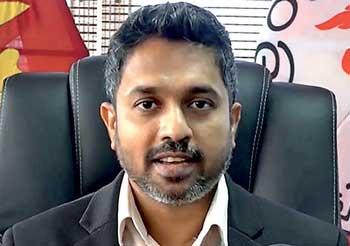
Accordingly, when contacted for comment, the Managing Director, Dr. Mayura Neththikumara, stated as follows:
“There is no provision in the pricing formula stating that they should be paid 3%. What they are given is only a commission that corresponds with their expenses. Global fuel prices have increased. At a time when the entire country is facing losses, we cannot provide profits exclusively to them. Therefore, they receive an amount close to 3%.
“They should receive something in return for their service, but they are not entitled to profits from the business itself. The pricing formula does not state that 3% must be paid. No such payment structure has been established. The pricing formula we use does not include any requirement to pay 3%. There is no specified payment amount in that formula. The pricing formula available to us contains no such provision. If anyone claims otherwise, they may go to court and seek those payments.
“The pricing formula we have does not mention any approval by the Cabinet or the courts. We have never claimed anywhere that we made profits by unlawfully taking those funds. Anyone who believes there is an issue is free to go to court. We cannot operate according to every demand made by suppliers,” the Managing Director said.