 Kamanthi Wickramasinghe
 Reply To:
Name - Reply Comment

Pictured here is a garbage dump in Colombo. Discarded items such as yoghurt cups have become potential dengue breeding grounds
 Certain individuals who call themselves doctors prescribe steroids such as prednisolone. One feature in these types of steroids is that you feel like you have recovered for about a day or two
With over 54,000 dengue cases and 31 deaths being reported in the country, medical experts warn that the country’s healthcare system would be crippled if more cases surge. A majority of patients reported so far are women, and medical experts suspect whether this is due to a delay in seeking treatment. During a special media briefing, medical experts advised public to refrain from doing self-diagnosis and to seek treatment immediately.
Public support requested
Even though medical experts forewarned about a surge in dengue cases a few weeks ago, people too, weren’t keen to prepare for it, said Dr. Manilka Sumanatilleke, President, Sri Lanka Medical Association (SLMA).
“The situation at present is critical as hospitals have almost reached maximum capacity. Sri Lanka has reported 0.01% deaths due to the expertise from our doctors. But if more patients are being admitted to hospitals, doctors need to get an hourly update of full blood counts, conduct urine tests, and doctors will have to work round the clock. In this case, it would be difficult to treat them as expected, and there would be more deaths. Therefore, we request public support to manage this situation. The dengue mosquito remains active in a radius of 400 metres. People should individually check their own surroundings and ensure that their premises is kept clean. It is important to get rid of places that mosquito larvae are likely to breed in order to reduce the rate of disease transmission.
Dr. Sumanatilleke said that patients with non-communicable diseases (NCDs) including diabetes, cholesterol should take extra precautions in this situation. He said that they have a higher tendency of developing complications if infected with dengue.
“If they develop fever, they should consult a doctor immediately. Since a majority of cases being reported are elderly women, we suspect that they delay seeking medical treatments. We advise them to seek treatment immediately to refrain from developing further complications, and to support us in our attempts to manage this situation,” he added.
Situation update
Dr. Prashila Samaraweera, Consultant Community Physician at the National Dengue Control Unit, said that as of June 30, 54,189 cases have been reported in addition to 31 deaths. She said that a majority of cases are being reported from Western, Southern and Sabaragamuwa provinces. High risk districts include Colombo, Gampaha, Matara, Kalutara, Ratnapura, Kandy, Galle, Hambantota, Kurunegala, Batticaloa and Puttalam.
Speaking at the media briefing, she said that special dengue prevention programmes are being conducted in the aforementioned districts.
“Cases are being reported from all 25 districts. Out of 31 deaths reported so far, 25 out of them are women and the rest are men. Five of these deaths are of people below age 19 and the age group of the rest of the deceased are above 20. Around 5200 cases have been reported within a week. As mentioned earlier the situation would be critical if more cases continue to be reported,” she warned.
Reasons for surge in dengue cases
A dengue outbreak is currently being observed in Sri Lanka, said Neelika Malavige, Professor at the Department of Immunology and Molecular Medicine at the Sri Jayawardenepura University. She said that similar outbreaks are observed in other parts of the world from time to time, and this is due to several reasons.
According to Prof. Malavige, the dengue infection is caused by four serotypes (distinct variation or subgroup within a virus) – DENV1, DENV2, DENV3 and DENV4.
“These four serotypes are different from one another. In 2017, there was a major dengue outbreak in Sri Lanka and this was due to DENV2 serotype. Since 2016, DENV2 has been the dominant serotype in Sri Lanka. But in 2023 and 2024 DENV3 became the dominant serotype. What we observe now is that around 80% of cases admitted to hospitals have been infected by DENV2 and around 20% of them have been infected by DENV3. Irrespective of the serotype we need to identify whether a person has been infected with dengue and it is important to seek medical treatment immediately. People are also being diagnosed with chikungunya, influenza and other viruses as well,” she said.
Prof. Malavige said that the reason for people to develop complications or even die in worse situations is because people delay to seek treatments.
“If they need to seek treatments they need to be diagnosed with dengue. For this purpose some conduct NS1 antigen tests and various kinds of tests and come to conclusions about their own platelet counts and stay home. According to our data, the NS1 positivity is less for DENV2 serotype. If a person has been infected with DENV3 serotype, the NS1 test becomes positive in around 3 days. But in the case of DENV2, the probability of the test becoming positive is around 63%. Therefore you may be having dengue, but the NS1 antigen test maybe negative. So just because the test is negative it doesn’t mean that you don’t have dengue and therefore it is important to seek medical treatment,” she added.
Why steroids and other treatments should be avoided
Common symptoms of dengue include high fever, body pain, headache, spinal pain and vomiting, said Dr. Ananda Wijewickrama, Consultant Physician at the University of Moratuwa. He said that some people also develop diarrhea.
“Therefore people shouldn’t ignore these symptoms as some other illness and stay home,” he said. “If a person develops fever, they need to conduct a full blood count within 48 hours and seek medical advice. Depending on the blood test, the doctor would determine whether a person has dengue or not. It is important to refrain from taking any other type of medication except paracetamol in this case. People are advised against taking steroids for instance. Certain individuals who call themselves doctors prescribe steroids such as prednisolone. One feature in these types of steroids is that you feel like you have recovered for about a day or two. Therefore the patient is highly likely to assume that they have recovered and they forget about dengue. But what would really happen is that the patient may develop more complications and would have to be admitted to hospital,” he added.
Dr. Wijewickrama referred to the prescription of steroids as ‘one-shot treatments’ for patients. He requested the public to complain to the Health Ministry if they observe doctors prescribing such treatments. “There are special instances when steroids are being prescribed. If diagnosed with dengue people should take bed rest and consume liquids such as jeevani. Sometimes within 48 hours the fever may have gone down but people should do a full blood count even if they don’t have fever,” he advised.
Advise to parents
If children develop aforementioned symptoms, they should be allowed to bed rest, said Dr. Nalin Kitulwatte, Consultant Paediatric Intensivist, Head of the Department, Pediatric Intensive Care Unit, Lady Ridgeway Hospital for Children (LRH). He advised parents to refrain sending their children to school even if there’s an examination or a special event as their lives would be in danger.
“It is important to give them orange juice, lime juice, king coconut and other types of drinks and not just water. This is because the body is in need of nutrients. In order to treat fever, they should be given the correct dosage of paracetamol. Some parents try to reduce the fever by giving various types of medication and that is not good. If they use other medicines, the child would develop more complications. It is important to do a full blood count 48 hours after developing fever. In the case of dengue there are more complications after the fever subsides. Parents shouldn’t assume that the child has recovered just because the fever has gone down. If you observe that the child is in pain or has been inactive for some time, they should be referred to a doctor immediately. In 2025, only 51,000 cases were reported. This time cases have doubled and in that case, complications also double. Therefore everybody should extend their fullest support to manage the situation at hand,” he added.
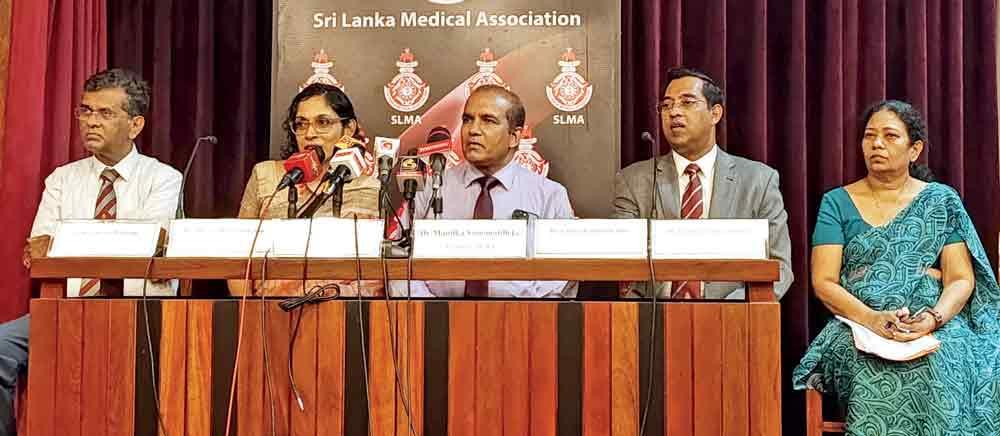
L- R – Dr. Ananda Wijewickrama, Prof. Neelika Malavige,
Dr. Nalin Kitulwatte, Dr. Manilka Sumanatilleke and Dr. Prashila Samaraweera

 0
0