Reply To:
Name - Reply Comment
 |
| Kapila Chandrasena |
By Bhagya Silva
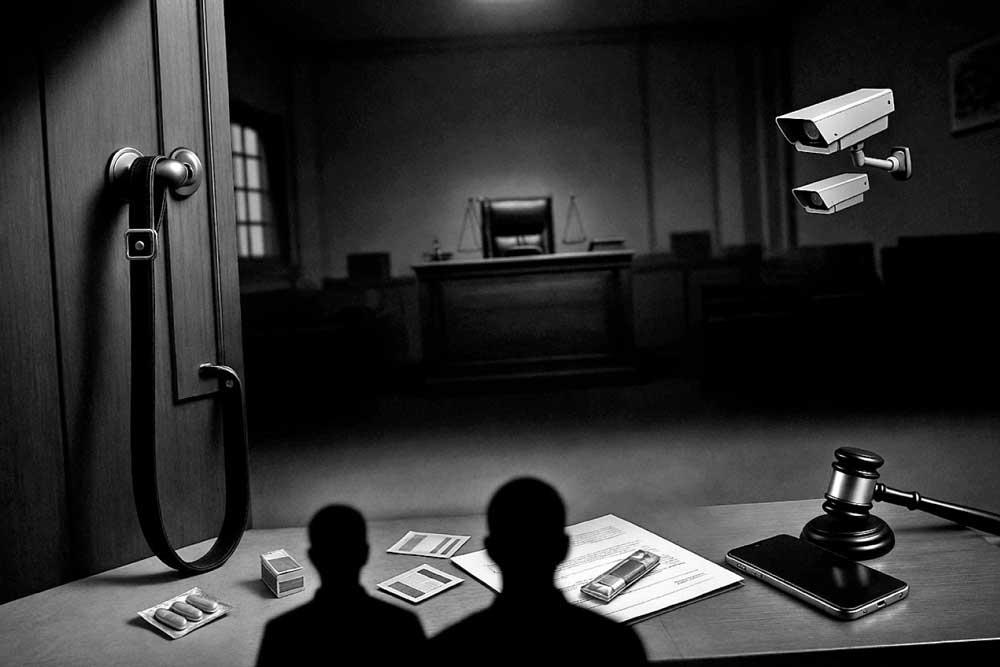
The judicial inquiry into the death of Kapila Chandrasena has entered a critical phase, revealing a web of procedural hurdles and haunting final testimonies. Held over two days at the Magistrate’s Court, the inquiry painted a picture of a man gripped by the “fear of being remanded” only hours after securing bail in a highprofile SriLankan Airlines case. Forensic gaps took center stage as investigators admitted to the court that while the house’s CCTV system was active, it failed to record any data during the window of the incident. Adding to the technical deadlock, police revealed that Chandrasena’s iPhone 16 Pro Max remains impenetrable, with even grim attempts to use facial recognition on the deceased failing to unlock the device. From the “blue exercise belt” requested for the gym—but found around his neck—to the conflicting reports of a CID raid at his home just as he was found dead, the testimony of eight witnesses suggests a timeline fraught with tension and unanswered questions.
Did Kapila Chandrasena die within one to two hours before he was found dead? Did he die in the morning?
“Witnesses Aravinda de Silva and Priyangi Anushka stated while giving evidence that he had been fearful of being remanded again.”
During the first day of evidence, while hearing testimony, the Magistrate asked the Police whether several types of unnamed medicines wrapped in an piece of paper found at the crime scene had been forwarded to the Government Analyst.
The Police then stated that all types of medicine found at the crime scene had been forwarded to the Government Analyst.
Further, the Magistrate asked whether the strap tied around the deceased’s neck had been sent to the Government Analyst. The Magistrate also questioned whether there had been any damage to the upper surface of the door from which the deceased was suspected to have hanged himself.
Responding to this, the investigating officers stated that no such damage had been observed, and that several fibre samples had been obtained while examining that surface.
“The device operated on a facial recognition security system... attempts had been made to unlock it by bringing it close to the face of the deceased’s body, but those attempts had failed.”
The investigating officers also stated that the deceased’s iPhone 16 Pro Max mobile phone was a highly secured device and that it had not yet been possible to unlock it.
They stated that the device operated on a facial recognition security system and that attempts had been made to unlock it by bringing it close to the face of the deceased’s body, but those attempts had failed.
Accordingly, the investigating officers requested court to issue an order permitting the device to be sent to its parent company or another suitable institution in order to unlock it.
During the second day of the inquiry, the Magistrate questioned the investigating officers as to whether all CCTV camera footage from the house where the deceased had died had by now been taken into their custody.
Responding to this, the investigating officer stated that although the CCTV camera system at the relevant house had been functioning, investigations had revealed that no data storage had taken place within the system.
Accordingly, although no usable CCTV footage relating to that house had been found for the investigation, the investigating officer stated that CCTV footage containing front and side-angle visuals from CCTV systems installed at two nearby houses, covering the period from May 06, 2026 to the afternoon of May 08, 2026, had been taken into police custody.
At that point, the Magistrate further questioned, “How many entrance doors are there to the house where the deceased had been staying?”
The investigating officer replied that there was only one entrance door to access the house and stated that the CCTV data system currently in police custody contained footage relating to persons entering and leaving the house.
During the Magistrate’s inquiry into the death of Kapila Chandrasena, evidence has so far been given by Priyangi Anushka Wijenayake, the sister-in-law of Kapila Chandrasena’s wife, her husband Aravinda de Silva, Attorney-at-Law Priyantha Upali Amarasinghe, who first saw Kapila Chandrasena’s body ,Emergency Treatment Unit Medical Officer Yashoda Liyanage, who arrived to examine the body,two employees from Kapila Chandrasena’s house and two drivers from Aravinda’s residence.
So far, eight witnesses have given evidence in relation to this death.
1st Witness
The first witness, Priyangi Anushka Wijenayake, answered the questions raised by the officer leading evidence as follows,
The officer leading evidence asked the witness whether any special incident had happened to Kapila during these days.
“Kapila had been remanded because of something relating to SriLankan Airlines. On May five or six, he was released. I do not remember how I came to know he had been granted bail. After obtaining bail, Kapila came directly to our house. He came on Wednesday, May six. He came home alone. I do not know how he came after obtaining bail. My husband must have been at the office. I was the first person Kapila met. Kapila spoke with me, and after I asked him whether he had eaten, I gave him food. Kapila again came alone the next day, Thursday, around four in the evening. After coming, he handed over the key of his car and said to send the car to his house. I did not see whether he came home in a religious car because I was upstairs. My husband was not at home. He came around four-thirty. He had come straight from a conference meeting and went to his room. My husband had to attend something as chief guest at D.S. College and he called and said he was going there. He said an appointment had been arranged to meet the lawyer. The people who had signed bail, my husband and I went to meet the lawyer. The people who went to sign bail were two people named Chamil and Shantha. I do not know the others by name. After meeting the lawyer, we came home around ten. Around ten-forty-five, I went upstairs with my son. He slept in the elder son’s room. Aravinda called me and told me to prepare a room for Kapila to stay in. I told a worker and prepared it. I do not know at what time Kapila went to sleep.”
Thereafter, the witness described the events that took place on the morning of the death.
“I woke up at around four in the morning. I was in the Buddha shrine room. Around six, one of the sons woke up and called my husband because he had to go to work. Afterwards, I got dressed to go to work. Aravinda called me and said, ‘The person who has come there, give him tea.’ Afterwards, when I went there, the Lawyer said Kapila was not answering calls. It would have been around seven in the morning at the time of the incident. It was the Lawyer named Priyantha who had come. Aravinda went upstairs while knocking on the door. Since there was no response after knocking on the door, the Lawyer asked whether there was a key to open the door. I brought the master key kept at the house. The Lawyer and I opened the door. When I opened the room, the first thing I saw was that there was no one on the bed. I saw a chair near the bathroom.
The Lawyer said, ‘Let us go downstairs.’ Afterwards, my husband called Durdans. Two doctors and an ambulance from Durdans arrived. I do not know what happened inside the room because I was downstairs. A lady doctor came. I was not upstairs, I was downstairs. I called my office and said I would not be able to come to work. I knew there was some kind of issue inside the room. Either he had died or he had fallen ill.”
The officer leading evidence then asked the witness whether there was any reasonable cause regarding the deceased’s death and why he may have died.
Responding to this, the witness stated,
“It may be because he had to appear in court. He had been very stressed, so it may be because of that. The doctor said while writing the report that he was dead. They did not say how he had died. Aravinda had called the Police and the Police had arrived. At that time the Police asked me to identify the body. The second time, they asked me to identify it at the mortuary.”
The officer leading evidence then asked the witness whether she had any suspicion regarding this death, and she answered in the negative.
Thereafter, the Magistrate questioned the witness as to where the elder son was.
Responding to this, she stated that he had gone abroad for educational purposes.
The third witness, Aravinda de Silva, testified before court.
“…..On the day Kapila was granted bail, he called me and said, ‘Call the lawyer and arrange the money to post bail.’ He also said, ‘There is one surety, two more are needed.’ Somehow, after it was said that ‘the two sureties produced did not have Grama Sevaka certificates,’ I produced two other sureties who were close to me and known to Kapila, and obtained bail the following day. On the morning of the 7th, Kapila called me and said, ‘Thank you very much, when there was no one else, only you all were there.’ Afterwards, two or three people had sent me messages saying Kapila had another issue. When I called Kapila again, he said, ‘There is another court case again.’ I said, ‘Come to our house, let’s speak with Lawyer Mr. Rienzie and see what can be done.’ Later in the evening when we called the Lawyer, he said he needed to know all the details, so he told us to ‘leave Kapila at home and come meet him.’ We left Kapila at our house and went to meet the Lawyer. By then, a warrant had already been issued to arrest Kapila. Mr. Rienzie said, ‘Kapila needs to be produced before court the next day. I will send a Lawyer named Priyantha to the house in the morning,’ and gave the number. After I came home, I called Lawyer Priyantha. He said, ‘I will come in the morning to take Kapila, so tell him to stay at our house instead of going home.’ After that, in front of me, Kapila called the person working at his house. He said, ‘I need some medicine and some clothes brought.’ He also said, ‘There is a gym mat, send that too.’ I asked, ‘Where are you planning to go to the gym at this time, machan?’ He said, ‘No, I need to hang clothes.’ I told my driver to go to Kapila’s house and bring those items…..”
When the officers conducting evidence asked Aravinda whether there was any suspicion regarding the death of Kapila Chandrasena, he answered, “No,” and said, “He was sleeping.”
Thereafter, Attorney-at-Law Priyantha Amarasinghe, who had first seen the scene where Kapila Chandrasena was found dead inside a room at Aravinda de Silva’s residence, gave evidence.
“On May 08, 2026, I went to Mr. Aravinda de Silva’s residence following information given the previous night by President’s Counsel Rienzie Arsecularatne. Around 9.30 p.m. the previous night, Rienzie Sir called me and said, ‘Kapila Chandrasena has to be produced before court. The motion has already been prepared at Sir’s chamber. Go in the morning, file the motion and keep the case down until Sir arrives.’ He also said, ‘Kapila is afraid that he will be remanded, so go and meet him and explain clearly that this motion is to recall the warrant.’ Later around 11 p.m. that night, Aravinda de Silva called me saying Mr. Rienzie had asked him to speak to me. Aravinda told me that Kapila was also there at that time. Aravinda also told me, ‘Kapila keeps talking all the time about some Section, maybe 31 or 21, and is afraid he will be remanded because of it.’ Afterwards, I told Aravinda, ‘I will come to your house around 7.15 in the morning the next day.’ Around 7.15 a.m. the next day, when I arrived at the house and called, Aravinda woke up. When I entered the house, Aravinda was coming downstairs from the upper floor saying, ‘I called Kapila, he is not answering.’ Then I said, ‘Knock on the door and see.’ Aravinda went upstairs, knocked on the door, came back and said, ‘He is not opening the door.’ Then Aravinda, his wife and I went upstairs. When Aravinda went to the washroom, I asked his wife, ‘Do you have a master key?’ His wife brought the master key and opened the door. It must have been around 7.35 then. As soon as the door opened, I saw that the bed sheet on the bed looked crumpled. Since no one was on the bed, I looked to the left side. There was something like a tie hanging over a door there. Below it, I saw a bald head on a blue-coloured stool on the floor. I also observed that part of the strap hanging over the door was around the neck. Afterwards, I moved Aravinda’s wife back with my hand and came out of the room. At that moment, Aravinda came there. I told Aravinda, ‘Looks like he is dead, call a doctor you know.’ As soon as he heard that, I saw that he too became frightened. Afterwards, when he was making calls, I could see that he was disturbed.”
Thereafter, Dr. Yashoda Lakshani Liyanage of a private hospital, who first examined the body of the suspiciously deceased Kapila Chandrasena, also testified in relation to the death inquiry.
“On May 08, around 7.45 a.m., following a call received by the Emergency Treatment Unit of our hospital, I went to that location around 7.50 a.m. along with several staff members. A person who introduced himself as a Lawyer took us into a bedroom. The bed was empty. There was a door at the left corner. A chair had been turned facing the door in front of it. A person was lying there. Afterwards, I checked the ‘Signs of Life’ to determine whether the person was alive. Breathing had stopped and one side of the face was pressed against the chair. The pulse had also stopped. When I lifted the right hand, which was lying towards my side, it was partially stiffened. The pupil of the right eye was enlarged and fixed. That means that when I examined him, the person was already dead.”
The police officer conducting the evidence then asked the doctor how long before her examination the death may have occurred.
Responding to this, the doctor stated, “It must have been within one to two hours.”
Thereafter, in response to a question raised by the Magistrate, a worker employed at Kapila Chandrasena’s residence, identified as Somadasa Manathunga Mudiyanselage, stated before court that from the moment Kapila Chandrasena returned to his Barnes Place residence after obtaining bail on May 06 until he left again for Aravinda de Silva’s residence on May 07, no one had come to the house to meet him.
Thereafter, a domestic worker employed at Kapila Chandrasena’s residence at Barnes Place, identified as Subrahim Pramila, also gave evidence.
“On May 06, Kapila Sir came home around 5 p.m. Around 8.30 p.m., after having dinner, he spoke a little with us asking whether we were well and whether the dogs had been fed, and then said he was unwell and went to sleep. Around 3.30 p.m. the next day, Sir left the house in a car and never returned home again. Aravinda Sir’s driver later brought the car back to our house and gave me the key. Around 11.30 p.m., Kapila Sir called me. First, he said, ‘Put some clothes to wear at night into a bag.’ Then he called again a second time and said, ‘Put in two pairs of spectacles, the medicine, and a blue belt.’ He said, ‘The blue belt is under the sarong.’ That was a belt Sir used for exercise. Sir said he would send a vehicle to collect it. Afterwards, two people came in a vehicle. I handed it over to them. Since Sir did not return the next day, I called around 6.40 a.m., but Sir did not answer. I called because Sir had said he had to go to court.”
At this point, the Magistrate questioned on what occasion Kapila Chandrasena had stated that he needed to go to court.
She replied that during the call on the previous day when he requested clothes and other items, he had said, “I have to go to court tomorrow. Keep a white outfit ironed.”
The domestic worker further testified that around 7.25 a.m. on May 08, a group of five persons claiming to be from the CID arrived and searched the house after showing a search warrant.
She also stated that they said, “Sir is at home, isn’t he? Don’t lie, we will take you too.”
She further told court that after they left around 8.15 a.m., she learned that Kapila Chandrasena had died.
At this point, evidence was also recorded from the two drivers of Aravinda de Silva who had transported the bag containing Kapila Chandrasena’s clothes, medicine and belt from Kapila Chandrasena’s residence to Aravinda de Silva’s house.
One of the drivers testified as follows,
“Around 10.45, the other driver of Aravinda Sir and I went to Kapila Sir’s house to collect a bag of his clothes. Around 10.50 we reached there. Afterwards, while bringing the bag back, we stopped near Durdans Hospital and went to a pharmacy to buy medicine for Aravinda Sir’s younger son. After returning home, I went and placed the bag on the table where Kapila Mahaththaya and Aravinda Sir had been talking. The other driver who went with me took the medicine purchased from the pharmacy upstairs to Madam.”
The Magistrate then asked this witness whether he had seen Kapila Mahaththaya before the day he brought the bag.
The driver stated that he had never seen Kapila Mahaththaya before.
Thereafter, the other driver testified as witness number four and stated as follows,
He stated that he had been working at Aravinda’s house for two and a half years and that during those two and a half years he had seen Kapila Mahaththaya only about four times.
“I have gone several times to give food to Kapila Mahaththaya while he was in prison. After Kapila Mahaththaya obtained bail and returned home, I was also the one who dropped him at home again. On May 04, together with the driver named Pubudu, I went at 11.45 to Kapila Mahaththaya’s house to collect a bag. Afterwards, we brought the bag home. After returning, I went to park the car in the garage. Pubudu aiya went to hand over the bag to Kapila Mahaththaya.”
At that point, the Magistrate asked, “After taking the bag from Kapila Mahaththaya’s house and on the way to Aravinda Mahaththaya’s house, did you stop anywhere?”
The witness driver stated that they did not stop anywhere from the time they left Kapila Mahaththaya’s house until they reached Aravinda Mahaththaya’s house.
Further evidence was postponed until
May 19.