Reply To:
Name - Reply Comment
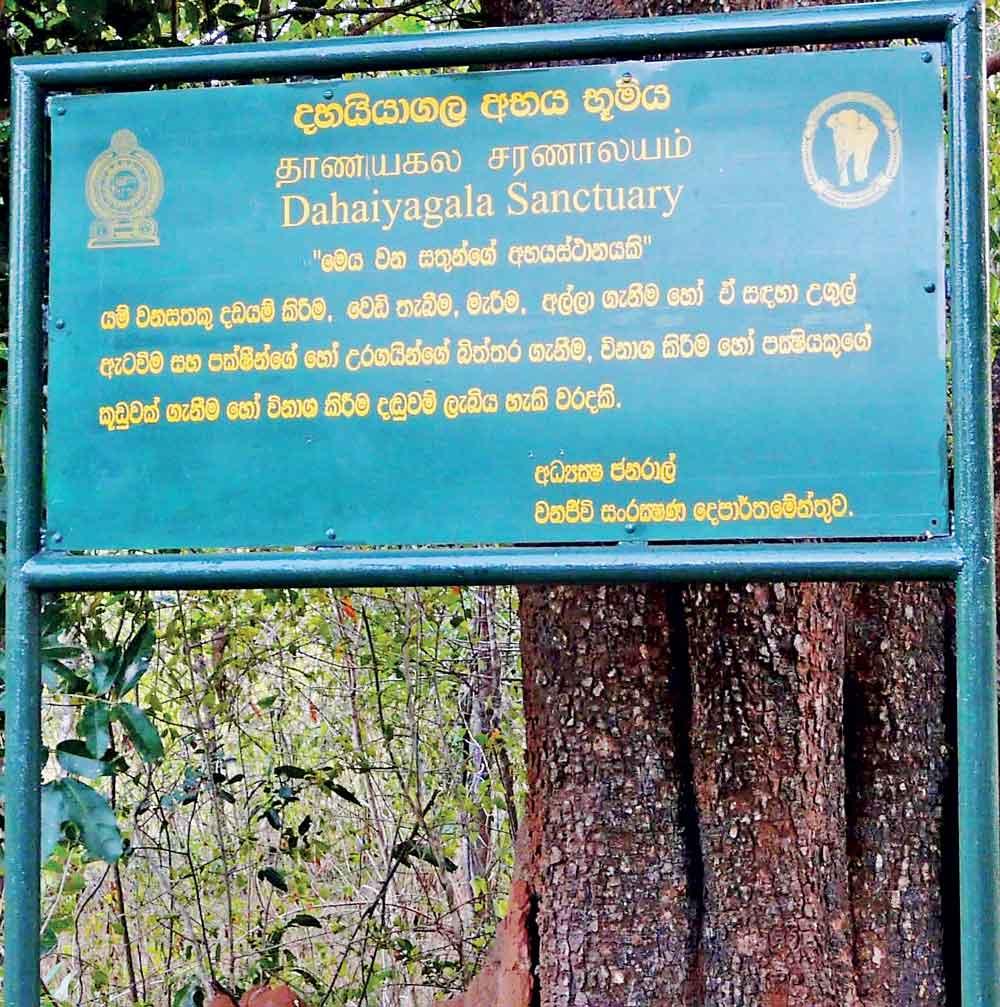
Elephants travel through an elephant corridor to get to Dahaiyagala Sanctuary. However, this corridor has been increasingly encroached upon by various individuals, causing a steady decline in its area
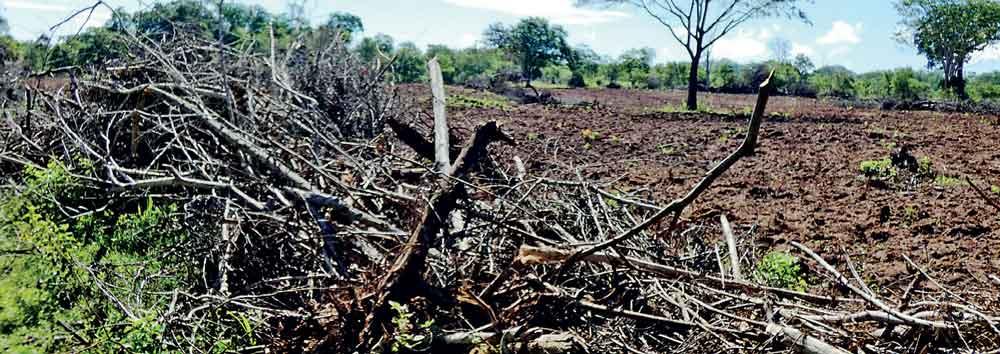
Picture shows the destruction done to the Dahaiyagala Sanctuary
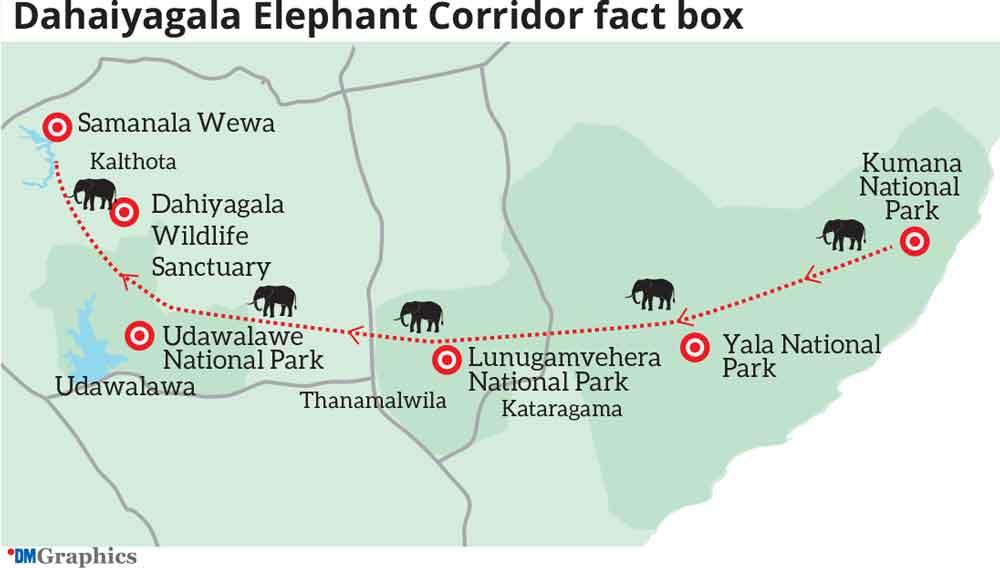
 Among the 16 major elephant corridors identified in Sri Lanka, the Dahaiyagala Elephant Corridor—which serves as a route for wild elephants travelling from Udawalawe National Park to the proposed Bogahapattiya Forest Reserve—holds a prominent position. Hundreds of wild elephants inhabiting Lunugamvehera, Kumana, Lahugala, Ruhuna National Parks and the Wandama Demaliya Residual Forests enter Udawalawe National Park via the Wetahirakanda Reserve and other access routes. From there, they proceed to the Bogahapattiya Proposed Forest Reserve through this corridor, which lies across the Dahaiyagala Sanctuary.
- The Dahaiyagala–Bogahapattiya route is a major migration path for elephants
- Efforts by politicians to distribute land within this corridor to private individuals have severely impacted its survival
- The Dahaiyagala Elephant Corridor was designated as a sanctuary to prevent forest fragmentation and preserve it as an elephant corridor
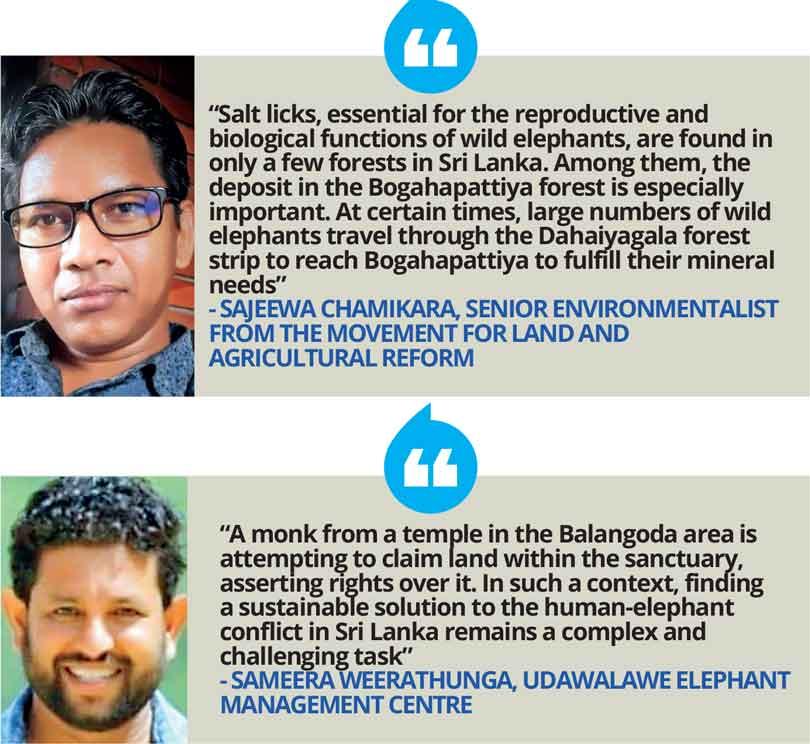
“Based on our observations, approximately 600 to 800 wild elephants use this corridor annually. The Dahaiyagala–Bogahapattiya route is a major migration path for elephants. However, over the years, this corridor has been increasingly encroached upon by various individuals, causing a steady decline in its area. Additionally, political and administrative efforts to distribute land within this corridor to private individuals have severely impacted its survival. As a result, the human-elephant conflict has escalated in numerous villages across a wide region, including Haldummulla, Haputale, Balangoda, Thanamalwila, and Wellawaya. A monk from a temple in the Balangoda area is attempting to claim land within the sanctuary, asserting rights over it. In such a context, finding a sustainable solution to the human-elephant conflict in Sri Lanka remains a complex and challenging task,” said Sameera Weerathunga at the Udawalawe Elephant Management Centre.
The Dahaiyagala Elephant Corridor, which extends from Udawalawe National Park to the proposed Bogahapattiya Forest Reserve, was declared a sanctuary by Gazette No. 1239/28, dated 7 June 2002. According to the gazette, the sanctuary covers an area of 2,685 hectares. It was designated as a sanctuary to prevent forest fragmentation and preserve it as an elephant corridor. However, environmental organizations claimed that half of the gazetted land has been acquired by various parties.
Attempts made to block corridor
This forest strip with an elephant corridor connecting the Udawalawe and Bogahapattiya forests, was under threat even before its official designation. At one point, a former Deputy Minister of the Monaragala District attempted to completely block the corridor by constructing an electric fence along the 6-kilometre jeep road from Pokunuthenna to Kaudaliara, east of Udawalawe National Park, thereby cutting off elephant movement entirely.
“This former Deputy Minister, along with a member of the Uva Provincial Council, the then Divisional Secretary of Thanamalwila, and several government officials, attempted to erect the illegal electric fence. Approval for this project was granted by then Minister of Environment, Patali Champika Ranawaka. With this approval, the Deputy Minister aimed to completely close off the Dahaiyagala Elephant Corridor and distribute the land among his political supporters in villages such as Netula, Maha Netula, Maha Pelassa, Kandiyapita, Kotawehera Mankada, Aluth Wewa, and Pokunuthenna. However, the plan was halted due to opposition from certain officials of the Department of Wildlife Conservation and environmental organizations. Still, during President Gotabaya Rajapakse’s administration, he again attempted to take over these lands. During the rural development programme “Gama Samanga Pilisandarak” held by the President in the area, efforts were made to release the lands and distribute them among party members.” The President, misled by certain individuals and politicians, instructed the relevant officials to distribute the forest lands to farmers. When wildlife officers attempted to explain the situation to the President, these concerns were dismissed. President Gotabaya Rajapakse had said, “There is no need for circulars to implement my instructions—every word I say is like a circular.” Following this directive, hundreds of people who had been eyeing the lands within the elephant corridor began encroaching on the forest the very next day.
However, the President later recognised the mistake and reversed his decision, banning further entry by people into the forest. Despite this, people from nearby villages have continued to make repeated attempts to seize land within the sanctuary. On another occasion, attempts were taken to divide and distribute parts of the forest through then Minister of Wildlife, Monaragala District MP Vijithamuni Soysa. “That attempt too failed due to opposition from environmental organizations and parties involved in tourism in Udawalawe. Therefore, it is essential that the new government takes steps to implement a sustainable solution to this problem,” said Weeratunga.
As previously mentioned, the forest area encompassing the Dahaiyagala Sanctuary is one of Sri Lanka’s 16 major elephant corridors. Wild elephants from not only Kumana, Lunugamvehera, and Udawalawe National Parks, but also from the residual forests in the Wandama and Demaliya areas of Wellawaya use this corridor to migrate to the forests of Bogahapattiya, Bogaha Pelassa, Rajawaka, and Samanala Wewa. According to wildlife experts, approximately 600 to 800 wild elephants use this corridor annually.
“Salt licks, essential for the reproductive and biological functions of wild elephants, are found in only a few forests in Sri Lanka. Among them, the deposit in the Bogahapattiya forest is especially important. At certain times, large numbers of wild elephants travel through the Dahaiyagala forest strip to reach Bogahapattiya to fulfill their mineral needs. This has been happening since ancient times. Since the corridor also offers environmental conditions for staying for a long time during that period, elephants are especially drawn to the area. No electric fence or trench can stop it. If such attempts to block their movement continue, it will severely escalate human-elephant conflict across areas such as Bogahapelessa, Bogahapattiya, Soragune, Veliya, Pathaha, Dadayamapola, Akkara Siyaya, Velanwita, Kumarathenna, Rajawaka, Samanalawewa, Balangoda, Kapugala, Pallebedda, Kolongasthenna, Diyaluma, Hiwelkandura, Gampaha, Miriswatte, Nikapotha, Punagala, Koslanda, Ampitikanda, Hambegamuwa, Thanamalwila, and Wellawaya,” according to Senior environmentalist Sajeewa Chamikara from the Movement for Land and Agricultural Reform.
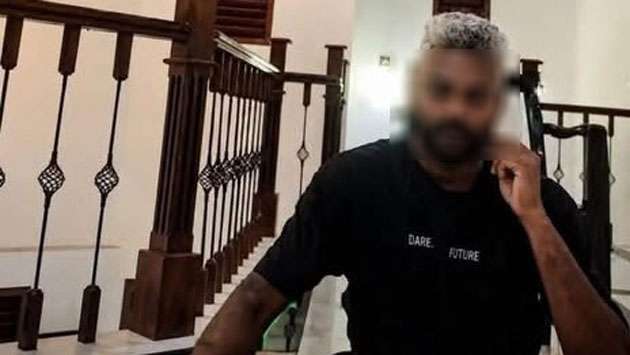
A banner displayed recently at the Dahaiyagala Sanctuary read, ‘This land is a property of the temple. No one is allowed to enter.’ The individual asserting ownership over the sanctuary is Ven. Karagasthalawe Dhammadassi, current incumbent of the Karagasthalawa Sri Shaila Gangaramaya Temple in Balangoda. He claims that the temple owns approximately 15,000 acres in the Dahaiyagala area, including land within the sanctuary.
The entire Dahaiyagala Sanctuary spans around 7,000 acres, yet the monk claims ownership of 15,000 acres in the area. He has reportedly informed villagers that after settling these lands, he plans to launch an agricultural project in collaboration with a Japanese investor. This claim by the incumbent monk of the Sri Shaila Gangaramaya Temple in Karagasthalawa has triggered a new controversy over the Dahaiyagala Sanctuary. This newspaper contacted N. A. Ajith Kumar, Wildlife Range Officer in charge of the Kalthota section of Udawalawe National Park, which includes the Dahaiyagala Sanctuary. He shared the following remarks: “Recently, a monk from a nearby village put up a sign in the Dahaiyagala Sanctuary claiming that the forest land, including the sanctuary, belonged to him and that entry was prohibited. However, a few days later, the monk removed the sign himself. Dahaiyagala is a sanctuary under the jurisdiction of the Department of Wildlife Conservation and was declared as such by a gazette in 2002. I have reported the incident to my superiors, presented the matter to the Magistrate of the Wellawaya Magistrate’s Court and obtained an order to arrest anyone attempting to enter this land. Therefore, from now on, if anyone enters the sanctuary with the intention of seizing land—regardless of their status—I will arrest them and produce them in court,” he added.
A major challenge for wildlife authorities
There are 28 small and medium-sized lakes within the Dahaiyagala Sanctuary. These serve as water sources for wild elephants inhabiting Udawalawe National Park and the surrounding isolated forests. Among them the lakes namely Pokunuthenna, Ginimulaara, Giniangawela and Diganpelessa are key sources of water for elephants in the sanctuary. In addition, areas such as Bogahapelessa, Bogahapattiya and Soragune act as water catchment areas for many large reservoirs such as Udawalawa and Mawara and other small lakes in this area. Environmentalists warn that clearing forests in these areas poses a serious threat to the long-term survival of these lakes.
Commenting on the ongoing issues, Ravindra Wickramasinghe of the Monaragala Soba Padanama Foundation stated: “Bogahapattiya and Dahaiyagala are two forests that have been under pressure from human activity for decades. Bogahapattiya is still only a proposed reserve, though it urgently needs to be gazetted as a protected forest. Unfortunately, that has yet to happen, and as a result, various individuals have claimed portions of this land. In the past, even a presidential advisor seized land there. Although Dahaiyagala is already a sanctuary, human activity within hasn’t decreased. At present, people in the surrounding areas continue to attempt to encroach upon its land. Controlling the encroachment of these forest lands has become a major challenge for wildlife authorities, as managing human activities within a sanctuary is not easy. Therefore, we propose that instead of gazetting Bogahapattiya and Dahaiyagala separately as sanctuaries or reserves, both forests should be incorporated into Udawalawe National Park. The park should be expanded and officially gazetted following that. By doing so, the safety of the wildlife inhabiting the area—as well as the protection of the forest itself—would be better ensured under national park status. This would also safeguard the catchment areas of both large and small reservoirs, including the Udawalawe Reservoir. Moreover, since wild elephants are abundant in this area, expanding the Udawalawe tourism zone and developing tourism in the area could strengthen not only the national economy, but also the livelihoods of communities living around Dahaiyagala, contributing significantly to the rural economy”.
“This land belongs to our temple under a Sannasa (Royal Proclamation). We have more than 15,000 acres here. We also have documentation to prove that my chief monk had leased part of this land to villagers in the 1950s. We have been requesting from the Divisional Secretary and the survey office for some time for the government to intervene and officially survey the temple land, but nothing has happened. So we hired a private surveyor to map out a portion of the land ourselves. We have that plan. We are not prepared to give up our rights to this forest and its sanctuary,” Ven. Karagasthalawe Dhammadassi told this writer before ending a telephone conversation he was having with the latter quite abruptly citing that he was traveling and was unable to continue the conversation.