Reply To:
Name - Reply Comment
 “Promoting respect for all languages is essential for national unity; it reinforces the importance of equal rights and inclusive access to public services for every citizen.”
“In Sri Lanka, Sinhala and Tamil have been shaped by centuries of interaction; this dynamic nature shows that language is not static but grows with its people.”
“Language is not merely a tool for communication but a fundamental part of culture itself, both reflecting and shaping the patterns of the society in which it is spoken.”

Language is far more than a system of voluntary symbols; it is the fundamental vessel of human culture, identity, and collective memory. In this insightful analysis, Prof. Manoj Ariyaratne explores the profound relationship between language and society. From the cognitive foundations of the mother tongue to the global significance of International Mother Language Day, he highlights how linguistic diversity serves as a vital cornerstone for national unity and reconciliation within Sri Lanka’s multicultural landscape.
Language is one of the most essential elements of human life. It is a structured system of communication that enables individuals to express thoughts, emotions, ideas, and experiences through spoken, written, or signed forms.
Beyond communication, language carries culture, traditions, beliefs, and values from one generation to another. According to Edward Sapir (An American Linguist and an Anthropologist) (1921:8) (Edward Sapir. (1921) Language: An Introduction to the Study of Speech. New York: Harcourt, Brace and Company), Language is a purely human and non-instinctive method of communicating ideas, emotions, and desires by means of voluntarily produced symbols.
He suggested that humans perceive the world principally through language, and in Ethnolinguistics, Sapir considers the relationship between Language and culture. He considered the relationship between language and culture to be deeply interconnected and mutually influential. As a pioneering linguist and anthropologist, Sapir argued that language is not merely a tool for communication but a fundamental part of culture itself. In his above mentioned influential book, he emphasized that language both reflects and shapes the cultural patterns of the society in which it is spoken.
According to UNESCO (2023), languages are central to identity, communication, social integration, and education. Therefore, language is not merely a tool for conversation but a foundation of human civilisation. Accordingly, it is evident that though the primary purpose of language is communication, language also preserves cultural heritage by transmitting folklore, literature, customs, and historical knowledge.
It plays a vital role in education, as children understand concepts more effectively when taught in a language they are familiar with. Furthermore, language fosters social cohesion and national development by enabling citizens to engage in governance and civic responsibilities, particularly in a country like Sri Lanka, where there is a multilingual and multicultural society. Thus, language shapes both personal identity and collective progress.
Language is also: A carrier of culture and tradition A depository of collective memory A medium of education and knowledge A marker of identity and belonging
Every language reflects the worldview of its speakers. Through language, people categorise their experiences, describe their environment, and interpret reality. Idioms, proverbs, poetry, and folklore embedded in a language reveal how a community thinks and feels.
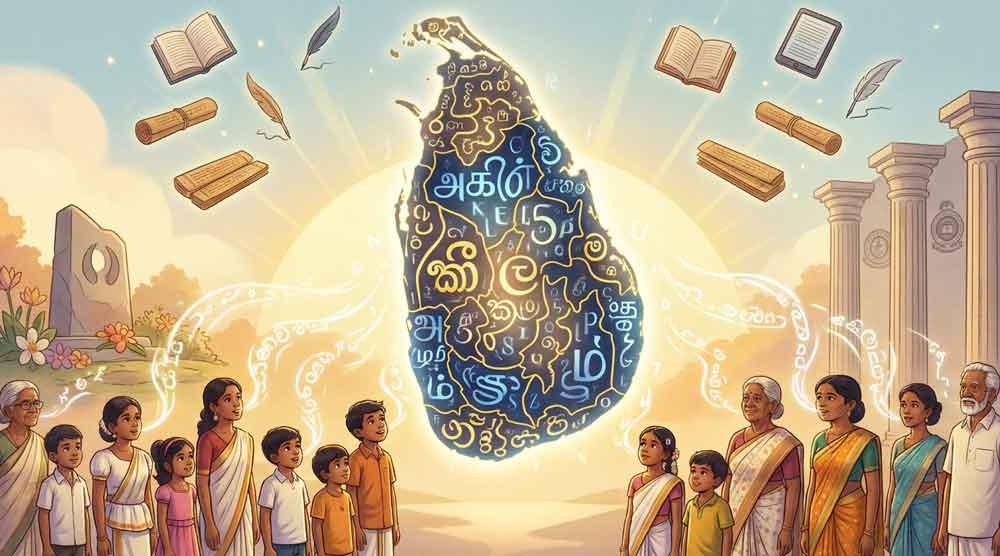
In the process of evolving Languages it absorbs influences from other languages, adapts to social changes, and generates new vocabulary to meet modern needs. In Sri Lanka, for example, Sinhala and Tamil have been shaped by centuries of interaction with Prakrit, Pali, Sanskrit, Portuguese, Dutch, and English. Sinhala and Tamil Languages have shaped each other. This dynamic nature shows that language is not static; it grows with its people and language contacts.
What is a Mother Tongue?
A mother tongue is the first language a person learns from birth. It is usually the language spoken by one’s parents and immediate community. The term does not necessarily imply that the language comes exclusively from the mother; rather, it signifies the primary language of early childhood.
The Origins and Meaning of International Mother Language Day
The mother tongue plays a crucial role in shaping a child’s cognitive and emotional world. It is through this language that children first understand love, discipline, culture, and moral values. Nursery rhymes, bedtime stories, and everyday conversations in the home form the foundation of linguistic and intellectual development.
A mother tongue is also:
The language of early emotional bonding.
The foundation for literacy.
The anchor of personal and communal identity.
In multilingual societies, individuals may grow up speaking more than one language fluently. Even in such cases, there is often one language that forms the core of their early development and cultural attachment.
A mother tongue forms the basis of a child’s cognitive, emotional, and social development. Research indicates that children who receive early education in their mother tongue perform better academically and develop stronger literacy skills (UNESCO, 2023). It is deeply connected to cultural identity, as it conveys traditions, values, and shared history.
In recognition of the importance of linguistic diversity, International Mother Language Day is observed annually on February 21. The day was proclaimed by UNESCO in 1999 to promote multilingualism and protect endangered languages. It celebrates the 1952 language movement in Bangladesh, where students sacrificed their lives to defend their mother tongue. Since 2000, the day has been commemorated worldwide to highlight the importance of preserving linguistic and cultural diversity (UNESCO, 2023).
The day serves several global purposes:
Promoting linguistic and cultural diversity.
Raising awareness about endangered languages.
Strengthening solidarity among different linguistic communities.
By celebrating this day, nations reaffirm their commitment to protecting linguistic rights and ensuring inclusive education systems.
Celebrating International Mother Language Day is particularly significant in a multilingual and multicultural country like Sri Lanka.
Sri Lanka recognises by its Constitution in its CHAPTER IV LANGUAGE 18
The Official Language of Sri Lanka shall be Sinhala. 5 [(2) Tamil shall also be an official language.
(3) English shall be the link language.
(4) Parliament shall by law provide for the implementation of the provisions of this Chapter 19.
The National Languages of Sri Lanka shall be Sinhala and Tamil. This linguistic diversity reflects the country’s rich cultural heritage.
However, language has also been a sensitive issue in Sri Lanka’s history. Therefore, promoting respect for all languages is essential for national unity and reconciliation.
Observing this day in Sri Lanka encourages mutual understanding among different ethnic and linguistic communities.
It reinforces the importance of equal language rights, inclusive education, and access to public services in all official languages. Moreover, it is important to remind younger generations to value and preserve their mother tongues while learning other languages for global engagement. In conclusion, language is the foundation of identity, culture, and communication.
A mother tongue shapes an individual’s worldview and connects them to their heritage. Celebrating International Mother Language Day promotes unity in diversity, especially in a multicultural society like Sri Lanka. By respecting and preserving all languages, Sri Lanka strengthens social harmony and ensures that its rich linguistic heritage continues to thrive.