 Moiz Mustafa
Reply To:
Name - Reply Comment
By Moiz Mustafa
Colombo, Daily Mirror (February 21) - Every year on February 21, International Mother Language Day shifts the spotlight away from the languages that fill boardrooms and news headlines, toward the thousands that are quietly fighting to stay alive.
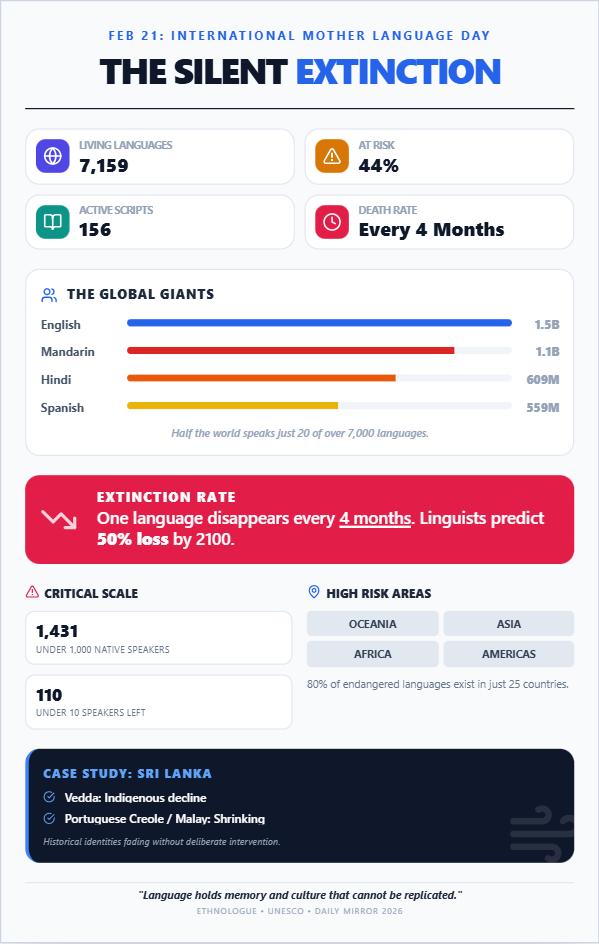
More than 7,000 languages are spoken across the globe today, yet a significant number are under serious threat. According to Ethnologue, a leading reference on global languages, roughly 40 percent are considered endangered. In simple terms, this means they are no longer being consistently passed down to children, and their long-term survival is far from certain.
English remains the most widely spoken language in the world, with an estimated 1.5 billion speakers across 186 countries. Only about two in ten of them are native speakers. The rest use English as a second or additional language, reflecting its role as the world's most relied-upon bridge across cultures and borders.
Mandarin Chinese follows with nearly 1.2 billion speakers and holds the top position when counting native speakers alone. Hindi comes next at around 609 million, followed by Spanish with 559 million and Standard Arabic with 335 million. The 20 most common languages, each with more than 50 million speakers, are collectively spoken by half the world's population. Yet the vast majority of the world's languages are spoken by fewer than 10,000 people. That gap between the languages that dominate and the many that quietly persist tells a story worth paying attention to.
Language is not only spoken. It is also shaped by the way it is written. Scholars have identified 293 writing systems worldwide, of which 156 remain in active use. Others, including Egyptian hieroglyphs and Aztec pictograms, have long passed into history.
The Latin alphabet is the most widely used script in the world today. It forms the foundation of English, Spanish, French, German and hundreds of other languages. At least 305 living languages rely on it, and more than 70 percent of the world's population uses the Latin script in daily life. Yet even as a handful of scripts reach billions of people, the languages written within them tell only part of the story.
Of the 7,159 languages currently spoken worldwide, about 44 percent are classified as endangered. UNESCO breaks this down across six levels of risk, ranging from "vulnerable," where most children still speak the language but only at home, to "critically endangered," where the youngest speakers are grandparents who use it only partially and rarely. Nearly half of all languages are considered stable, while only a small share hold institutional status, meaning they are used officially in government, education and the media.
Languages typically begin to fade when communities start favouring a more dominant tongue for economic or social reasons. Over time, younger generations stop learning the original language at home, and with each passing generation, the thread connecting them to it grows thinner. On average, about 3.5 languages become extinct every year, roughly one every four months. Without serious intervention, linguists estimate that more than half of today's languages could be severely endangered by 2100.
Ethnologue records 337 languages as dormant and 454 as fully extinct. Around 88.1 million people still speak an endangered language as their mother tongue. Among these, 1,431 languages have fewer than 1,000 native speakers, 463 have fewer than 100, and 110 are spoken by fewer than 10 people.
Just 25 countries account for nearly 80 percent of the world's endangered languages. Oceania has the highest concentration, followed by Asia, Africa and the Americas.
The examples are as varied as they are sobering. In Australia, the Aboriginal language Yugambeh is endangered but experiencing a revival through community efforts and digital tools. In Japan, Ainu is critically endangered, with only a few hundred speakers recorded in recent surveys. In Ethiopia, Ongota survives among a handful of elderly speakers. Across the Americas, languages such as Louisiana Creole in the United States and Leco in Bolivia are now largely confined to older generations. In Europe, Cornish has made a remarkable journey from extinction back to endangered status through decades of revival efforts, with 563 first-language speakers recorded in the 2021 census in England and Wales.
Recognising the urgency, the United Nations declared 2022 to 2032 the International Decade of Indigenous Languages, a global push to draw attention to language loss and mobilise resources for preservation efforts around the world.
Sri Lanka officially recognises Sinhala and Tamil as national languages, with English widely used as a link language. While these two dominate public life, smaller languages tell quieter and equally important stories about the island's layered history.
The language of the indigenous Vedda community has steadily declined as younger members shift to Sinhala. Sri Lanka Portuguese Creole and Sri Lanka Malay, both shaped by centuries of trade and colonial contact, are now spoken by shrinking communities. Though far less visible in everyday public life, these languages carry histories and identities that risk fading away without deliberate effort to preserve them.
Languages hold memory, culture and ways of understanding the world that cannot be replicated once they are gone. As major global languages continue to expand their reach, thousands of others grow more fragile with each passing year. International Mother Language Day is a reminder that linguistic diversity is not something we can take for granted. It has to be protected, consistently and with intention, if it is to survive.
Language is personal. Whether you speak one of the world's most widely used languages or one that only a small community still knows, your language is part of a living history. Drop a comment below and tell us: what language or languages do you speak at home?