Reply To:
Name - Reply Comment

The essence of the Buddha’s teachings is encapsulated in the Four Noble Truths, which serve as the foundation of his philosophy
 The term “Buddha” means “Awakened One,” signifying someone who has dispelled ignorance and grasped the nature of reality
Buddha underscored the importance of self-reliance and perseverance in his teachings
Buddhism is a deeply spiritual tradition grounded in the teachings of Siddhartha Gautama
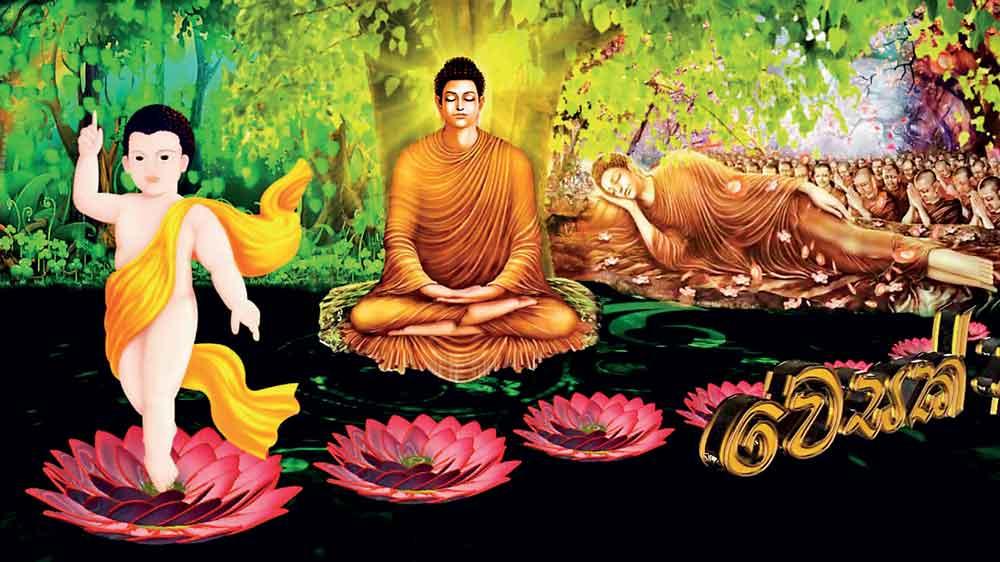
The full moon day in May holds profound significance in Buddhism. It commemorates three pivotal events in the life of Prince Siddhartha Gautama: his birth, enlightenment, and passing, all of which occurred on the same day.
 Buddhism is a deeply spiritual tradition grounded in the teachings of Siddhartha Gautama, born in 653 B.C. in Lumbini, Nepal. Throughout its 2,600-year history, Buddhism has transformed into a vast religious and philosophical system embraced by more than 500 million adherents worldwide. Since its inception, Buddhism has played a central role in spiritual and cultural social life. Today, it stands as one of the major religions globally, guiding its followers toward spiritual enlightenment and liberation from suffering.
Although Buddhism has undergone various adaptations and transformations since the time of the Buddha, the essence of his core teachings remains as relevant as it was 2600 years ago. The wisdom of the Buddha has endured through the ages, and his teachings continue to guide individuals toward happy and fulfilling lives. The core principles he shared during his 45 years of ministry remain undiminished and timeless (akaliko), providing valuable insights, spiritual solace, and relief for navigating the complexities of modern existence, often marked by immense suffering, intolerance, chaos, and rampant desires.
Moreover, Buddhist teachings have brought mental peace and satisfaction to people in times of crisis, uncertainty, and insecurity, as well as when they are in desperate situations. Buddhism does not fit within the narrow definition of typical religion, as many philosophical and scientific elements are encapsulated in its teachings, distinct from its strictly religious, ritual, and devotional aspects.
Although a mere human being, the Buddha was an extraordinary individual who lived and died like all humans. He was neither a deity nor a divine saviour; rather, he attained enlightenment through dedication and self-discipline. Widely recognised as one of humanity’s greatest thinkers, the Buddha is esteemed as a model of the virtues he preached. The term “Buddha” means “Awakened One,” signifying someone who has dispelled ignorance and grasped the nature of reality.
Timeless wisdom
His teachings, collectively known as the Dhamma, contain timeless wisdom that enhances our understanding of human existence and directs us toward personal transformation and inner peace. His insights into mindfulness, compassion, and meditation empower individuals to enhance self-awareness, alleviate anxiety and stress, and discover a sense of calm and fulfilment in their daily lives.
By rejecting superstition and ritualistic practices, the Buddha underscored the importance of self-reliance and perseverance in his teachings, urging his followers to depend on themselves for liberation from suffering. In the Parinibbana Sutta he exhorted his disciples, “Be islands unto yourselves, be a refuge unto yourselves, seek not for refuge in others”.
In “The Three Greatest Men in History,” H.G. Wells describes the Buddha as “a man, simple, devout, lonely, battling for light: a vivid human personality, not a myth.” The Buddha’s message resonates universally and aligns closely with contemporary ideas. He believed that the root of all human discontent lies in selfishness and insatiable desires, suggesting that true serenity can be achieved by overcoming these fundamental flaws.
The essence of the Buddha’s teachings is encapsulated in the Four Noble Truths, which serve as the foundation of his philosophy. These truths elucidate the nature of human suffering, its causes, the possibility of its cessation, and the path to achieving liberation from suffering. The First Noble Truth acknowledges that suffering is inherent to human existence.
Buddha was an unequalled teacher endowed with towering wisdom and great intellect. He was a foremost analyst of mind and worldly phenomena. Buddha’s teachings have provided a great deal of insight to mankind so that they may live a more mindful, compassionate life. Buddha made a deep analysis of how the human mind works, and he had a keen insight into the human condition.
Buddhism asserts that the human mind is the realm within which lies the source of our suffering and salvation, and locates the source of suffering and the problems of human beings in their never-ending craving and ignorance. He gave his adherents the unfettered freedom to examine and investigate what he expounded for nearly half a century during his lifetime. He never expected them to accept his truths blindly. Buddhism is not merely a theoretical philosophy; it is a practical framework for cultivating deeper meaning, purpose, happiness, and wisdom in life. It is founded on verifiable facts rather than dogmatic beliefs. he advocated for free thought and never imposed restrictions on others’ beliefs. He emphasised the importance of empirical observation and rational inquiry in his teachings, as is borne out by the often-quoted Kalamasutta. The Buddha saw himself as a guide, encouraging his followers to seek their path to salvation rather than submitting to any divine authority. He taught that Buddhahood is attainable for anyone willing to make the necessary effort, emphasizing that every individual has the potential and inconceivable possibilities to become a Buddha.
Buddha did not claim to have created worldly conditions or universal phenomena. He merely rediscovered the existing incontrovertible truth and made it known to mankind so that they could free themselves of suffering and find salvation. On one occasion, Buddha declared, “Whether Thathagatha appears in the world or not, order exists; the fixed nature of the phenomenon, their regular pattern, and their general conditionality. This is the Thathagatha discovers and comprehends, and having done so, he points it out and teaches it, explains and establishes it, reveals, analyses and clarifies it, and says: Look”.
Buddha’s teachings emphasize compassion, kindness, and empathy toward all living beings. In an increasingly interconnected world, fostering compassion and understanding can contribute to resolving conflicts and promoting harmony. Moreover, the advent of Buddhism has paved the way for social equality and democratic values. He established a democratically constituted celibate order for deserving men and women regardless of caste and social condition. Unequivocally condemning the caste system prevailing at the time, Buddha declared: By birth is not one an outcast, is not one a brahmin, by deeds is one an outcast, is one a brahmin.
Buddhism emphasizes morality in life, like many other major religions of the world. It upholds lofty and demanding moral and ethical values in many of its scriptures and codes of precepts. The Five precepts in Buddhism, which are known as Pancha Silla in Pali and Sanskrit, constitute the minimal standard of morality that Buddhists are expected to observe in their daily lives and can be validly observed by anyone regardless of their religious persuasion. They constitute basic ethical principles that Buddha laid down for lay followers may help people in the contemporary world desist from harming themselves and others, regard life as inviolable and respect property, maintain purity and honesty, and preserve clarity in thinking.
The emphasis on nonviolence and compassion towards all beings is reflected in various discourses of the Buddha and would be of tremendous help for the promotion of peace and harmony among diverse communities. In a world where divisions and conflicts exist, people draw inspiration from the Buddha’s teachings as they provide essential insights and practices that may help people lead a more mindful and compassionate existence. Moreover, Buddhism has become an important guide for many of those who experience armed conflict in war-torn situations.
There are instances where even agnostics and atheists who are sceptical of religious beliefs turn to Buddhism to reconcile themselves to situations that are beyond their control.
The teaching of mindfulness
Many practice Buddhist meditation and the essence of its teachings as an antidote to stress, anxiety, and the strain of modern life. Meditative practices in Buddhism can be useful to a person as a way of training the mind and helping to develop more beneficial attitudes toward life. The teaching of mindfulness emphasizes, the importance of being present in the moment and developing awareness of one’s thoughts, emotions, and actions. Moreover, Buddhist meditation practices have been of great help to neuroscientists who have discovered that they lead to changes in the brain structure and function that have led to the discovery of new treatments for conditions such as anxiety, depression, and addiction.
 The Buddha’s message resonates universally and aligns closely with contemporary ideas. He believed that the root of all human discontent lies in selfishness and insatiable desires, suggesting that true serenity can be achieved by overcoming these fundamental flaws
Similarly, the Four Sublime States that is loving-kindness (metta), compassion (karuna), sympathetic joy (mudita), and equanimity (uppekka). enunciated in buddhism are some of the positive mental qualities even non-Buddhists can cultivate and radiate to all living beings in the present problematic world.
Buddhism teaches us that life is a journey beset with many problems and challenges. It has been likened to a pendulum that turns to the right and left. Four undesirable conditions prevail in this world that everyone, without exception, faces in the course of their life. (Narada). Life has phases of happiness and unhappiness. When one is blessed with fame, praise, or happiness, he is delighted and satisfied. On the other hand, when the same person faces unfavourable situations such as loss, insult, ill fame, blame, and pain, he will be dejected and unhappy. The inability to face unfavourable situations in life drives some to resort to such extreme measures as suicide, murder, violence, theft, etc.
We live in a world in which ordinary people are constantly prone to temptation to moral transgression, as unwholesome states of mind, delusion (moha), greed (raga), and hatred (devesa) are firmly embedded in their minds. Any mental or physical actions springing from these roots, known as akusala in Buddhism, would be detrimental to a person’s well-being. Realization of this truth will enable us to lead a more meaningful and morally acceptable life.
Moreover, today, people who live in a hedonistic, materialistic world saturated with distractions and otherworldly things caused by insatiable greed can find solace and inspiration from the core teachings of the Buddha.
Buddha’s teaching on impermanence emphasizes the transient nature of all things and the need to accept change, indicating there is a reconciliation of religious belief and scientific thinking.
Finally, rulers and those in power constitutionally appropriate ways to explore the impact of major religious practices on society, and where appropriate, recognize their role.
Overall, Buddha’s teachings are relevant even today and continue to inspire and guide people worldwide towards a more fulfilling and compassionate way of life.