Reply To:
Name - Reply Comment
By Mojtaba Barghandan
Embassy of the Islamic Republic of Iran – Colombo
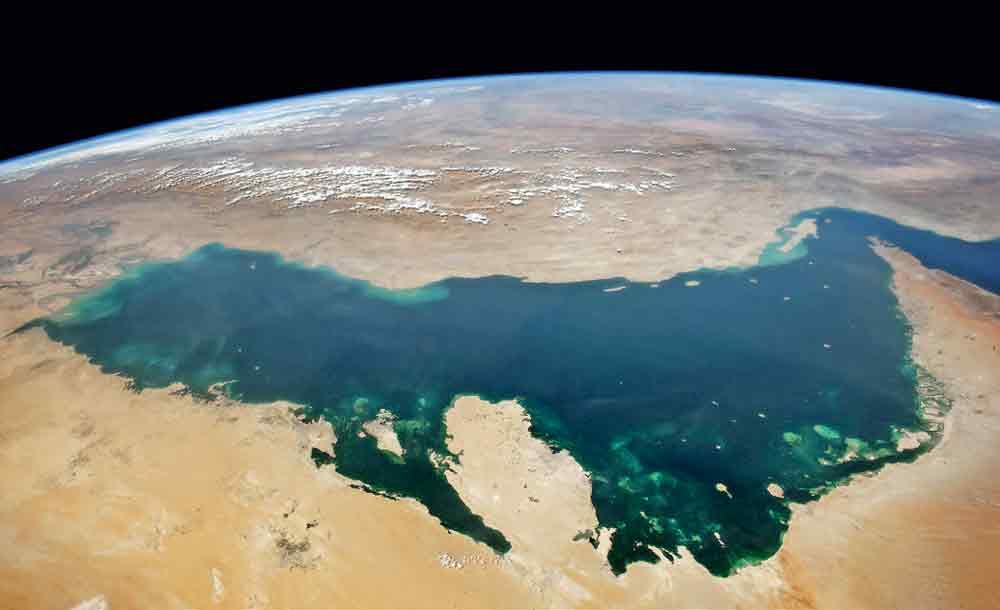
April 30 is recognized in Iran as “National Persian Gulf Day”—an occasion that goes beyond historical commemoration and enters the realm of historical awareness, legal continuity, and geopolitical identity.
The Persian Gulf is not merely a geographical designation; it is a documented historical reality recorded over millennia in cartographic sources, maritime texts, and the civilizational memory of humanity.
From ancient Iranian and Greek sources to Islamic geographers and European cartographers, the name “Persian Gulf” has been used with remarkable consistency.
However, in recent decades, the replacement of this historical name with alternative expressions and politically motivated variants has created unnecessary confusion in global media and discourse, as if such alternatives were neutral substitutes.
The Persian Gulf in the Course of History
According to historical records, from pre-Christian millennia to the modern era, the name “Persian Gulf” or “Sea of Persia” has been consistently used in Greek, Roman, Islamic, and European sources.
During the period from 559 to 330 BCE, when the Persian Empire ruled over much of the Middle East—particularly the entire Persian Gulf and the Arabian Peninsula—the name “Persian Gulf” was widely documented in written sources.
In Achaemenid inscriptions, including those attributed to Darius the Great, this waterway is explicitly referred to as the “Sea of Persia,” demonstrating the deep historical roots of the name within the political and geographical structure of ancient Iran.
Based on more than 6,000 historical maps, hundreds of classical geographical texts, and extensive written sources, this designation has been firmly established in global historical memory and is preserved in reputable international archives.
A notable acknowledgment of this historical reality appears in Al-Ahram Al-Arabi Magazine (Issue 219, 2001) and in the book Tatawwur al- ‘Alaqat, where two prominent Egyptian scholars explicitly state that there is no historical evidence for changing the name of the Persian Gulf
The Persian Gulf in Treaties and Agreements Among Arab Countries
In all treaties and agreements over past centuries—whether between regional Arab governments or between European states and regional countries—whenever reference is made to the southern maritime region of Iran, the name “Persian Gulf” consistently appears.
The name “Persian Gulf” appears consistently across centuries of diplomatic history, ranging from the General Treaty of 1820 with the Trucial tribes to various 19th-century anti-slavery and peace agreements signed between regional Arab sheikhdoms and foreign powers.
Legal Systems and Principles of Stability in Geographical Naming
In international law, the principles of stability and continuity in historical practice hold significant importance. The rule prior in tempore potior in jure establishes that historical precedence and continuity carry greater legal weight than later claims.
Important judgments such as the Island of Palmas (1928) and Eastern Greenland (1933) cases constitute supplementary sources, from which the legal reasoning underlying these decisions may be drawn to support the legitimacy, correctness, and necessity of respecting the name “Persian Gulf” from the perspective of international law.
Furthermore, the “Critical Date Doctrine,” an important concept in international law—particularly in territorial disputes and historical evidence assessment—has been affirmed in International Court of Justice cases such as Minquiers and Ecrehos (1953) and Pedra Branca (2008).
It establishes that historical evidence prior to the emergence of a dispute carries greater legal value.
Under this doctrine, in the examination of a legal or historical dispute, a specific “point in time” (the critical date) must be identified, and the legal value of evidence and conduct must be assessed with reference to that period, rather than developments occurring after the emergence of the dispute, since evidence arising after the critical date carries less probative value and may be reactive or politically motivated.
This doctrine prevents the rewriting of history or the production of new evidence.
In the context of geographical nomenclature, this principle implies that long-established names with continuous international usage enjoy a presumption of legitimacy in the absence of an official international decision to alter them.
Confirmation by International Institutions
International and specialized organizations have consistently recognized the name “Persian Gulf.” The International Hydrographic Organization (IHO), in its authoritative publication Limits of Oceans and Seas (S-23), lists this body of water as “Persian Gulf (Gulf of Iran).” The United Nations Secretariatin 1999, stated that the standard name in official documents is “Persian Gulf” and must be used without alteration. The UN Group of Experts on Geographical Names (UNGEGN) has also emphasized this.
In addition, institutions such as National Geographic, Encyclopaedia Britannica, and the U.S. Department of Defense’s GEOnet Names Server all consistently use the same standard designation.
Moreover, several United Nations and UNESCO directives address the use of the name “Persian Gulf.” Among them is ST/CS/SER.A/29/Rev.1 dated 14 May 1999, which explicitly states: “The term “Persian Gulf” is used in documents, publications and statements emanating from the UN Secretariat as the standard geographical designation for the sea area between the Arabian Peninsula and the Islamic Republic of Iran.
Media Ethics and Responsibility in Geographical Naming
In the field of media and international communication, the use of accurate geographical names constitutes part of professional and ethical standards.
Replacing established names with informal or politically motivated alternatives not only creates conceptual ambiguity but also contradicts principles of accuracy, neutrality, and reliance on authoritative sources.
Where a geographical name has been officially recognized by the United Nations and specialized international institutions, any deviation from it constitutes a violation of accepted standards in international communication.
The International Federation of Journalists (IFJ), in its Declaration of Principles on the Conduct of Journalists, emphasizes on the truthfulness. Similarly, UNESCO, in its Model Curricula for Journalism Education and its journalism ethics guidelines, emphasizes the same.