 Kamanthi Wickramasinghe
 Reply To:
Name - Reply Comment
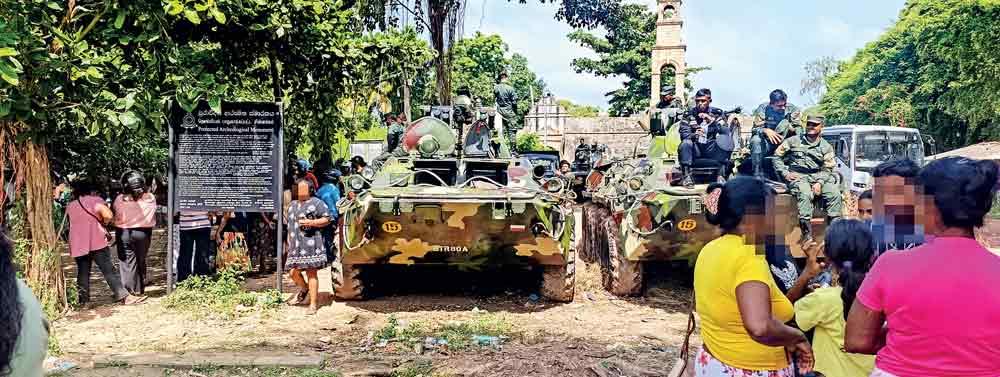
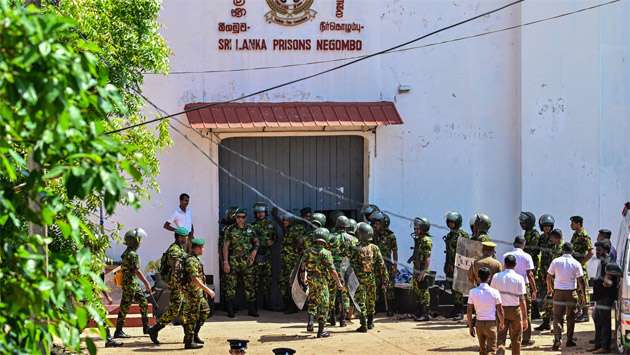
Armored vehicles parked outside the prison premises
 It came to be known that the same name had appeared in all lists, indicating lapses in coordination within the prison department
Lists of names were read out, but many complain that the whereabouts of many of their loved ones are yet unknown
Mothers and wives of inmates have been waiting in front of the prison premises since Sunday evening
Loved ones of inmates blame media for labelling the latter as drug addicts and glorifying prison officials killed during riots
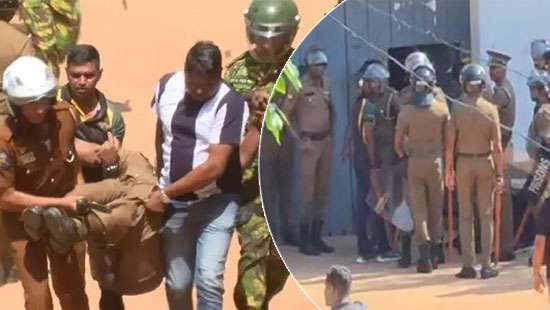
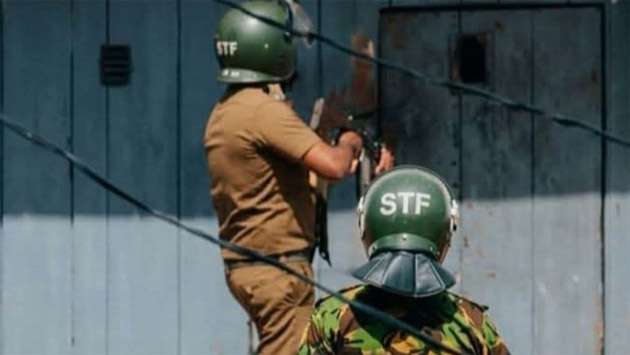
It felt like stepping into a war zone. A No Entry sign greeted us at the entrance to the road leading up to the Negombo Prison. Usual routes were closed to manage crowds, that kept running towards the prison premises. The crowds were families of inmates running helter skelter to find information regarding their loved ones following the brutal aftermath of the riots that occurred on Sunday (5) and Monday (6).
Air of uncertainty
By the time this writer reached the entrance to the prison premises, people were already engaged in a confrontation with law enforcement officers. They were complaining about not being able to find out the situation inside the prison. Lists of names were being read out from time to time, but many complain that the whereabouts of many of their loved ones are not yet known. Some mothers and wives of inmates have been waiting in front of the prison premises since Sunday evening. Many were in a quandary as to whether their husbands, sons, brothers-in-law and other relatives were killed or are still alive.

 I still have no clue regarding him. The police and Special Task Forces had enough opportunity to control the situation on Sunday but they didn’t deploy the military
Deepani Livera, resident of Kotugoda
“Some of us haven’t had any food since Sunday because we don’t know the situation inside the prison,” said a relative of an inmate. She had come to find information regarding her brother-in-law who had been remanded for allegedly attacking a police officer. She didn’t want to disclose her name as she expressed disappointment towards the media. “The media has labelled all inmates as drug addicts and have glorified prison officials who were killed during the riots. It’s sad that they too were killed but it’s wrong to label people that way” she claimed.
Lapses in communication
Deepani Livera, a resident from Kotugoda, on Sunday, had visited her younger brother, who was convicted for possessing drugs.
“On Sunday I purchased some items from the visit card and handed them over to him. However I thought the situation was controlled on Sunday. But on Monday it has aggravated, killing many of the inmates. So I came rushing to see what has happened to my brother. I still have no clue regarding him. The police and Special Task Forces had enough opportunity to control the situation on Sunday, but they didn’t deploy the military. My brother’s name was not in any of the lists and it’s deeply frustrating,” she said in tears.

 The immediate reaction of the state, whether in prison riots or in the case of an allegation against a state official, is to transfer them to another place. In this case, the transfers might be taking place to separate rival groups and to safeguard persons who might be at risk of being attacked. To that extent it makes sense, but this is not a long or even medium term solution”
Ambika Satkunanathan, Lawyer and former Commissioner of the Human Rights Commission of Sri Lanka
This is the plight of many other individuals gathered outside the prison premises. They claim that the name lists issued by the prisons department doesn’t include accurate names and information regarding inmates who have been injured and/or killed. The Daily Mirror learned that the same name had sometimes appeared in all lists, indicating lapses in coordination within the prison department.
Their only ray of hope is to await an occasional announcement on lists of names of inmates who have been transferred to other prisons.
Inside the mortuary
This writer was also able to catch a first-hand glimpse of the situation inside the mortuary at the Negombo District Hospital. Many family members have already gathered at the mortuary to identify and claim the bodies of their loved ones. But this writer learned that only two bodies were being released at a given time and statements were being obtained from family members, who have come to claim bodies. Outside the hospital, several more name lists were pasted on the wall. A handwritten note indicated that the lists were names of inmates who had been injured during the riots. Security has been tightened inside the hospital premises and tokens were being issued to families who had come to visit injured inmates.
Overcrowding and congestion within prisons
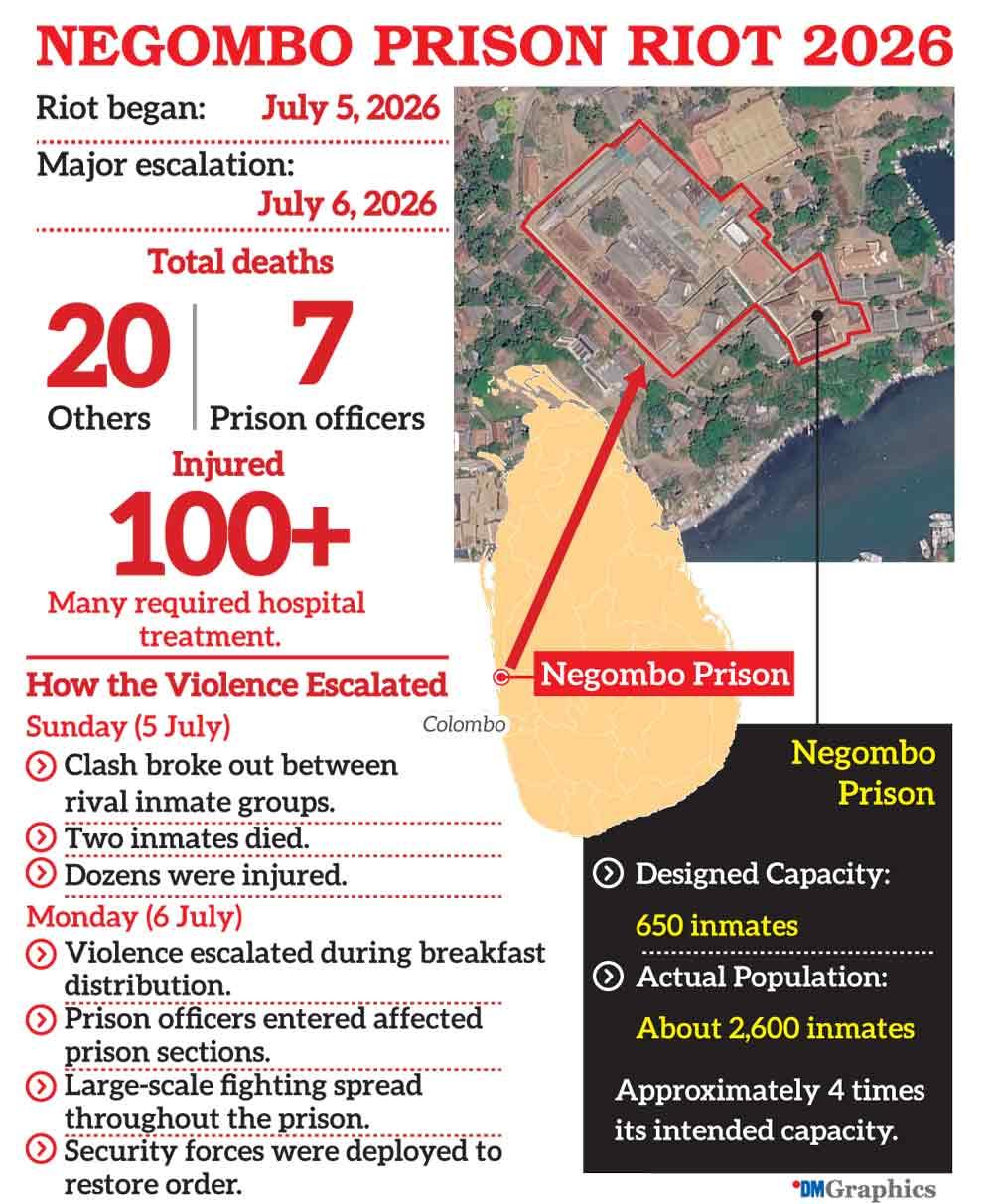
According to official reports, 27 individuals including seven guards and 20 others including inmates succumbed to gunshot and other injuries. But this is not the first instance that such an incident took place inside a local prison. Senaka Perera, Chairman of the Committee for Protecting Rights of Prisoners identifies this incident as a national crisis. He said that irrespective of the reason as to why such an incident occurred, law enforcement authorities and the government should look at why this situation went out of control.
“Congestion is one of the main issues faced by inmates in our prisons. Around 10,600 people could be kept in all 26 prisons. But now there are over 41,000 people in them. At the Negombo prison the maximum capacity is 650 inmates, but there were 2600 inmates at the time this incident took place,” he told the Daily Mirror.
According to the Prisons Commissioner and spokesperson A. C Gajanayake, the incident had occurred on Sunday (5) following a confrontation between two groups of inmates leaving two dead and 38 others injured. On Monday, tensions flared when prison officers entered the facility to distribute breakfast.
According to Perera, prison officers are trying to justify the situation by claiming that the confrontation occurred in relation to drugs. “The Prison spokesperson indicated names of people who had initiated the riot. But those details are irrelevant. During the recent past there were two similar incidents that took place; one was in 2012 in Welikada where 27 inmates were killed and the other took place in 2020 at the Mahara Prison where 11 inmates were killed. In the aftermath there were committees appointed to investigate each of these incidents. Each of these reports indicated that inmates were stressed as a result of overcrowding and the reports identified that such situations could lead to fights among rival gangs. But none of the governments intervened,” he added.
Demands of female inmates ignored
A video of female inmates voicing out their frustrations pertaining to poor medical services went viral on social media. One female inmate was seen wearing a stethoscope around her neck indicating the need for medical services. Perera said that wealthy inmates are transferred to the prison hospital, but it’s not the case with the majority of inmates. He said that lack of sanitary facilities and other welfare issues have led to frustration among inmates. “There are anomalies created among prisoners as some who have been sentenced for five years would get presidential pardons and those serving 30 year sentences are being ignored. Even though the situation was curtailed on Sunday, the prison officials failed to manage the situation,” he added.
Challenges at hand
Sri Lanka has witnessed an increase in the number of remand prisoners particularly due to many suspects being arrested on charges of possessing drugs, said Udayakumara Amarasinghe, Head, Department of Criminology and Criminal Justice at the Sri Jayawardenapura University. He said that inmates in Sri Lankan prisons are categorised as remand prisoners and convicted prisoners.
“A considerable percentage of remand prisoners are addicted to drugs. According to Nelson Mandela Rules which were adopted in 2015 and UN-approved Standard Minimum Rules for the Treatment of Prisoners in 1957, remand prisoners and convicted prisoners should be kept separately. But our prisons were built during the British period,” he told the Daily Mirror.
 Around 10,600 people could be kept in all 26 prisons. But now there are over 41,000 people in them. At the Negombo prison the maximum capacity is 650 inmates, but there were 2600 inmates at the time this incident took place”
Senaka Perera, Chairman of the Committee for Protecting Rights of Prisoners
According to Amarasinghe, after 1980, many narcotic drugs such as heroin were being used and distributed and after 2010-2015, methamphetamine (ice) became popular. “Over 55% of convicted prisoners have been charged on excise and narcotic offences. With population increase and amendments to acts such as the Poisons, Opium and Dangerous Drugs (Disposal of Court Productions) Regulations of 2023 there are more offences being listed. But in this backdrop it is difficult to construct new prisons. Therefore the Prisons Department is compelled to keep them in remand because when there are drug addicts and drug peddlers out in the open, there’s a threat to society as well. As a result there’ll be more violence, poverty and drastic impacts on children’s education,” he said while adding that there has to be alternatives to resolve the issue of overcrowding in prisons.
Need for alternatives
As an immediate remedy, prison officials decided to transfer inmates from the Negombo prison to other prisons in the country. So far, around 700 inmates have been transferred. But according to Ambika Satkunanathan, lawyer and former Commissioner of the Human Rights Commission of Sri Lanka, it is a way of appearing to take action without addressing the root causes. “The immediate reaction of the state, whether in prison riots or in the case of an allegation against a state official, is to transfer them to another place. In this case, the transfers might be taking place to separate rival groups and to safeguard persons who might be at risk of being attacked. To that extent it makes sense, but this is not a long or even medium term solution as the reasons the violence took place remain,” she said.
Speaking about alternatives to imprisonment, she referred to the Community Based Corrections Act which allows non-custodial measures for an offence for which the imprisonment is less than two years.
She said that in 2023, 67.8% of persons in prisons were imprisoned due to their inability to pay fines, which is criminalisation of poverty. “Sometimes these fines are as little as a few thousand rupees. Drug users are arrested instead of being provided evidence and community based health services to deal with drug dependence. Imprisoning drug users creates demand for drugs in prison, which are provided to them with the collusion of prison officials,” she added. Satkunanathan said that it is important to factor in how much the government spends in a day to maintain these persons in prison- in 2023 it was LKR 395,000 per person annually. “Does spending this amount to imprison a person who cannot pay a fine or uses drugs, serve the public good?” she questioned.
She said that the government needs to tackle the crumbling penal system in Sri Lanka, which requires reform of the police department and the criminal justice system as well. “The first step should be acknowledgment a structural problem exists. Violence is in the DNA of prisons, which are inhumane, discriminatory environments which beget more violence. The solution is not to build new prisons but to take measures to address the root causes of violence and crime and prevent people from coming into contact with the criminal justice system and being imprisoned,” she underscored.
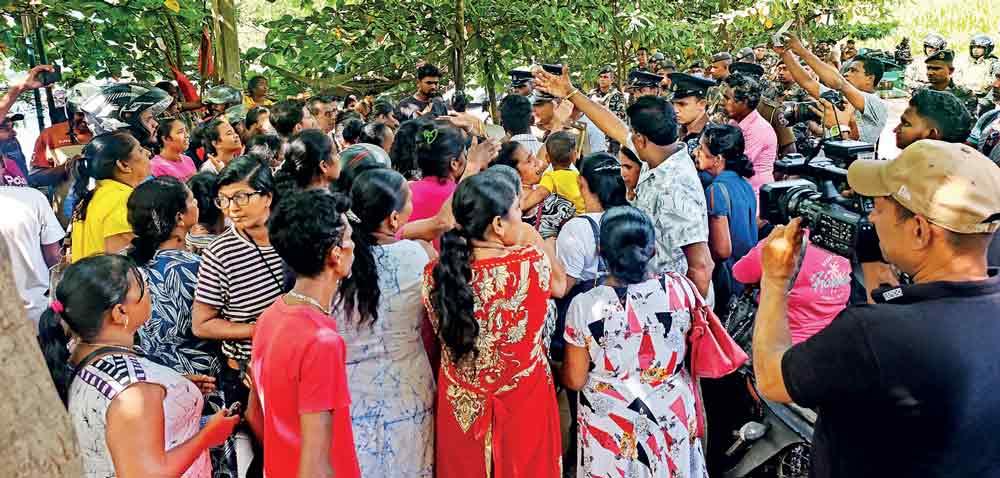 Families of inmates continue to seek information regarding their loved ones