 Kamanthi Wickramasinghe
 Reply To:
Name - Reply Comment
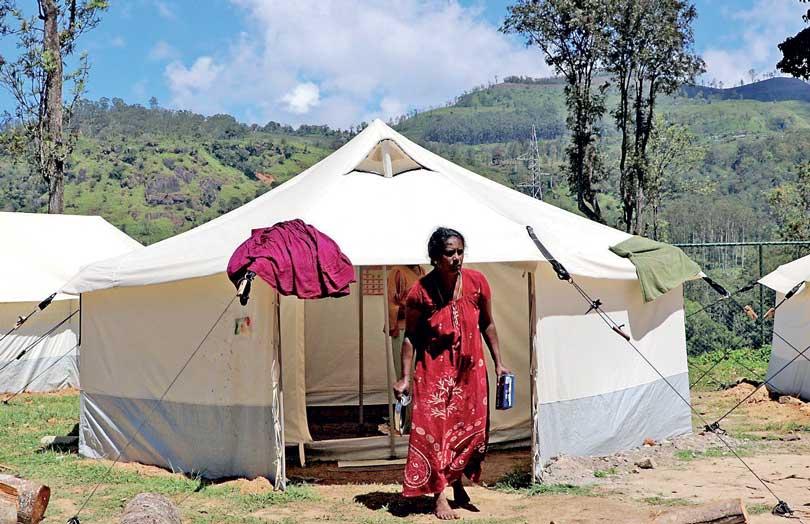
The displaced Malaiyaha community now resides in temporary shelters as seen in this photo. (Images courtesy of Selvaraja Rajesh)
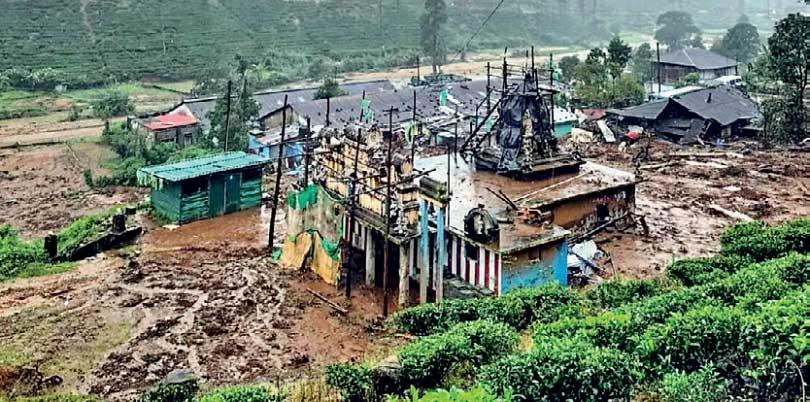
The aftermath of the cyclone, damaging houses, properties and livelihoods of the Malaiyaha community
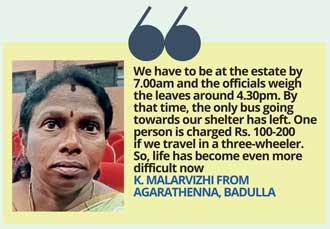 Three months after Ditwah, K. Malarvizhi from Agarathenna, Badulla lives in a tea shed converted into a temporary shelter, shared with dozens others who were displaced following the devastating cyclone. Initially, around 48 families were cramped into this tea shed, where men and women living there were separated by a small space in the middle. The conditions they live in are so dire that they cannot imagine returning to normalcy anytime soon. While the rest of the country has moved on, Malarvizhi and the rest of the Malaiyaha community are struggling to move on and feel that they have been ignored by state actors, once again.
Bracing for difficult times
“Despite living in the shelter we have to go to work,” Malarvizhi told the Daily Mirror. She complained of having to commute a long distance from the shelter to the estate. “We have to be at the estate by 7.00am and the officials weigh the leaves around 4.30pm. By that time, the only bus going towards our shelter has left. One person is charged Rs. 100-200 if we travel in a three-wheeler. So, life has become even more difficult now,” she said.
Apart from that they are also burdened with sending children to school and bringing them back. Malarvizhi said that due to limited space, around 14 families moved out of the shelter to live on rent basis. But the authorities hadn’t allocated funds to tenants as promised, making matters more complicated. Therefore, these families had no choice, but to return to the shelter.
Malarvizhi said that if people don’t like to stay at the shelter, the officials ask them to write a letter of consent and leave. “Thereafter they ask us to go back to our previous houses knowing very well that they are now in high risk areas. If rains exceed 75-100mm they ask us to return to the shelter. But there’s no space. We are wasting our time going from one place to the 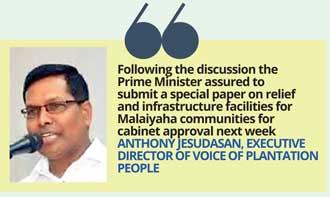 other,” she added.
Challenges in obtaining compensation
The Daily Mirror learned of discrepancies in distributing the Rs. 25,000 compensation among Malaiyaha communities affected by Ditwah. “It took us three days to fill a form that needs to be submitted in order to obtain Rs. 25,000 compensation,” said T. Kalaivani. “Then we had to take it to a Justice of Peace in Passara to get the document attested. The authorities know that we don’t have deeds and they shouldn’t be so strict when providing us with compensation. We have to face a lot of discrimination when obtaining services from authorities and that is quite unfair,” she added.
Community demands presented to political hierarchy
The Civil Society Collective for Malaiyaha Reconstruction questioned the accountability of state actors when distributing compensation and relief to victims of this community. Nadesan Suresh representing the Collective said that people living in Central Highlands don’t have access to land and housing. “These people need to return to normalcy and immediate reconstruction is a necessity. Hence we are making a joint appeal with 15 demands which would be developed into a countrywide advocacy programme,” he added.
 Some of the main demands are as follows;
Provide Rs. 5 million to families whose houses have been fully damaged and Rs. 2.5 million to families with partially damaged houses as per the circular no. NDRSC/02/04/10.
Provide individual houses with deeds to the individuals of the Malaiyaha community. The Collective rejects the construction of condominiums or housing complexes in estates.
The government shouldn’t have any agreements with plantation managements during the reconstruction process and that these projects should be handled directly by the government.
Women too should be given the right to land ownership.
Provide transitional shelters adhering to SPHERE standards until these communities receive permanent housing.
Provide official communication in Tamil language
Establish a grievance handling mechanism at the provincial, district and national level.
The government should take the responsibility to upgrade community infrastructure including bridges, stairways, retaining walls and buildings in the estate sector.
Civil society activists meet with Prime Minister
Following the recent discussion held in Colombo, the Collective decided to obtain signatures from those who support the cause and subsequently hand over the demands to the President and Prime Minister. But the response from the Presidential Secretariat had not been satisfactory.
“We went to the Presidential Secretariat on Thursday (March 26), but we failed to meet with a responsible official to hand over the demands,” said Anthony Jesudasan, Executive Director of Voice of Plantation People. “They kept us waiting for around two and a half hours. But
thereafter we met with Prime Minister Harini Amarasuriya and highlighted the discrimination faced by the community when obtaining relief and compensation. Following the discussion the Prime Minister assured to submit a special paper on relief and infrastructure facilities for Malaiyaha communities for cabinet approval next week. The Commissioner General of Essential Services Prabath Chandrakeerthi said that those impacted by the cyclone in plantation areas will be provided with housing and land valued at no less than 50 lakhs,” he added.
Practical issues in resettlement
Immediately after the cyclone, the National Building Research Organisation (NBRO) conducted an assessment on the country’s landslide prone areas. According to the assessment, nearly 30% of the country’s land area is classified as vulnerable to landslides.
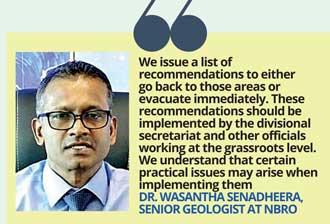
Speaking to the Daily Mirror, Dr. Wasantha Senadheera, Senior Geologist at NBRO said “We have received 7097 complaints to conduct site inspections. For each inspection there are multiple sites to be inspected. These include houses, buildings, villages etc. So far we have received complaints to inspect 50,399 sites. Out of 1408 locations earmarked for resettlement purposes we have completed site inspections on 867 locations. These are figures obtained from all 13 districts,” he said.
But he said that due to extreme weather conditions, ground level inspections and site visits would take a couple of more months to be completed. Dr. Senadheera further said that once a site inspection is complete, they provide mitigation measures to avert any further risks of landslides or flooding. “We issue a list of recommendations to either go back to those areas or evacuate immediately. These recommendations should be implemented by the divisional secretariat and other officials working at the grassroots level. We understand that certain practical issues may arise when implementing them,” he added.
He further said that evacuation is not easy as it affects people’s livelihoods. “Therefore a holistic approach is needed when relocating people in order to safeguard their livelihoods. The issue is that people have already encroached into prime locations and there’s an issue with regards to land availability,” He said.
Progress of distributing compensation
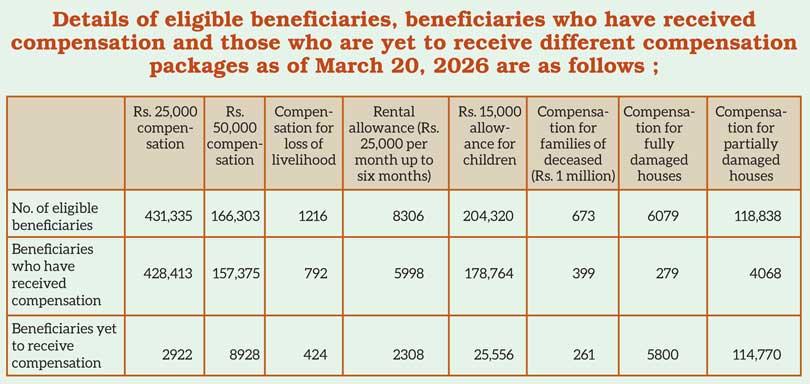
However, as per the latest figures released by the National Disaster Relief Services Centre, compensation has been distributed to a majority of beneficiaries who are eligible. But many are yet to receive compensation for partial and fully damaged houses.
Details of eligible beneficiaries, beneficiaries who have received compensation and those who are yet to receive different compensation packages as of March 20, 2026 are shown in above table.