Reply To:
Name - Reply Comment
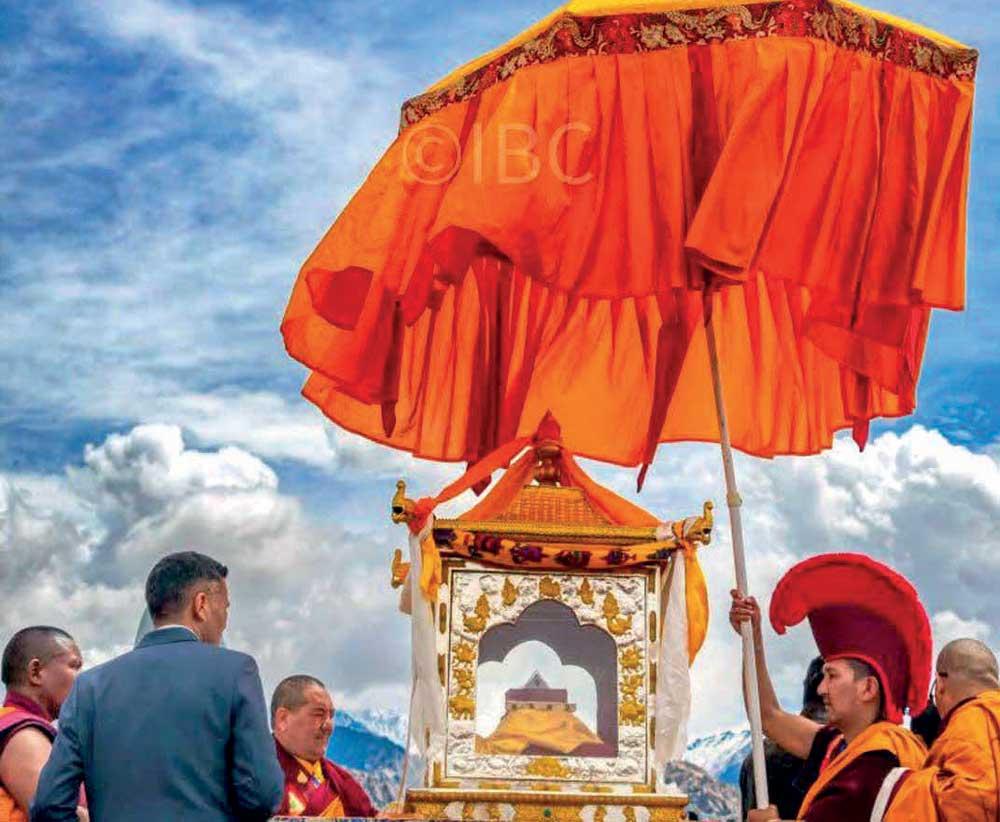
In a landmark moment of spiritual diplomacy, Union Home Minister Amit Shah hailed the historic return of Lord Buddha’s sacred relics to Ladakh after 75 years as a “divine realization” for the region. Speaking at the First International Exhibition in Leh, Shah positioned Ladakh not merely as a geographic frontier, but as a “living laboratory of compassion” and a guardian of the Dhamma. By weaving ancient history with modern connectivity, he framed the event as a testament to India’s enduring legacy of peace, urging the world to embrace the “Middle Way” as the definitive solution to global conflict.
The following is the text of the address by the Union Minister of Home Affairs and Cooperation of India, Amit Shah at the First International Exhibition of the Sacred Relics of Lord Buddha, Leh (Ladakh), 1 May 2026
On this sacred occasion today, I extend my greetings to all the Rinpoche, all the Buddhist monks present here, Hon’ble LG Shri Vinay Kumar Saxena ji on the dais, Hon’ble Member of Parliament from Ladakh Shri Mohammad Hanifa ji, Shri Govind Mohan ji, Home Secretary of India, Shri Tapan Deka ji, Director of the Intelligence Bureau, at whose invitation I have come here, President of LBA Shri Lakhrog ji, senior officers of the Ladakh administration, and the large number of followers of the Tathagata who have gathered here today.
First of all, I would like to extend my heartfelt greetings to the people of Ladakh on the occasion of Buddha Purnima. This Purnima comes every year, but this year’s Buddha Purnima is a rare and auspicious confluence for the people of Ladakh. Today is Buddha Purnima, it is also a Thrice Blessed day, and today Lord Buddha himself is present here in the form of his holy relics. In a way, the significance of today’s Buddha Purnima has increased manifold.
Friends, after 75 years, these holy relics have come to Ladakh. As Shri Lakhrog ji rightly said, when these holy relics had come here 75 years ago, only a few people would have been able to have their darshan, experience their spiritual energy, and receive the message of Lord Buddha. At that time, there were no transportation facilities in these difficult valleys—no roads, no connectivity.
Today, after 75 years, on the day of Vaishakh Purnima, on Buddha Purnima, when these relics have come here, I firmly believe that all followers of Buddha in Ladakh and Kargil, as well as followers of other faiths, will gain spiritual energy from these holy relics and experience a divine realization.
Today is a Thrice Blessed day. On this very day in 563 BCE, Prince Siddhartha was born in Lumbini, who later became Tathagata Buddha after attaining enlightenment. His birth day, the day of enlightenment under the Peepal tree at Bodh Gaya, and the day he attained Mahaparinirvana at Kushinagar at the age of 80—all fall on this same sacred day. It is rare that in the life of any divine incarnation, birth, enlightenment, and Mahaparinirvana occur on the same day. Therefore, this day is extremely auspicious and inspiring for all of us.
On this very day, making the holy relics of Lord Buddha available for public darshan is a matter of great fortune for all of us. Today’s occasion is not only a religious event but also a historical reunion. After so many years, Tathagata Buddha has returned to this sacred land, his most beloved and familiar land. This is indeed a matter of great fortune.
For centuries, Ladakh has been a living land of Dhamma. When the Dalai Lama comes here, he says that this land is not merely geographical, it is a living laboratory of Buddhist culture and compassion. This land has preserved knowledge and also nurtured it. Whenever Buddhism faced challenges, this land safeguarded the teachings of Buddha, and in times of peace, it helped expand and propagate that knowledge. It was this very route through which the teachings of Tathagata spread from India to China and many other countries.
The spiritual identity of Ladakh is shaped by four major traditions—Nyingma, Kagyu, Sakya, and Gelug. These traditions teach us to see things as they are. Realisation of truth is a profound form of knowledge. Secondly, the grace of the Guru and continuous introspection and meditation are the gateways to liberation. Knowledge may be attained through the Guru, but without meditation, it cannot be internalized. Knowledge without practice is incomplete, and practice without knowledge is blind. The union of both is the right path. Finally, without moral discipline, a wise life cannot be achieved. Moral discipline is the foundation of a truly enlightened life.
The message that has emerged from the land of Ladakh has guided countless seekers across the world. The presence of these holy relics reminds us that Bhartiya civilisation has, for thousands of years, propagated the message of peace and coexistence. In a diverse region like Ladakh and Kargil, this message becomes even more relevant. Even today, this legacy tells us that amidst conflict and unrest, the path of peace and compassion alone can provide solutions.
Buddhism reached Ladakh in different phases over centuries, flourished, and then spread beyond Ladakh. Kashmir was an ancient center of Buddhist studies, Mahayana philosophy, and Buddhist art. From there, Ladakh first came into contact with Buddhism. The envoys of Emperor Ashoka laid the foundation of Buddhist influence here through Kashmir and Gandhara. The second phase came during the Kushan period (1st to 3rd century CE), when Mahayana Buddhism flourished and spread to Ladakh. Ancient stupas, rock sculptures, and Kharosthi-Brahmi inscriptions bear testimony to this period.
The Silk Route also played a major role, not just for trade of goods but for exchange of ideas. It connected Kashmir, Yarkand, Khotan, and Tibet, becoming a vital medium for cultural and intellectual exchange. Manuscripts, art forms, inscriptions, Mani walls, stupas, and Buddhist architecture found here stand as evidence. The fourth phase came with Tibetan influence (7th to 10th century), when Mahayana and Vajrayana traditions enriched Ladakh further. A decisive contribution came from Rinchen Zangpo (10th–11th century), who translated Sanskrit texts into Tibetan and established 108 monasteries, including the Alchi monastery, giving Buddhism a stable and institutional form.
Friends, even today, wherever Buddhist traditions exist in the world, the knowledge nurtured in Ladakh is considered extremely important. As these holy relics have come here, I would like to say that Mahayana literature states that having the opportunity to behold holy relics is equivalent to beholding Buddha himself. After such a long time, the people of Ladakh have the fortune of witnessing Buddha himself.
I extend my heartfelt congratulations to all of you. I also request the Ladakh administration to ensure that followers of all faiths can come here, and especially that no follower of Buddhism is left out from having darshan. ITBP, the Army, and the Ladakh administration should treat this as Buddha himself arriving at their home and ensure the best arrangements and hospitality.
Friends, in conclusion, when Lord Buddha attained enlightenment and spread his teachings, he sent monks across the land to propagate this knowledge. The teachings of Buddha were as relevant then as they are today—even more so after 2500 years.
I hope that the knowledge of India, the great message of Tathagata Buddha, is understood and accepted by the entire world, guiding humanity towards solutions and the path of the Middle Way.
Once again, I bow to all the monks and to the holy relics, and I conclude my speech.