Reply To:
Name - Reply Comment
 There is a moment everyone knows, regardless of age. The bus is late. The kettle is boiling. The class hasn’t started. The meeting hasn’t begun. And in that small gap, almost without deciding to, a hand reaches for a phone.
A teenager does it between lessons. A university student does it between lectures. A tired professional does it between meetings. A retired grandparent does it between television programmes. The device changes nothing about who we are. It simply reveals what we all already share: an inability to sit, even briefly, with nothing happening.
This is the quiet problem two physics PhDs in northern Germany, Max and Philip, decided to take seriously. Their starting point wasn’t “people don’t know enough.” We have never known more, about more things, more instantly, in the history of our species. The real shortage isn’t information. It’s attention, and for years, entertainment has won that fight without much of a contest.
Their answer is an app called NerdSip, and what makes it worth discussing isn’t really the technology. It’s the idea sitting underneath it.
A Different Kind of Course
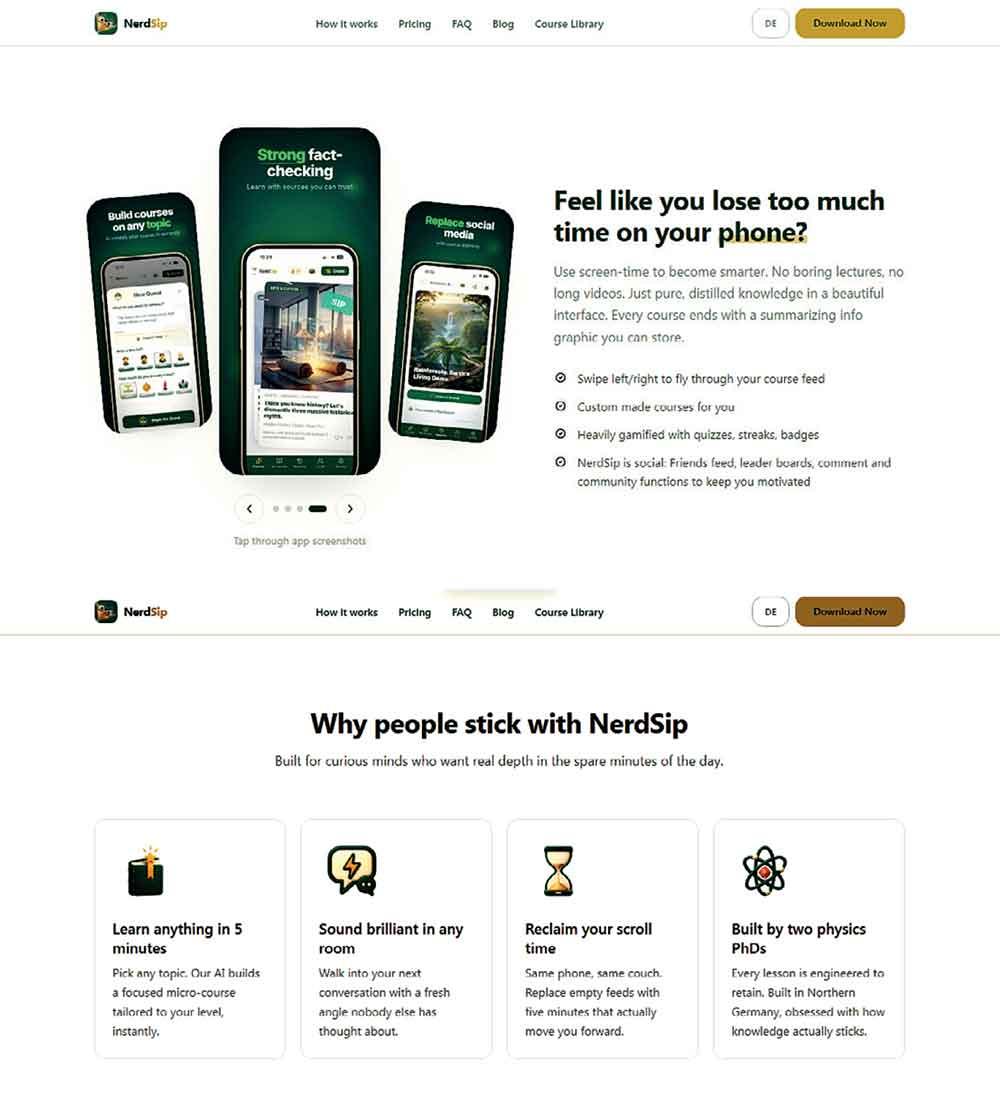
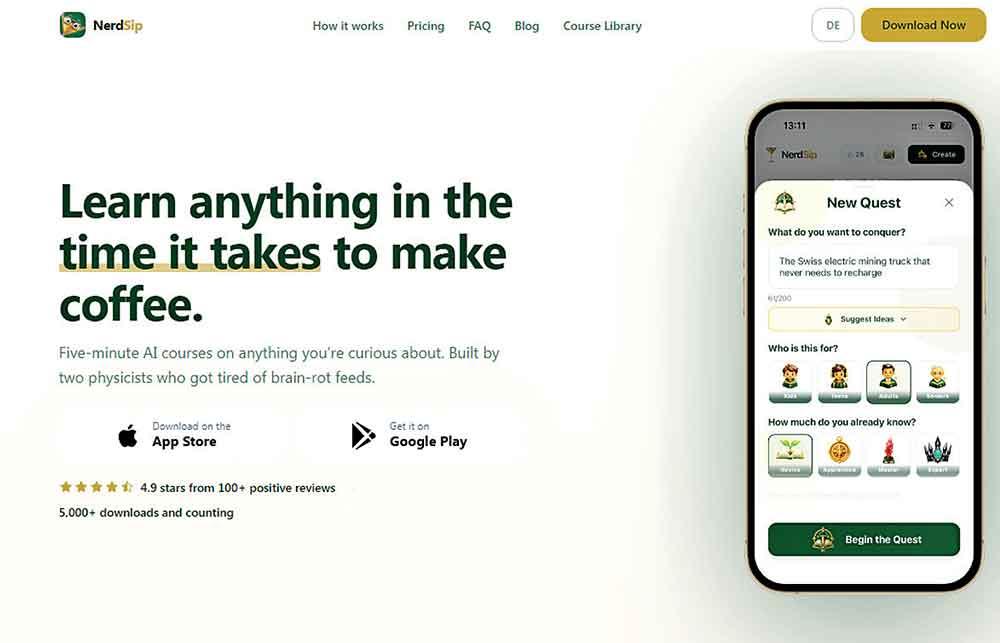
Most learning platforms hand you a syllabus and expect you to follow it. NerdSip flips that completely. You simply type whatever you’re curious about: how negotiation actually works, why luxury brands charge what they do, what quantum physics really means, and an AI builds you a short course on the spot. Seven small lessons, a quiz, a clear takeaway, even a podcast version for anyone who would rather listen while walking the dog or washing the dishes. For a schoolchild, that might mean turning a confusing textbook question into something that finally clicks. For a university student, it might mean a five-minute detour into a subject outside their degree, purely for the pleasure of it. For a working professional, it might be using a commute to understand something useful before the next meeting. For someone retired, it might simply be the joy of learning something new with no homework, no deadlines, and nobody marking it wrong.
That is the quiet brilliance of the idea. The format bends to whoever happens to be holding the phone.
NerdSip does not pretend to be above the very apps it is competing with. It borrows from them on purpose.
Borrowing What Already Works
NerdSip does not pretend to be above the very apps it is competing with. It borrows from them on purpose. There are streaks for showing up daily, points for progress, and a social feed for a little friendly competition, the same small rewards that make a game or a social app so hard to put down. The difference lies in what those rewards are attached to. Instead of being rewarded for watching, you are rewarded for understanding something new.
It is a clever bit of design because it does not ask anyone to fight their habits. It simply redirects them.
The Honest Limits
None of this should be oversold as magic. Five minutes can open a door, but it cannot replace years of real study, a good teacher, or a proper book read slowly over many weeks. AI-written lessons can simplify too far, or occasionally get a small detail wrong, a fair concern for any AI tool, regardless of who is using it or how old they are. And like every habit-forming app before it, the true test is not the first excited week of downloads and streaks. It is whether anyone is still opening it in six months, long after the novelty has worn off and life has gone back to being ordinary and busy.
The Real Lesson
Strip away the app, the streaks, and the clever marketing, and what remains is a fairly old idea wearing new clothes: that curiosity, taken in small enough doses, can compete with distraction.
None of us, whether student, graduate, employee, or retiree, is truly short of time in the way we often believe. What we are short of is five honest minutes spent on purpose, free of guilt and free of scrolling.
What NerdSip is really betting on is not artificial intelligence at all. It is something far older and far more human: the quiet hope that, even in the smallest gaps of an ordinary day, we might still choose to grow.
Image Credits https://nerdsip.com/