Reply To:
Name - Reply Comment
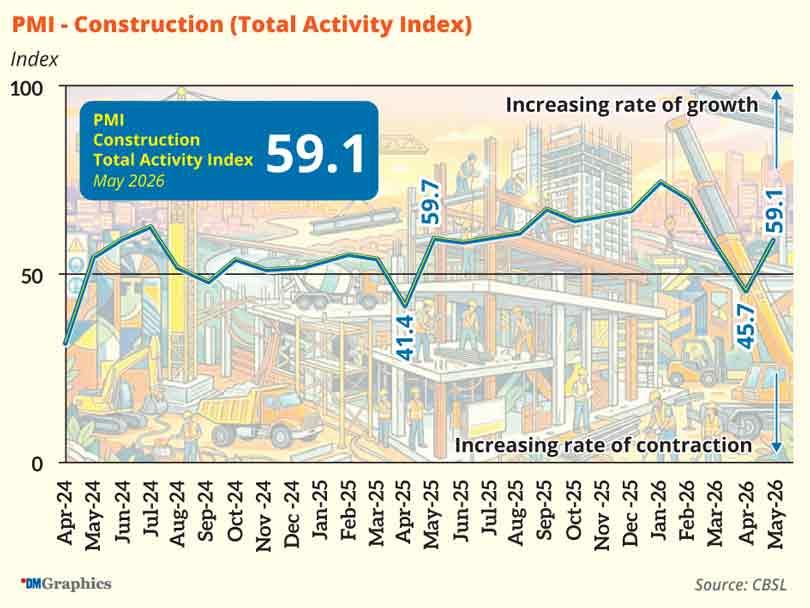
Sri Lanka’s construction sector regained momentum in May as a steady flow of new project awards helped drive activity back into expansion territory, offering fresh evidence that investment activity remains resilient despite higher borrowing costs and global uncertainty.
The Central Bank’s Purchasing Managers’ Index (PMI) for Construction rose to 59.1 in May from 45.7 in April, as contractors resumed work following the seasonal slowdown associated with the April festive period. More importantly, the sector’s New Orders Index climbed further to 63.6, signalling that construction companies continued to secure new projects at a robust pace.
The latest reading suggests that the project pipeline underpinning Sri Lanka’s construction industry remains largely intact even as businesses navigate the fallout from Middle East tensions, rising input costs and tighter monetary conditions.
The strength in new orders was reflected across other indicators. Construction firms increased hiring for another month, with the Employment Index rising to 56.1, while purchases of construction materials rebounded sharply in line with higher project activity.
Construction is often viewed as one of the clearest indicators of future investment trends, given its links to infrastructure development, tourism projects, industrial expansion and real estate activity.
However, the survey also highlights growing strains within the sector.
Many respondents cited the continued shortage of skilled workers as a major constraint, despite ongoing recruitment efforts. Labour availability has increasingly become a challenge for several sectors of the economy as outward migration and skills mismatches continue to weigh on the domestic workforce.
At the same time, construction firms reported that elevated prices of key materials remained a significant concern. Shortages of inputs such as bitumen were also flagged by respondents, underscoring the cost pressures facing contractors even as demand improves.
Business sentiment also remained positive, with firms expecting activity to remain supported over the next three months by a sustained flow of projects and hopes that geopolitical tensions in the Middle East will ease.