 KELUM BANDARA
 Reply To:
Name - Reply Comment
 We believe that the magnitude and diversity of threats and challenges in the region are such that no single country has the wherewithal to tackle these alone
A truly “free and open” Indo-Pacific should not evolve into bloc politics or military alliances that marginalize certain states or disrupt regional balance.
 |
 |
The security of the Indian Ocean is once again in the spotlight because of the US-Israeli war on Iran. Sri Lanka, once, sought the region to be declared a zone of peace. The ocean’s significance for freedom of navigation is talked about with fresh perspectives now in the wake of Iranian warship IRIS- Dena being torpedoed in Sri Lanka’s Exclusive Economic Zone by a US submarine. Sri Lanka, given its strategic positioning, is dragged into the vortex of geopolitical rivalries involving China, India, the US and Japan.
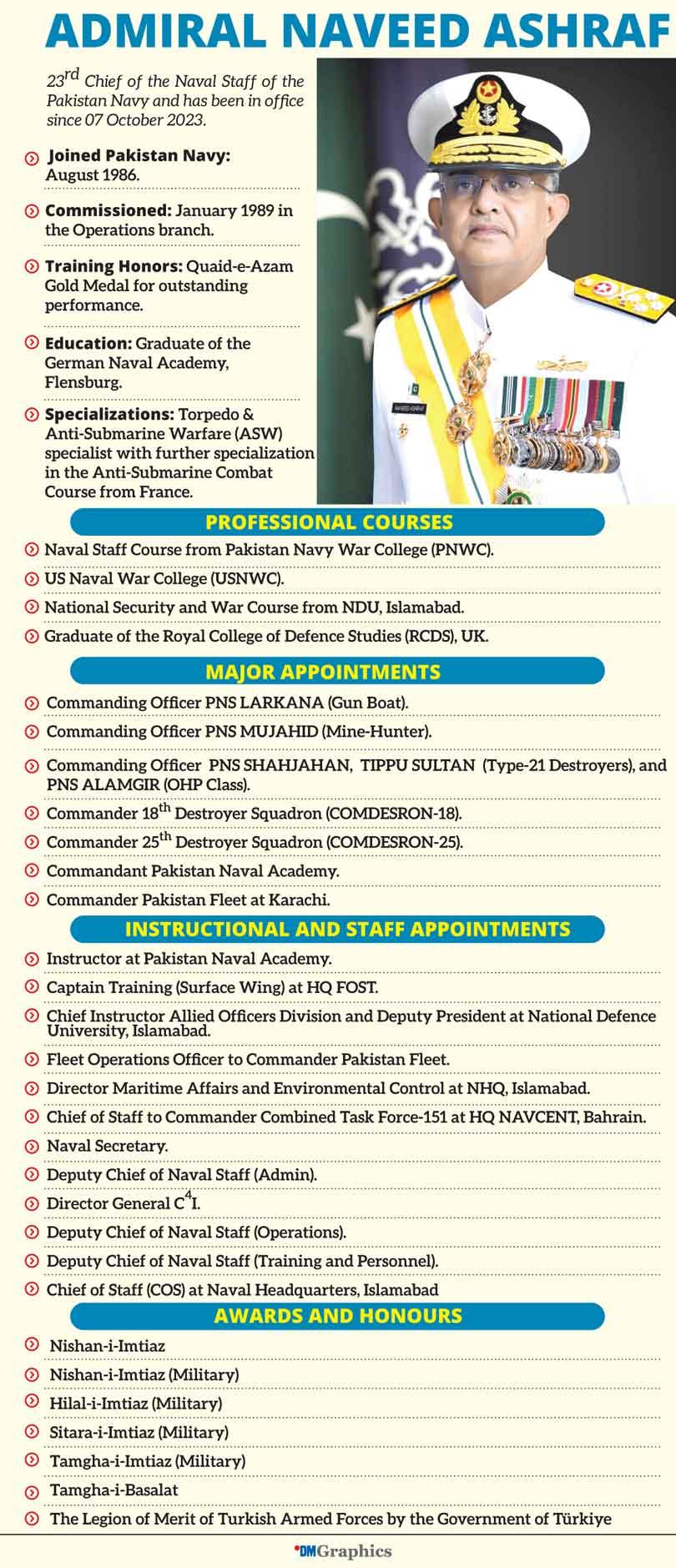
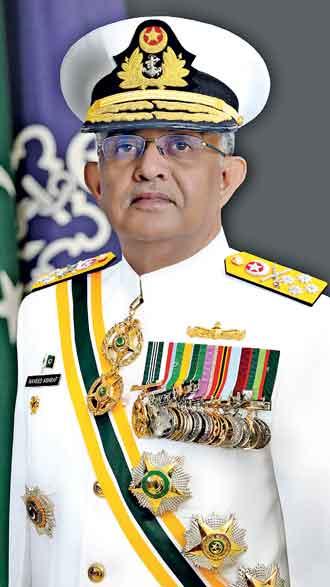
The region is home to one-third of the world’s population and carries two-thirds of global oil shipments and a third of bulk cargo. Security in the Indian Ocean is crucial for maintaining stability of the world order. Beyond serving as a conduit for international trade, the Indian Ocean is also home to vital marine resources and accounts for 15% of all reported global marine catches. Against the unfolding circumstances, Admiral Naveed Ashraf, the Chief of the Naval Staff of the Pakistan Navy, shares his views with Daily Mirror regarding Pakistan’s role, expectations and bilateral cooperation in between the navies of Sri Lanka and Pakistan. Following are excerpts of the interview:
Q Pakistan has significantly enhanced its undersea warfare capabilities in recent years. How does your expanding submarine fleet alter the maritime balance in the Northern Indian Ocean?
The complex maritime security situation in the Indian Ocean Region necessitates a balanced and capable naval force to maintain deterrence. Pakistan Navy continues to upgrade its capabilities according to the security dynamics in the region. We believe that enhancement of our submarine fleet is an important element in strengthening deterrence and maintaining regional balance of power.
Q With the induction of new platforms, including advanced submarines, what doctrinal shift — if any — has the Pakistan Navy adopted in terms of deterrence and sea denial?
In the last few years, Pakistan Navy has undertaken major modernization and expansion through induction of modern and potent surface platforms like Frigates, Corvettes and OPVs. In this regard, Type-054 A/P Frigates acquired from China and MILGEM Class Corvettes from Türkiye are the most technologically advanced platforms of PN Surface Fleet equipped with modern surface, subsurface and anti-air weapons, sensors and combat management system.
In the underwater dimension, the HANGOR Class SMs are advanced conventional SMs equipped with state-of-the-art weapons and sensors. The naval aviation arm of Pakistan Navy is also being strengthened through induction of Jet LRMPs.
Furthermore, enhanced focus on additional domains of cyber and space with induction and integration of emerging technologies like unmanned systems and AI-supported decision making will transform our Navy into a formidable force capable to carry out Multi-Domain Operations (MDOs) to accrue cross-domain effects. Operationalization of these capabilities has necessitated a doctrinal shift. We are, therefore, moving towards manifestation of MDOs to generate an integrated response to evolving threats across the conflict spectrum.
Q How does Pakistan view the growing strategic competition in the Indo-Pacific, particularly between major powers such as the United States, China and India?
The increasing Great Power Competition in the Indo-Pacific region is manifesting through complex geo-political and geo-economic influences on the regional countries. We deem this growing Indo-Pacific competition as primarily a maritime security issue which is intertwined with rapidly transforming maritime environment in the Indian Ocean.
The ongoing conflict between US, Israel and Iran has seriously affected the maritime security close to our shores and disrupted vital energy supplies from the Strait of Hormuz impacting economies worldwide. We believe in peaceful co-existence and negotiated settlements as the best way forward for durable peace and stability in the region.
Q There is increasing global emphasis on a “Free and Open Indo-Pacific”. What does that concept mean from Pakistan’s strategic perspective?
Pakistan supports principles like open sea lanes, unimpeded trade and adherence to international maritime law. However, from its strategic viewpoint, a truly “free and open” Indo-Pacific should not evolve into bloc politics or military alliances that marginalize certain states or disrupt regional balance.
Instead, Pakistan favours an inclusive maritime order that supports collaborative maritime security resulting in peace and stability in the region.
Q Does Pakistan see the Indo-Pacific construct as inclusive and cooperative, or as a bloc-driven security architecture that could heighten tensions?
Pakistan supports cooperative maritime security, freedom of navigation and inclusive regional connectivity. We are of the view that any such framework should not be exclusionary, whereby it poses increased risks of polarization and strategic rivalry.
Pakistan favours a non-bloc regional order, where economic integration and security cooperation favour the collective good and are not directed against any single state.
Q Given Sri Lanka’s location astride major sea lanes, how does Pakistan assess its strategic importance in regional maritime security?
We believe Sri Lanka is an important country located strategically in the Indian Ocean overlooking critical Sea Lines of Communication. Security of these lines is paramount for regional stability and Sri Lanka is playing an important role in upholding that order.
Sri Lankan Navy and Air Force rescued precious lives and recovered bodies of the crew of IRIS DENA sunk in a torpedo attack off Galle in early March this year. Sri Lanka also facilitated the rescue of the crew of another vessel IRIS BUSHEHR which faced operational issues while plying close to its coast.
These vessels were returning from an international exercise held on the east coast of India which had concluded a week earlier. Sri Lanka undertook these actions based on international law and provided medical care, shelter and repatriated the deceased which have demonstrated its role as a responsible, proactive and neutral littoral nation.
We believe that the magnitude and diversity of threats and challenges in the region are such that no single country has the wherewithal to tackle these alone. Therefore, collaborative maritime security has become an imperative for ensuring maritime security in the region.
Q Would Pakistan seek deeper naval cooperation with Sri Lanka, particularly in training, joint exercises, or maritime domain awareness?
Pakistan Navy and Sri Lankan Navy have all along maintained a strong, meaningful and mutually rewarding relationship. I would say that this relationship is historical and deep rooted. We continue to enhance collaboration in training and our ships regularly visit Sri Lankan ports.
We have always been pleased with the warmth and hospitality extended by the Sri Lankan Navy and its people.
Q How important is freedom of navigation for Pakistan’s own economic security, especially in the context of energy routes and trade corridors?
Freedom of navigation is vital to Pakistan’s economic security. The country relies heavily on sea-borne trade and a significant share of its energy imports, particularly oil and liquified natural gas, travels through the Arabian Sea and critical chokepoints such as the Strait of Hormuz.
Any disruption in these Sea Lines of Communication directly affects overall economic stability. For this reason, Pakistan strongly supports secure and uninterrupted maritime traffic in the Indian Ocean region.
In the backdrop of the recent US-Israel-Iran conflict and disruption to global supply chains, Pakistan Navy launched “Operation Muhafiz-ul-Bahr” to ensure flow of national energy supplies and security of Sea Lines of Communications. Pakistan Navy conducted escort operations in close coordination with Pakistan National Shipping Corporation and controlled movement of merchant vessels to ensure their safe transit.
We believe ensuring open sea lanes is not only about global norms but also about safeguarding export markets, import flows and the credibility of emerging trade corridors in a competitive Indo-Pacific environment.
Q In an era of increasing submarine deployments by regional navies, how can smaller Indian Ocean states avoid being drawn into great power rivalry?
As submarine deployments increase across the Indian Ocean, driven largely by competition among major powers, smaller states can reduce the risk of entanglement by adopting balanced engagement. They can also invest in maritime domain awareness and transparent legal frameworks grounded in international maritime law.
Strengthening regional institutions for rapid information sharing and collaborative maritime security can pave the way for collective stability.
Q Finally, what role does Pakistan envision for itself in shaping a stable, rules-based maritime order in the Indo-Pacific?
Pakistan envisions a role for itself as a responsible maritime stakeholder that supports peace, stability, secure sea lines of communication and adherence to international maritime law in the Indo-Pacific. Pakistan continues to play an important role in collaborative maritime security initiatives like CTF-150 and 151. In October last year, Pakistan Navy as part of CTF-151 conducted a counter-narcotics operation wherein ships apprehended the largest ever cache of narcotics in the history of CMF amounting to approximately USD 1 billion.
Further, Pakistan conducts the AMAN series of exercises every alternate year with the motto “together for peace”. The last AMAN exercise was held in February 2025 with the maiden AMAN Dialogue which saw participation of around 60 countries from across the globe.
These initiatives highlight Pakistan Navy’s role in promoting regional maritime security and strengthening a rules-based maritime order.