 DARSHANA SANJEEWA BALASURIYA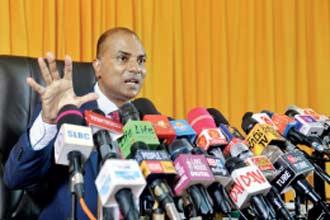
Reply To:
Name - Reply Comment
 Targets grand corruption
Finance Ministry accused of blocking CIABOC recruitment drive
Nearly 300,000 asset declarations filed, processing delayed due to limited staff
|
Pic by Pradeep Pathirana |
Director General of the Commission to Investigate Allegations of Bribery or Corruption (CIABOC) Ranga Dissanayake said yesterday that the Commission operates independently and takes action regardless of political affiliation or individuals involved.
Responding to concerns over whether the Bribery Commission acts on a predetermined list, Dissanayake acknowledged the existence of a priority list, but clarified that it mainly covers cases of grand corruption and large-scale thefts.
“Once I assumed office, I established a special unit alongside four other administrative units. The special unit directly investigates grand corruption and thefts under my direction,” he told the reporters.
Speaking on to the media, the DG said that he does not decide which cases should be prosecuted. “The decision to prosecute under the Bribery Act rests with the three-member Commission, not with the Director General.
Once a decision is made, my duty is to file the indictment as recommended by the Commission,” he said.
Citing examples, Dissanayake said that cases sometimes span several administrations. “For instance, a case against former minister Mervyn Silva, initiated in 2013, was finally acted upon in 2025. Public expectations are clear, they demand action on major corruption cases, not just on minor bribes of Rs. 1,000,” he added.
Addressing reports that CIABOC officers had attempted to arrest former minister Manusha Nanayakkara at the airport, Dissanayake explained that Nanayakkara had been summoned for questioning but left overseas, later informing the Commission he would appear on September 28. Investigators learned of his earlier return and went to serve notice at the airport. “There were reasons to arrest him, but instead we asked him to appear before the Commission on the 26th. He later sought anticipatory bail from court,” he said. Rejecting political allegations, Dissanayake strongly denied ever being a member of a political party’s legal committee, as claimed by former JVP front liner Nandana Gunathilaka.
“In 2004 I became a magistrate, in 2020 a High Court judge, and in 2025 I assumed this post. If I had been in active politics, I would not have qualified to hold judicial office. Anyone is free to file a complaint with the Constitutional Council, but such baseless accusations should not be made through the media,” he asserted.
He also dismissed claims linking him to a travel ban on former Central Bank Governor Arjuna Mahendran, stating he had issued warrants in his capacity as Fort Magistrate, but no such incident occurred as alleged.
Dissanayake charged that the accusations were part of attempts to undermine CIABOC and erode public trust. “This is a culture where accusations are made and the accused is expected to prove innocence. We will continue our work independently, targeting corruption irrespective of persons or political affiliations, as long as there is sufficient evidence,” he said.
Meanwhile, Dissanayake revealed that the Finance Ministry has failed to provide the necessary support to fill critical staff shortages at the Commission, despite repeated requests.
He said that while CIABOC continues to receive an increasing number of complaints and faces a large backlog of cases, efforts to expand staff have been hindered by the Ministry’s lack of cooperation.
“I believe there is a lack of understanding. According to the Anti-Corruption Act, the Commission decides the required number of staff, and Parliament approves the salaries. However, after lengthy discussions, the Finance Ministry informed me that it had determined the cadre and salary structure itself. Later, we learned they had acted under the Public Finance Management Act. That created a legal obstacle,” Dissanayake said.
He said that the matter has since been referred to the Speaker, who in turn has sought the Attorney General’s opinion.
The DG said the Commission plans to establish 24 regional offices across the country to handle the surge in bribery complaints and pending cases, which would require increasing staff strength to 967, including investigators.
Speaking on asset and liability declarations, Dissanayake said the Commission has already received nearly 300,000 declarations from public officials. However, with only a five-member team assigned to process them, progress remains slow. He also said that CIABOC is in the process of introducing a case tracking system. Once implemented, it will allow all pending and ongoing investigations to be monitored more effectively, he said.