Reply To:
Name - Reply Comment
By Indika Sri Aravinda
Sri Lanka’s wild elephant population has seen a 21 per cent birthrate decline according to the latest consensus, compared with the last one conducted 13 years ago.
The Department of Wildlife Conservation revealed the preliminary findings ahead of the official report, set to be released next week.
According to the census, the country’s wild elephant population, as counted during the census, is 7,451 males, but the actual figure can be 8,000. Of them, only about 420 calves have been spotted. 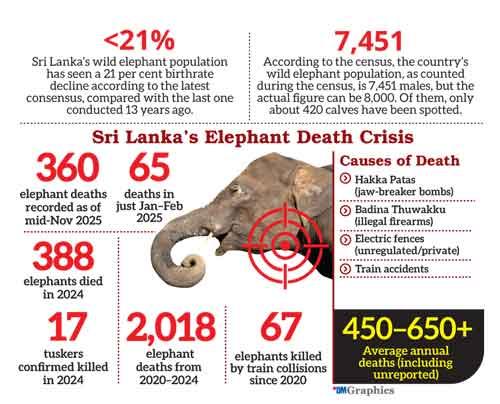
Director General of Wildlife Conservation Ranjan Marasinghe confirmed that the survey shows a “clear decrease in the growth rate of wild elephants,” raising concerns over long-term population sustainability.
The report also indicates that around 360 wild elephant deaths have been recorded so far this year. However, fatalities among humans due to elephant attacks have shown a decline.
The 2024 survey spanned 12 wildlife zones, excluding the Western Wildlife Zone, and faced delays of more than 15 months due to administrative and logistical issues.
Conducted from August 17 to 19, 2024, the island-wide survey covered 3,130 observation points, using five time frames across day and night. Data collection involved officers from the Wildlife Department, other state institutions, universities, the Civil Defence Force, and the security forces. Teams operated from elevated platforms and protected locations to ensure safety in elephant habitats.
However, some wildlife experts have criticised the survey, calling it “unsuccessful” due to alleged heavy rains during the count, which they claim made accurate observation difficult.
Responding to the criticism, DG Marasinghe said that while an exact count of wild elephants is not fully achievable, the survey provides “hypothetical but valuable data” to track trends and plan conservation strategies.
Officials emphasise that the survey is not a traditional census aimed at determining the exact number of elephants, but a comprehensive data-gathering effort to assess:
- Elephant population growth patterns
- Herd structures
- Distribution of males and females
- Numbers of adults and juveniles
- Movement patterns inside and outside reserves
This information will be used to design strategic plans for long-term conservation and to mitigate human–elephant conflict, which remains one of the country’s most pressing wildlife issues.
Sri Lanka last conducted a nationwide elephant census in 2011, which estimated a population of around 5,000 elephants. The 2024 survey, carried out at significant cost and under challenging field conditions, marks the first such undertaking in more than a decade.
The Department of Wildlife Conservation is urging the public and experts not to misinterpret the exercise as a precise census, noting that counting every wild elephant with 100 per cent accuracy is not feasible.
The full report, detailing the findings and future conservation recommendations, is expected to be published within the coming week.