Reply To:
Name - Reply Comment
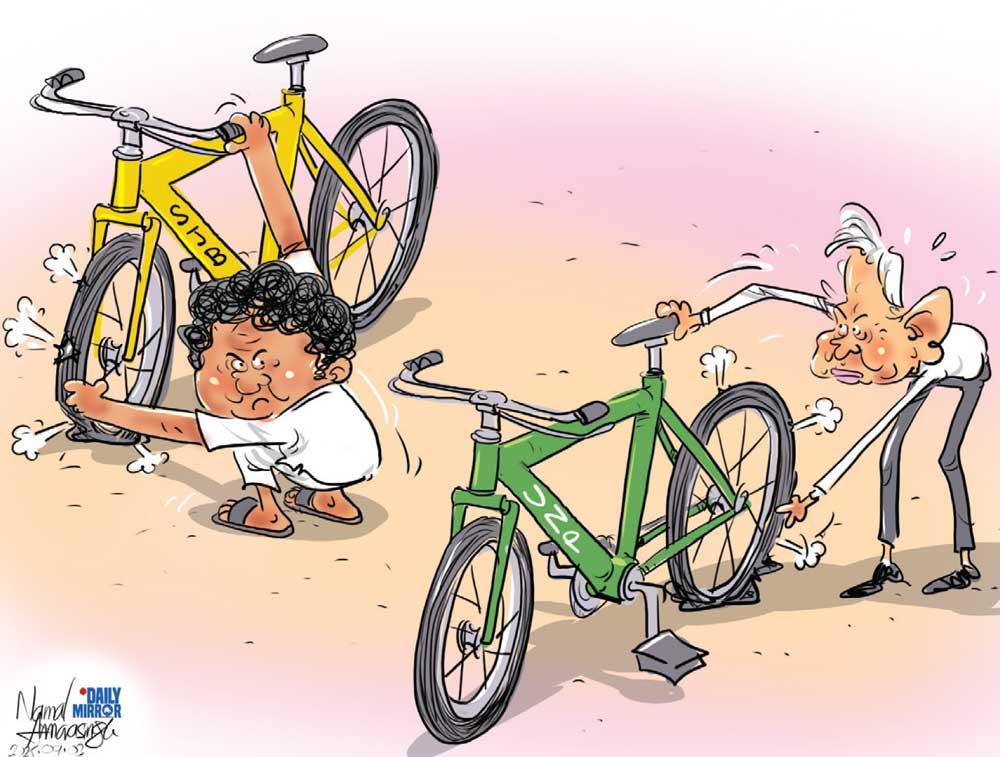
The cartoon portrays two politicians, each straining desperately to move bicycles labeled SJB and UNP. Instead of pedaling forward, both figures are locked in a futile struggle—their faces twisted with effort, their bodies tense, yet their bikes remain stuck in place.
The imagery is deceptively simple yet deeply symbolic. Bicycles are vehicles of progress: they move only when there is coordination, balance, and forward motion. Here, the bikes represent political parties meant to carry their movements and their voters forward. But instead of advancing, they are paralyzed by friction and rivalry. The squeaking wheels suggest strain without momentum, sound without movement.
The two politicians embody not just competition but dysfunction. Both appear stubbornly focused on their own ride, unable—or unwilling—to see that they are exhausting themselves in isolation. In politics, such stubbornness mirrors parties clinging to their own power bases rather than building coalitions or offering coherent alternatives. The result is a spectacle of exertion without achievement.
The cartoon cuts deeper into the nature of political leadership: when parties focus more on internal rivalry and survival than on direction, citizens are left stranded. A bicycle that doesn’t move is useless, no matter how brightly painted. The effort becomes performance rather than progress.
This image, at its core, is a warning about stagnation. Political cycles become literal circles—lots of pedaling, no forward journey. And in the end, the people who need the transport—the voters—are left walking alone, while their leaders remain locked in a sweaty, unproductive contest of wheels that go nowhere.
The bigger question is clear: how long can citizens watch leaders wrestle with bicycles when what they need is a road forward?