Reply To:
Name - Reply Comment
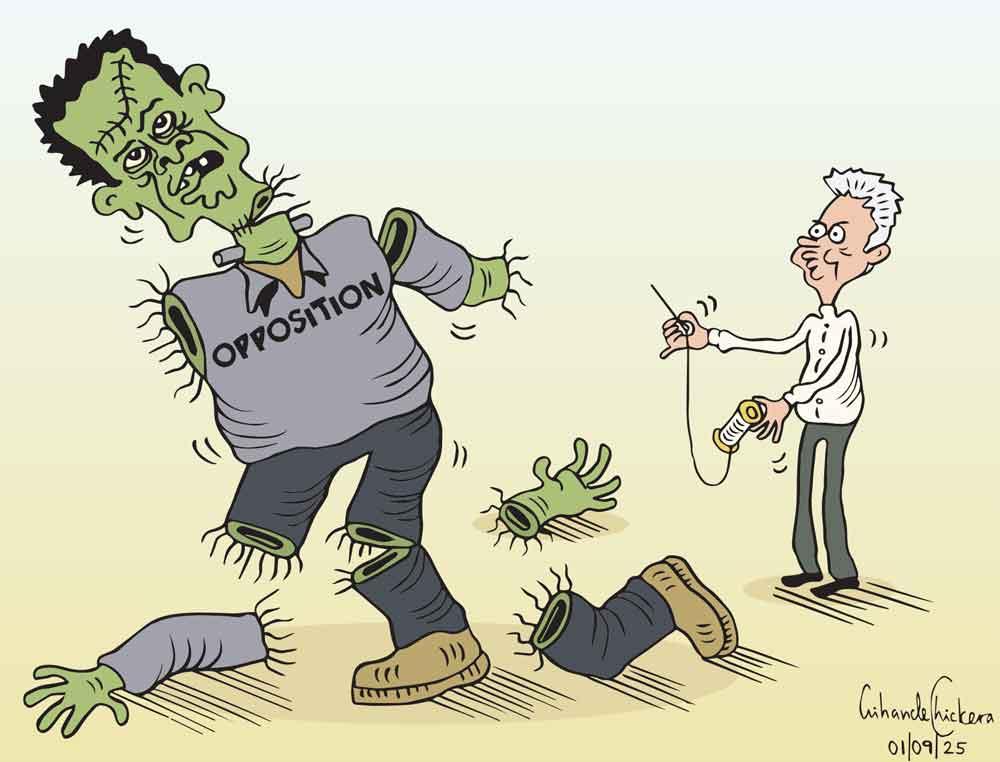
This cartoon delivers a darkly humorous yet piercing critique of the state of politics. A monstrous figure, stitched together like Frankenstein’s creature, lumbers awkwardly with missing limbs and a grotesque expression. Its shirt is labeled Opposition. On the side, a grinning politician holds a spool of thread and needle—ready to stitch, re-stitch, and keep this monstrosity alive.
The symbolism is sharp. The Opposition is portrayed not as a strong, coherent force, but as a disjointed, patched-up body cobbled together from mismatched parts. Limbs lie scattered on the ground, suggesting fragmentation, infighting, and lack of direction. Instead of an organic movement, it is a stitched construct—kept alive artificially, unable to stand firmly on its own.
The politician with the needle represents the manipulator—perhaps a ruling figure or rival leader—who thrives on keeping the opposition weak yet alive. By piecing it together just enough to stumble forward, he ensures it can neither mount a serious challenge nor completely disappear. It is a strategy of controlled survival: the opposition is allowed to exist, but only as a dysfunctional parody of itself.
The Frankenstein metaphor deepens the critique. Just as Mary Shelley’s creature was feared and pitied for its unnatural creation, this “Opposition” is presented as both grotesque and tragic—an entity with potential for strength, but crippled by its flawed construction. Instead of inspiring hope, it inspires ridicule.
The larger political insight is sobering: a democracy without a strong opposition is itself a stitched-up monster. Without real checks and balances, the ruling class can shape the opposition into whatever form best suits their grip on power. The system then becomes less about accountability and more about performance—an ugly spectacle of stitched limbs rather than a contest of ideas.
The cartoon leaves us with a question as unsettling as the image itself: is the opposition failing on its own, or is it being deliberately kept weak by those who benefit from its dysfunction? Either way, the monster is not frightening the rulers—it is frightening democracy itself.