Reply To:
Name - Reply Comment
Tells local industries to be more productive
By Chandeepa Wettasinghe
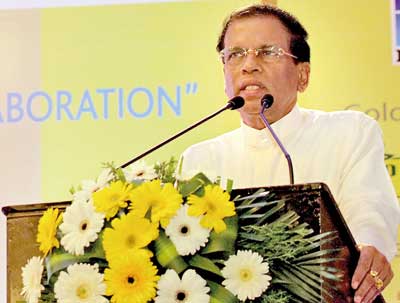 President Maithripala Sirisena highlighted the need for a customer-centric, market driven, competitive economy to which the local industries must adapt instead of resorting to protectionism, while delivering a speech at the inauguration of the 6th Ceramic and Glass Symposium.
“Our local industries are in a sad state, even though we have had a proud history of thousands of years during which we didn’t import anything. The global powers today have developed all their industries as one nation. But we are the opposite. We are only thinking about the past and being proud and nostalgic. Are we going to create a proud future?” President Sirisena asked.
He noted that the local culture has now transcended the local/foreign debate of the 1950s and the 1970s, and people are now looking for goods and services that benefit them.
The comments of the President come as protectionist elements which thrived under the previous regime continue to ask for further concessions.
Protectionism has led to a decline in competitive and productivity spirit in the local industry, while industrialists continue to profit from inefficient processes at the cost of the consumer, while high quality, cheap foreign products are taxed heavily to be beyond consumer purchase levels.
“The government has the power to increase or decrease import tariffs, but the people ask for high quality. So, there you have the power to change and
influence your future. If you want to create high quality, competitive products, the government will support you,” President Sirisena assured.
His policy appears to be falling in line with the new UNP policy of people-led, knowledge-based, highly competitive social market economy.
Last week, the President called on local industrialists to do away with traditional, low productivity models and to adopt high-tech, productivity-based processes, sentiments which were reinforced yesterday as the Ceramics and Glass Council called for anti-dumping laws.
“All politicians, public servants and the industry must think of, and have genuine feel for improving local industries. They need to upgrade local products with value addition and competition, find the markets, and export to improve foreign exchange. For that we need national policies,” the President said.
He added that ceramic exports currently account for just 0.1 percent of the country’s total exports and said that the government is open to constructive dialogues to uplift industries.
Sri Lanka’s tile and ceramic manufacturing sector is protected by high import tariffs.
Business magnate Dhammika Perera is said to be controlling around 80 percent of the market share in tiles and ceramics through Royal Ceramics PLC and its subsidiaries and associate companies.
Currently, an import tariff of 74 percent is imposed on most ceramic and tile products.