Reply To:
Name - Reply Comment
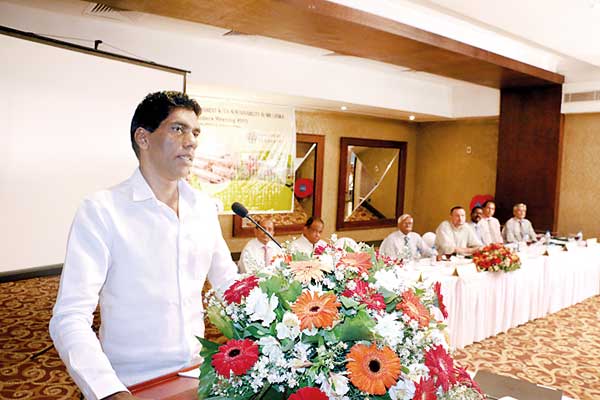
The current crisis in the plantation industry is caused by worker union leaders and politicians manipulating workers to achieve their own ends, according to the Plantation Industry Development Minister, who was speaking at a tea sustainability and decent work environment promotion forum organized by the Institute of Social Development in Kandy (ISD).
“The trade union leaders and politicians, to their own benefit, are manipulating the workers. The union leaders try to incite the workers by saying the workers can get Rs.2000 from RPCs (Regional Plantation Companies),” Palani Digambaram, who is also a union leader said.
He noted that RPCs are justified in not being able to give more wages due to the global price slump and the crises in the Middle East and Russia—Sri Lanka’s biggest tea markets. However, he added that workers do require greater care and comfort.
Digambaram said that 3 parties are responsible for the development and sustainability of the tea industry; the workers, the worker union leader and the RPCs.
“In my opinion, no one should come in and mediate. Let the 3 parties decide within the industry, because there are other people across the country in plantations and agriculture, but only the tea plantation workers are asking for more and having big hopes. They (leaders) are going to destroy the industry by keeping these unions,” he said.
Digambaram said that he had asked workers to oppose the ongoing ‘go slow’ action, but was called a traitor. He noted that while many within the estates opposed the strike, violence had erupted between those for and against it, leading to the community putting aside differences and presenting a united front.
“If the 3 parties don’t resolve this through negotiations, it won’t take 100 or 50 years, the industry will die in 25 years,” he further added.
The 23 RPCs represented by the Planters Association of Ceylon (PA) too have feared the same for the past few years, as labour already accounts for 70 percent of the tea production, and trade unions continue to ask for more, despite Sri Lanka being considered the least productive tea producer in the world.
PA had forwarded 2 proposals linking labour to productivity to the trade unions, both of which were turned down last week, leading to the ‘go slow’ motion calling for a basic wage increase to Rs.1,000 from the present Rs.620. PA in response closed off the tea factories and evacuated supervisory staff.
RPCs say that they take care of workers and their dependents totalling 1 million from the cradle to the grave, but are concerned over the rising alcoholism linked to increasing wages.
Meanwhile, ISD Chairman P. Muthulingam expressed that a continuous dialogue should have been present ideally. “There should be a continuous social dialogue between the community, politicians and the private sector. Earlier, the Labour Ministry tried to do it, but the trade unions opposed. ‘What’s this social dialogue,’ they asked,” he said.
Meanwhile, younger generations growing up in the tea estates have left their traditional trade to seek better opportunities.
“Today, saying they’re getting less pay, the young people are going to Colombo, Kandy, Jaffna and abroad. In one of the estates where my union members work, there were 300 workers 5 years ago. Now there are 60. We’ll have to bring workers from outside in the future if this continues,” Digambaram noted.
Plantation Infrastructure Ministry Secretary V. Sivaghanasothy said that a cabinet appointed committee is currently evaluating the industry as a whole; from the worker welfare up to global promotion. (CW)