Reply To:
Name - Reply Comment
 The proposed additional tariffs on the US imports from Canada, China and Mexico went into effect early Tuesday morning (March 4), paving the way for a trade war between the US and major trade partners. In addition, the Presidential Memorandum on Reciprocal Trade and Tariff of the United States (US) has called for studies on the ‘unfair trade practices’ of the US trade partners to determine reciprocal tariff rates as a counter measure. This means that, if the EU has a 10 percent automobile tariff, the US reciprocal tariff would also be 10 percent, matching its trade partner’s tariff.
With the US having roughly about 13,000 tariff lines, 200 trading partners and about 2.6 million individual tariff rates, if the proposed reciprocal tariffs are fully implemented, this complex tariff system may have unprecedented effects on the global economy. This could then potentially lead to retaliation from the trade partners.
The threat of reciprocal tariffs could also potentially cause a trade war between the EU and US with the EU likely to decrease imports from countries like Sri Lanka, making sustainable export growth in a more protectionist global economy more difficult for countries like Sri Lanka.
Tariff threats are also being used as a bargaining tool and the US may stop implementing high tariffs in exchange for concessions from major trade partners.
The possible disintegration of the current global free trade system, which may be inevitable if the US implements broad-based tariff hikes, is a great and immediate concern for Sri Lanka, as it is a small economy with limited domestic demand and a high dependency on external value chains.
Given that the US accounts for a quarter of exports from Sri Lanka, if the US government goes ahead with reciprocal tariffs, how would the said reciprocal tariffs impact Sri Lanka’s exports?
Reciprocal tariff rates: How will US determine these rates?
The Office of the US Trade Representative (USTR) lists various policies as ‘unfair trade practices’, providing flexibility for the US authorities to determine the reciprocal tariff rate. These include high tariffs, value added taxes (VAT), non-tariff barriers, subsidies, burdensome regulatory requirements, exchange rate interventions and any other practice deemed by the USTR. The US plans to complete all the studies on unfair trade practices by April 1, 2025.
The flexible definition of what constitutes unfair practices and the inclusion of domestically applied taxes like VAT have injected substantial uncertainty into the global trade system. Over 170 economies worldwide have VAT, which is a significant revenue source for their governments. VAT is imposed non-discriminately, regardless of the product’s origin. If VAT is included in the US reciprocal tariff, the tariff hike will be larger for any economy.
Reciprocity of tariffs: How will they affect Sri Lanka?
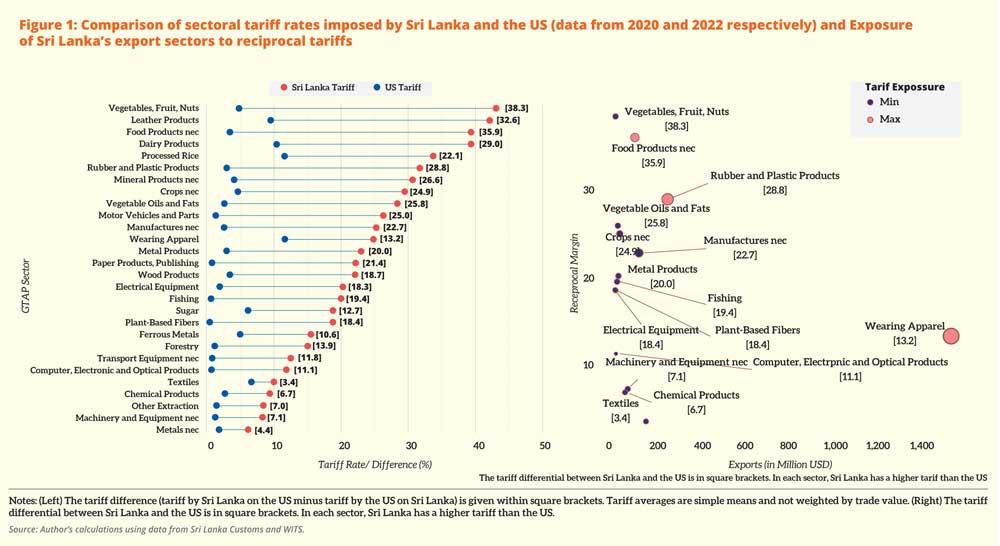
Ignoring VAT, subsidies and exchange rate interventions, reciprocity can be simplified to import tariffs and para-tariffs. Sri Lanka has general custom duties, an Export Development Board cess, excise duty, port and airport development (PAL) and social security contribution levy. Once the product level tariff rates are calculated on an ad valorem basis, Sri Lanka has a higher tariff rate than the US for almost all sectors (Figure 1).
This implies that if the US raises the tariffs reciprocally, Sri Lanka will be affected directly by the increased price levels in the US market (Figure 1). As the magnitude of the negative export effect coming from a reciprocal tariff depends on the tariff differential – i.e. the percentage points of tariffs Sri Lanka charges more than the US – industries such as wearing apparel, rubber and plastic products and food products will be more vulnerable to the reciprocal tariffs.
The export effect of tariff hikes can be estimated once the reciprocal tariff rates are announced, as the magnitude of the effect on Sri Lanka’s exports depends on the relative price change compared to the competitors in the US market. Moreover, a uniform coverage across all products may not happen, given the inflationary outcome of a tariff. In the first trade war, although the US announced tariffs on apparel and footwear in August 2019, it was not implemented.
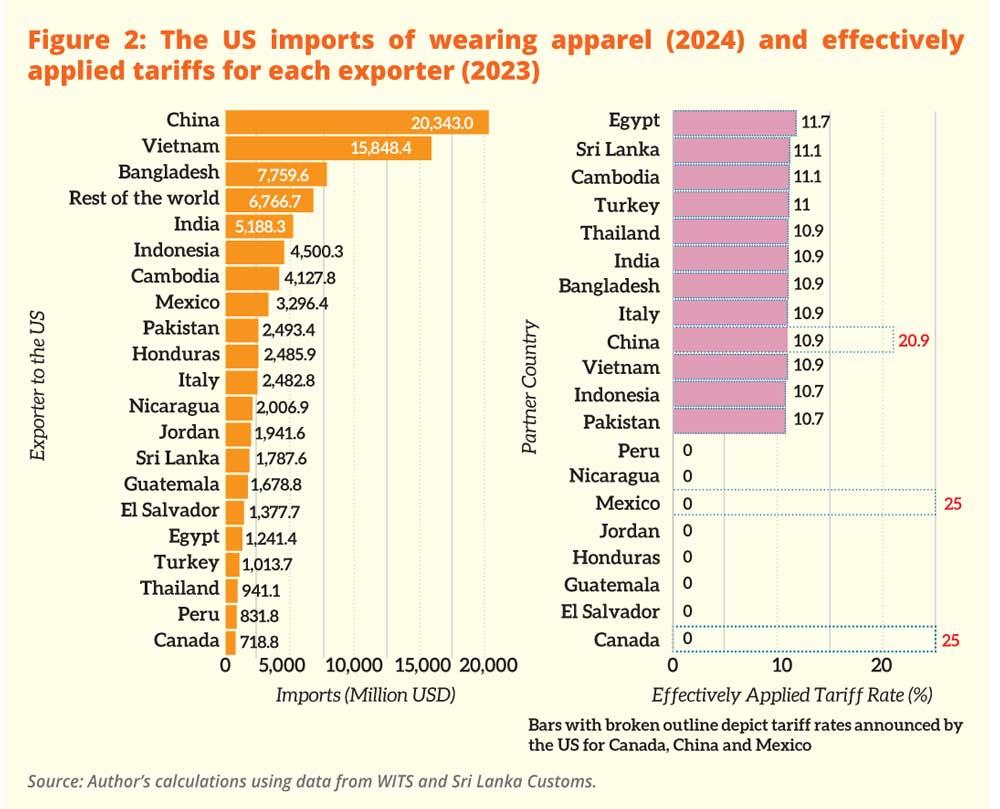
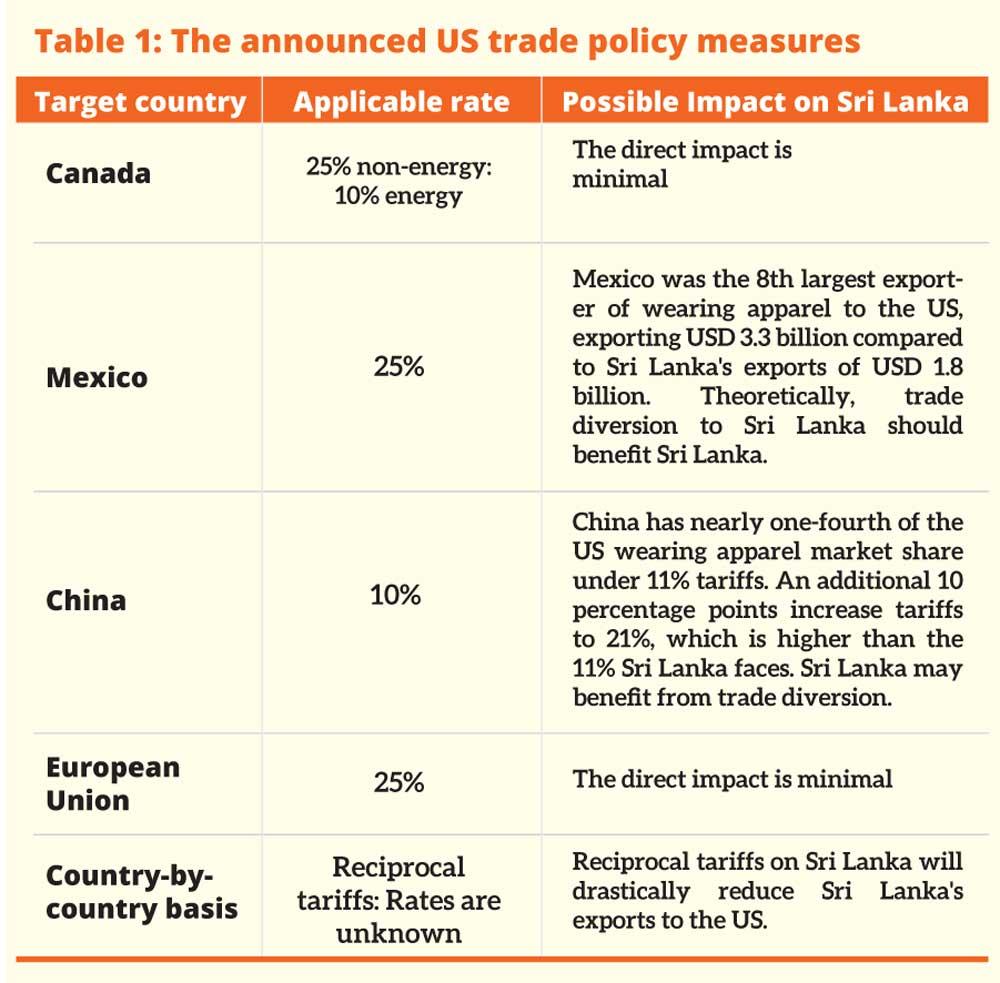
The reciprocal tariffs, among the other policies announced by the US in 2025, should be evaluated under different policy scenarios (Table 1). For instance, if Sri Lanka’s key export competitors face a higher relative tariff hike, Sri Lanka may benefit. Under the assumption that Sri Lanka will not face a tariff hike and the US will focus on large trade partners, the likely effect on Sri Lanka, due to trade diversion, might be positive. For example, the apparel exporters to the US, such as China and Mexico, are directly targeted for higher tariffs. At present, Mexico enjoys zero apparel sector tariffs under the United States-Mexico-Canada trade agreement (Figure 2).
However, the proposed tariffs on Canada, China and Mexico are estimated to cost a typical US household US $ 1,200 annually. The higher prices, alongside the recessionary impacts from retaliation and supply chain disruption, will negatively impact most US households, reducing import demand. This may dampen the positive gains from any anticipated trade diversion. Similarly, an EU-US trade war will affect the EU economy too, dampening the import demand, including from countries like Sri Lanka.
The US reciprocal tariffs, retaliations and dysfunctional multilateral organisations will break the post-GATT/WTO liberal trade system. Maintaining a sustainable export growth in a more protectionist global economy will be increasingly difficult for a country like Sri Lanka.
Sri Lanka’s options: Phasing out para-tariffs and tightening trade relations
A closer look at Sri Lanka’s tariff data shows a heavy reliance on para-tariffs and special commodity levies (SCL). There are plans to phase out para-tariffs and replace the SCL with VAT. Under the Singapore-Sri Lanka Free Trade Agreement too, Sri Lanka has currently phased out a portion of cess and PAL.
Under the Sri Lanka-Thailand Free Trade Agreement also, para-tariffs are planned to be phased out. Proceeding with such measures and broadening to all trade partners will reduce the differential tariffs between Sri Lanka and the US. Overall, eliminating para-tariffs in the long run can reduce the anti-export bias in the economy, incentivising production for exports.
A more immediate and greater worry for Sri Lanka is the possible disintegration of the current global free trade system, which may be inevitable if the US implements broad-based tariff hikes. As a small economy, with limited domestic demand and dependency on external value chains, Sri Lanka’s future growth will be drastically affected in a world where countries plunge into protectionism and beggar-thy-neighbour tariff practices.
Anticipating such global circumstances, Sri Lanka needs to tighten trade relations with the regional partners, particularly with the growing middle-income countries in East Asia. Continuation of negotiations for free trade agreements (FTAs) with East Asian economies and for a more effective Indo-Sri Lanka FTA are sound strategies Sri Lanka may take. Removing the existing hurdles like quotas for apparel sector in the Indian market will yield benefits from the growing middle-class demand in India.
(Dr. Asanka Wijesinghe is a Research Fellow at the Institute of Policy Studies, with research interests in macroeconomic policy, international trade, labour and health economics. He holds a BSc in Agricultural Technology and Management from the University of Peradeniya, an MS in Agribusiness and Applied Economics from North Dakota State University and an MS and PhD in Agricultural, Environmental and Development Economics from The Ohio State University. He can be reached via [email protected])