Reply To:
Name - Reply Comment
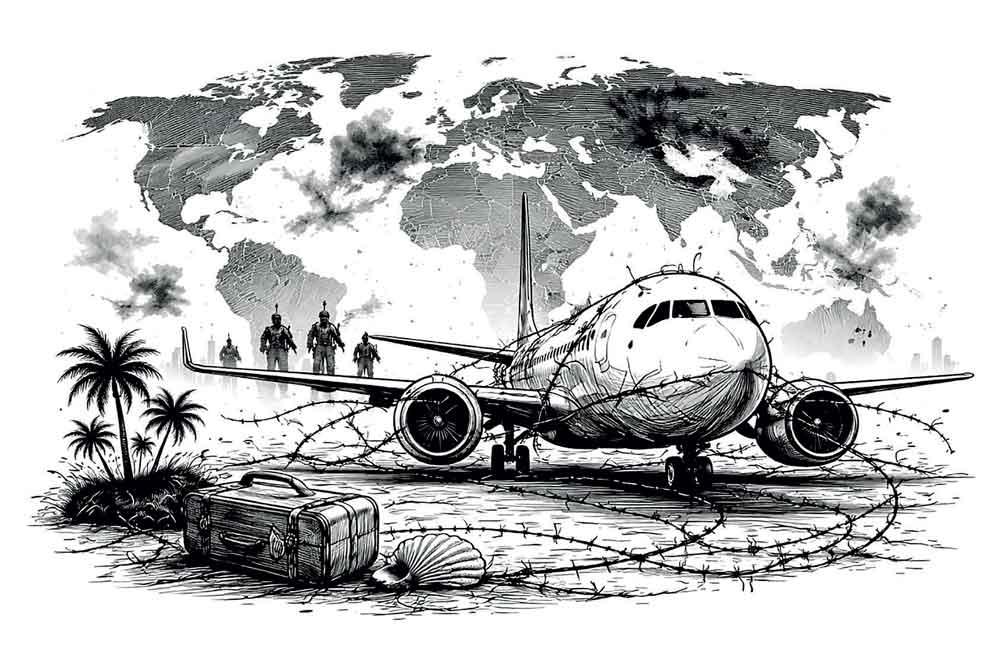
 The war in the Middle East is into its fourth week now and there seems to be no abatement. On the contrary it seems to be escalating. Prices of crude oil and gas are skyrocketing, as well as most other essential goods, due knock-on effect and severe supply chain disruptions and increasing shipping costs. Travel to Europe and West via the Middle Eastern hubs is in disarray, and airline costsare also rising.If the war prolongs, the situation will be disastrous and the world economymay face recession. Experts say that even if the war were to end tomorrow, the economic fallout will be felt for at least six more months.
Under these circumstances Sri Lanka is now rather precariously faced. We werejust beginning to stabilise with our macro indicators indicating a comforting story, with low inflation, improved reserves, stabilised rupee, and tourism and remittances showing strong growth. However the after effects of the economic crisis and the more recent cyclone are still prevalent with rising levels of poverty and malnutrition.
Hence the Middle East conflict could not have come at a worse time for Sri Lanka. It is hitting us exactly where we are most vulnerable. Fuel imports, aviation connectivity, tourism flows, freight costs, and remittances. The government’s move to ration and raise the price of fuel and curtail activityis precautionary, and sending a clear signal that the system is under strain and that it is trying to manage the unfolding situation..
Certainly we are still not in a full blown crisis as yet. But we still remain highly sensitive to the risks. If the disruption is short-lived, Sri Lanka will take a hit and manage to continue its recovery. If it drags on, the country risks a slow squeeze, of higher cost of living, pressure on forex, reduced tourism, and renewed stress on households, stagflation and possibly a full blown economic crisis.
So in the best case scenario we are going to have a 90-180 day structural disruption period.
What should we do?
There are two extreme schools of thought:‘Carry on normal activity ‘ or ‘shut down and hunker down’.
Carry on normal activity - Resonates well with the general Sri Lankan ‘island mentality’ of ‘make hay while the sun shines’. Continue with ‘tamashas’ and parades, full blown entertainment activities and night life. This may be psychologicallycalmingfor society in general, and gives a sense of ‘normalcy’, but definitely not recommended in an impending crisis situation like this. These are not ‘normal’ times that are unfolding. Such an option will lead to faster depletion of finite resources and the crisis will hit us quicker.
Hunker down - This is also not recommended. The full crisis has not hit us as yet. There is no need to shut down and retard economic activity, like what happened during the CoVid lockdown as yet. It will be self-inflicted damage, which will choke economic activity, destroy confidence, and deepen the downturn.And it will of course have a major psychological impact on society as we saw during the Lockdown in 2020.
Both paths lead to the same place by different routes.
Butlet’s not kid ourselves. This is unfolding into a major worldwide issue. The current government should not be blamed. We are not alone in this.and it will be a slow burner. The average person Sri Lanka has no in depth knowledge about the actual economic fallout. All they see is that there was a petrol shortage and queues, which now seems to have been resolved. ‘So let’s continue to grumble and scold the government, and get on with our life’!
Hence what is now required by the authorities is to accept reality and stop defensive thinking, and implement a well-planned, disciplined and controlled slow down. They need to give leadership to the country, and communicate honestly to educate the general public on the actual situation, rather than play politics.
Communication is key to managing the unfolding situation. During COVID, the greatest damage was not isolation but it was uncertainty. People will, by and large,tolerate inconvenience, but they find it difficult to tolerate not knowing what comes next.
Sri Lanka is a fuel-constrained, import-dependent economy. When oil prices rise and supply becomes uncertain, and there is a crisis in the making, and adjustment cannot be avoided. The question is not whether to adjust, but how but how intelligently we do it.
A controlled slowdown simply means aligning economic activity with available resources, without killing the momentum. It is by no means an easy task. On the one hand we must ensure that essential economic activity is not curtailed. On the other, we need to conserve our limited resources over time.
I think the government is on the right track, albeit a bit ‘slow of the blocks’.
We have already
 declared a four-day working week (although it could have been a work-from- home day instead of a holiday)
fuel is being rationed, with strict limits on usage and price adjustments made,to be more aligned with global markets
public transport is being curtailed and restricted to essential travel during weekends (it is should be implemented more strictly)
It is a demand suppression strategy.
What next?
The measures so far implemented are bound to generate wrong signals to the outside world. There will be concern from international business partners and tourists in particular, is Sri Lanka ‘closed’? When people see fuel rationing, compulsory holidays and reduced transport they immediately think ‘crisis’.
So firstly there should quick and clear clarification through formal government communication channels that these are only contingency measures, and that Sri lanka is not in crisis.
Secondly, some of the following additional cost management measures must be implemented in the next few weeks.
Selective petrol rationing (limits for owners with more than one vehicle)
Incentivise car-pooling, employer-run transport and structured ride sharing
Optimise public transport with new schedules and routes as demanded for greater efficiency
Prioritise and rationalise rail transport in and around Colombo and suburbs (more short distance trains)
Use more rail transport for freight
More work-from-home options and staggered working hours
Implement mandatory limitation of air conditioning (setting temperature to 26 deg. C) and other energy saving measures Selective power (load) shedding (not power cuts )
Suspend all non-essential long distance travel
Defer all travel abroad for government officials except in exceptional circumstances.
Cut back on all high energy requiring events such as concerts and entertainment programs
The above interventions will no doubt be unpopular and difficult to cope with. But the focus must be on conservation.
It is a behavioural adjustment that is needed at national level. We need to certainly start ‘tightening our belts’ but at the same time ensuring that essential economic activity continues as best as possible. And we need to ensure that we manage the negative psychological impact on society that some of these austerity measures will bring in its wake.
Government, Opposition, businesses, and individuals all have to respond unitedly with a carefully managed, controlled deceleration, until the external storm passes. This is a national crisis that is looming. It is time for a united response from our politicians.
(The writer is a tourism practitioner and strategist with over 25 years experience in the hospitality industry)