Reply To:
Name - Reply Comment
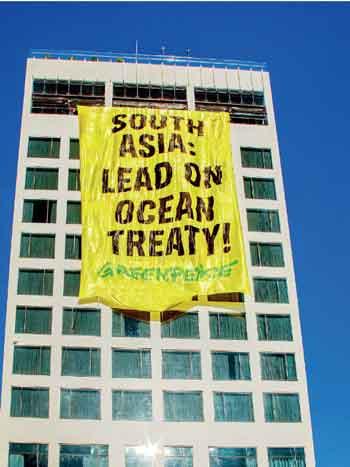 Greenpeace South Asia delivered a strong message for ocean protection on the eve of Sri Lanka’s National Day celebrations in Colombo, where the regional states leaders and representations gathered to honour the country’s independence, declared on February 4, 1948.
A large banner reading ‘South Asia: Lead on Ocean Treaty!’ was deployed on one of the prominent high-rise hotels in Colombo to welcome the positive steps by regional leadership in favour of the Global Ocean Treaty that will allow the creation of large-scale sanctuaries on the high seas.
In September 2024, at the UN General Assembly, both Bangladesh and the Maldives ratified this new treaty — formally known as the Agreement on Biodiversity in Areas Beyond National Juris-diction (BBNJ) — and India also confirmed its signature, when Nepal signed the year before. To complete the picture, last December, Sri Lanka in turn committed to sign and ratify the BBNJ Agreement.
“By taking this step, the Bay of Bengal nations are demonstrating bold, forward-thinking leadership in protecting marine biodiversity on the high seas and combating climate change. This commitment not only safeguards the livelihoods of their people today but also ensures a healthier, more sustainable future for generations to come,” said Greenpeace South Asia Campaigner Anita Perera.
The oceans cover 71 percent of the Earth’s surface; they host most of the biodiversity and represent the largest carbon sink on the planet and have so far absorbed more than 90 percent of the excess heat from human greenhouse gas emissions. Yet, they are facing multiple threats, from overfishing, mining, pollution, acidification and record water warming, which further leads to coral bleaching, shifts in marine species distribution, sea ice loss, sea level rise and extreme weather events. As a result, their ability to cope and absorb as much carbon dioxide to keep pace with human emissions is being compromised, which can only exacerbate climate change impacts. In contrast, the global Ocean Treaty will facilitate the declaration of large protected areas over key marine ecosystems to support their resilience and achieve 30 percent protection of the high seas by 2030.
“The oceans are critical for people’s livelihoods and food sovereignty but also to mitigate the dire consequences of climate change and extreme weather crisis that have become the norm in South Asia and elsewhere: cyclones, heatwaves, droughts, floods and landslides to name a few. Now is the time to curb fossil fuel emissions and preserve our best climate ally, the ocean,” said Greenpeace South Asia Deputy Programme Director Avinash Chanchal.
“In this period of celebration for Sri Lanka’s Independence Day, we are acknowledging all the recent efforts made by our governments but also urging them to ensure the full ratification of the Global Ocean Treaty on time for the UN Ocean Conference in June 2025, in order to enable protection measures with effective impact in the short term,” added Perera.