Reply To:
Name - Reply Comment
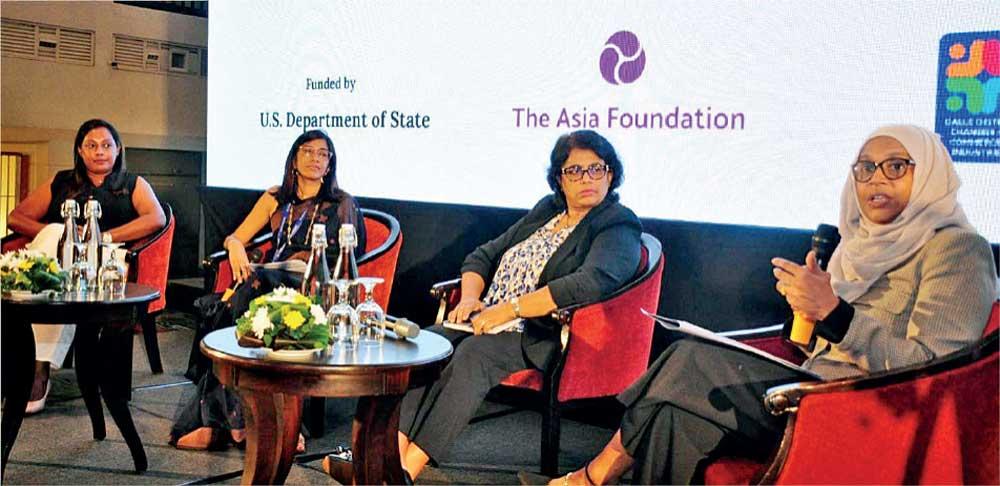
Good Market Founder Achala Samaradivakara, WUSC Country Director Mumtaz Faleel, WCIC Chairperson Gayani De Alwis and Moderator Zahra Cader
By Nuzla Rizkiya
Sri Lanka’s female labour force participation rate in the domestic workforce has dropped from 32 percent to an all time low of 29 percent, according to Women’s Chamber of Industry and Commerce (WCIC) Chair Gayani De Alwis.
The drop marks a troubling indication in the country’s efforts towards gender equality and the inclusion of women in formal economic activities given that the island shelters a local population in which 52 percent are women.
Sharing the update at a panel discussion organised by the Asia Foundation this week, De Alwis suggested that the drop in statistics may be due to women’s contribution in the informal sector not being captured in official data.
“Recent statistics show that female labour force participation has dropped to 29 percent for the first time ever. This is a bit of a dire situation for the country. Women do face a plethora of challenges in the formal labour force such as the triple burden of work. But very often, women in the informal sector are not recognised for their contributions,” De Alwis said.
To counter this issue she suggested that advocates should not mix entrepreneurship with livelihood development as this distinction would help policymakers better understand the unique challenges faced by women and direct their support more effectively to those who need it the most.
Reiterating De Alwis’s sentiments at the same panel was World University Service of Canada (WUSC) Country Director Mumtaz Faleel who revealed that a recent survey conducted by the organisation showed that 80 percent of women-led MSMEs in the Northern Province are not formally recognised as their income levels fall below the national definition of a micro and small enterprise (MSME).
“If financial products for SME support programmes are being developed based on this national definition, then Sri Lanka is missing out on a significant part of its potential, leadership and its strength that could contribute to economic recovery,” Faleel said.
Her opinion was reiterated at the panel by Good Market Founder Achala Samaradivakara who said the categorisation of livelihood and entrepreneurship within the same framework prevents the promotion of high-potential women entrepreneurs as many low-income women in the country engage in entrepreneurship as a source of basic livelihood.
“Most donor agencies now invest in livelihood development instead of entrepreneurship which I think is why we face challenges in promoting and identifying real women entrepreneurs. So, targeting these financial products to the correct people is a necessity,” Samaradivakara stressed.
The experts made these remarks at the event to mark the culmination of a three-year project carried out by the Asia Foundation to support 300 vulnerable and marginalised women entrepreneurs across five districts in the country.
The U.S. State-funded project is set to embark on its second phase to uplift 50 selected women-led SMEs to the export level through extensive training, seed funding and mentoring sessions.