Reply To:
Name - Reply Comment
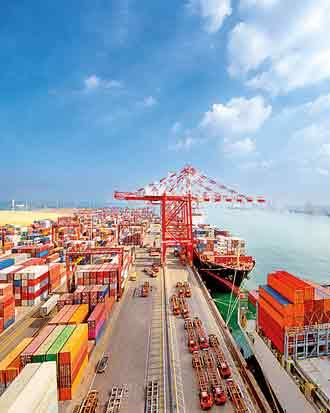 South Asia Gateway Terminals (SAGT), Sri Lanka’s pioneering public-private partnership container terminal, published its 2025/26 sustainability report titled ‘Staying The Course’.
The report marks the company’s seventh consecutive annual sustainability disclosure, reaffirming its commitment to embedding environmental, social and governance (ESG) principles into its core business strategy.
As the only terminal in the Port of Colombo to consistently publish an independently accredited sustainability report aligned with the global standards, SAGT continues to set benchmarks for responsible terminal operations.
In the financial year 2024/25, SAGT handled 1.8 million TEUs. This performance was achieved amidst strategic infrastructure investments and evolving market conditions, including the commencement of operations at a new terminal within the Port of Colombo and Strait of Hormuz crisis during the latter part of the reporting period. Despite these conditions, SAGT operated significantly above its original design capacity of 1.1 million TEUs.
A key infrastructure milestone during the year was the successful completion of a major quay crane rail replacement project from October 2025 to March 2026. This upgrade strengthens long-term crane reliability, safety and handling capability, helping future-proof terminal operations.
Decarbonisation remains a strategic priority for SAGT, with targeted initiatives continuing to reduce greenhouse gas (GHG) emissions while improving operational efficiency. As a result of the sustained efforts across its operations, SAGT achieved a 21 percent reduction in GHG emission intensity against its 2019/20 baseline by end-2025/26, reflecting meaningful progress in its long-term decarbonisation pathway. This reduction has been primarily driven by targeted Scope 1 emissions reduction initiatives across the terminal operations.
A major driver of this progress has been the hybridisation of SAGT’s Rubber Tyred Gantry (RTG) crane fleet, with 28 of its 31 cranes hybridised. Each hybrid unit consumes less than half the fuel compared to a conventional equipment, with the fleet using approximately 58 percent less diesel per move, significantly reducing the Scope 1 emissions while improving operational efficiency.
In parallel, the company is accelerating its transition to electrified equipment through the introduction of two electric forklifts and an electric vehicle for safety inspections, alongside the plans to deploy 30 electric prime mover trucks to further reduce the fossil fuel dependency.
Complementing these efforts, the company’s 460 kW rooftop solar photovoltaic system is now fully operational, generating an average of 44,000 kWh per month and meeting approximately 5 percent of SAGT’s electricity requirements, marking a tangible step towards reducing reliance on the national grid and reducing Scope 2 emissions.
The investment of four new twin-lift ship-to-shore (STS) cranes will increase the twin-lift capability from five to nine units over the coming years. While the increasing operational capacity, the new STS cranes are also expected to improve the energy efficiency per container move, contributing to lower Scope 2 emissions. Complementing these upgrades, the ongoing investments in automation and digitalisation, including terminal gate automation, partial quayside automation through Optical Character Recognition (OCR) technology and a Vehicle Booking System, will improve the truck turnaround times, reducing idling and congestion while enhancing the overall logistics efficiency, thereby contributing to lower the Scope 3 emissions.
SAGT’s environmental commitment extends beyond its operational footprint through initiatives focused on ecosystem restoration and fostering environmental responsibility among the employees and their families. These include the ongoing mangrove restoration at the Benthara River Mangrove Complex in Ittapana and the annual beach clean-up in partnership with the Marine Environment Protection Authority (MEPA), strengthening community engagement in marine conservation.
The company also prioritises best practices in material and waste management and water stewardship across operations. A dedicated hazardous cargo leaking bay further ensures that any incidental leaks are safely contained and managed, preventing environmental contamination and protecting the surrounding ecosystems.
In a landmark achievement for gender diversity, SAGT increased female representation from 4 percent to 6.9 percent over the past two reporting periods. This progress follows the integration of women into operational shift roles in 2024, challenging the long-standing industry norms. The company has set an aspirational target of 10 percent female representation by 2029.
Cultivating a culture of continuous improvement, SAGT completed organisation-wide LEAN Level 01 training for all employees. Through Kaizen events and ‘Just Do It’ initiatives, the teams across functions continue to drive incremental improvements in safety, efficiency and waste reduction.
Workplace safety remains a core priority. The company implemented advanced safety measures, including fatigue monitoring systems in yard cabs and enhanced halo lighting on mobile equipment, aimed at reducing man-machine interaction risks and reinforcing its commitment to ensuring every employee and contractor returns home safely.
SAGT CEO Steen Knudsen stated: “Our seventh sustainability report ‘Staying The Course’ reflects our steadfast approach to navigating a year defined by strategic investment, market evolution and external volatility. The theme captures our belief that consistent execution, rather than short-term reaction, is what drives meaningful progress over time. Achieving robust throughput while delivering a major infrastructure upgrade and advancing our decarbonisation agenda demonstrates that operational resilience and responsible business practices are inseparable. We are particularly proud of our tangible progress in diversity and safety innovation, which strengthens our organisational fabric. As we continue to stay the course, our focus on ensuring sustainability integration into every aspect of our operations will support operational excellence and sustainable value creation for all stakeholders.”