Reply To:
Name - Reply Comment
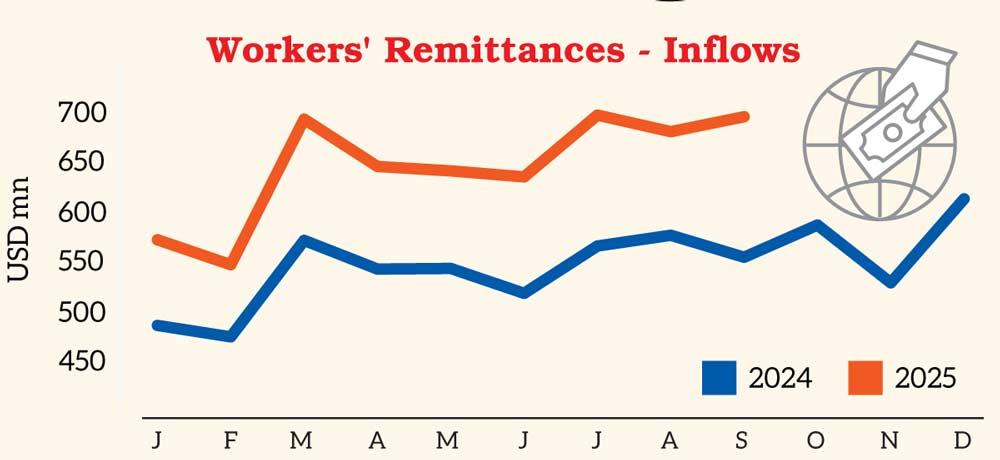
Sri Lankans working abroad sent US$ 695.7 million in remittances in September 2025, compared to US$ 680.8 million in August 2025 and US$ 555.6 million a year ago, in a sign that the year-on-year in growth in the country’s largest foreign income source continues unabated, helping the country to continue to record current account surpluses and also to rebuild buffers to withstand shocks.
The September earnings helped bring the total nine months inflows to US$ 5,811.7 million in remittances, which translated into a robust 20.0 percent growth from the same period last year.
With the current pace continuing, and in fact with more intensity towards the latter part of the year, as emigrants send a little more of their earnings back home for the year-end festive season, Sri Lanka is on course to record somewhere around US$ 7.8 billion in remittances for 2025.
If realised, this is going to be much higher than the US$ 6.58 billion the Sri Lankan expatriates sent back home in 2024 in formal channels, which was 10.1 percent higher than what the country received in 2023.
If realised, 2025 will also be the year with the highest income from remittance in the country’s history.
The Central Bank, although has not made public, their internal projections appear to have around US$ 7.8 billion worth of remittance income for 2025, giving more wiggle room for them to allow a bit more spending on vehicle imports which saw a surge this year.
This was one of the reasons why the Central Bank wasn’t too concerned about the country spending a bit more than what it would allow to be spent on vehicle imports.
However, the demand for vehicle imports are fizzling out as the pent up demand wanes. The higher inflows from exports, which hit a record monthly high in July, record remittances and rising tourism earnings have given the Central Bank to outperform on their net foreign currency purchases and Net International Reserve target agreed with the International Monetary Fund (IMF).
The departing IMF Staff Mission was impressed by the progress made by the Sri Lankan economy and commended the advances made in the real economy, fiscal side, inflation and the reserve building. All evidence points to Sri Lanka’s economic progress as a function of normalisation of the then stalled foreign currency inflows from remittances and tourism and not because of the IMF’s presence here. Some analysts point out that even Central Bank over-reacted in 2022 by raising the interest rates by 700bps, misdiagnosing the then inflation as a function of demand but later they acknowledged that the inflation was mostly and nearly entirely a result of supply side bottlenecks.