Reply To:
Name - Reply Comment
By Kumar Ranaweera
In a volatile world, India is emerging as a stable destination for global capital, said Baker Tilly CEO Francesca Lagerberg, to the Times of India last week. Investors are seeking trusted and stable markets and with the correct positioning, India can exceed expectations, she noted.
Lagerberg’s projection holds ample promise. India has stable GDP growth exceeding 6 percent and is projected to reach US $ 7.3 trillion by 2030. The country also has an enabling regulatory environment – like the Make in India and Digital India initiatives. Furthermore, 68 percent of its population are between the ages of 15 and 64, offering an able and educated workforce that can transform opportunities into action.
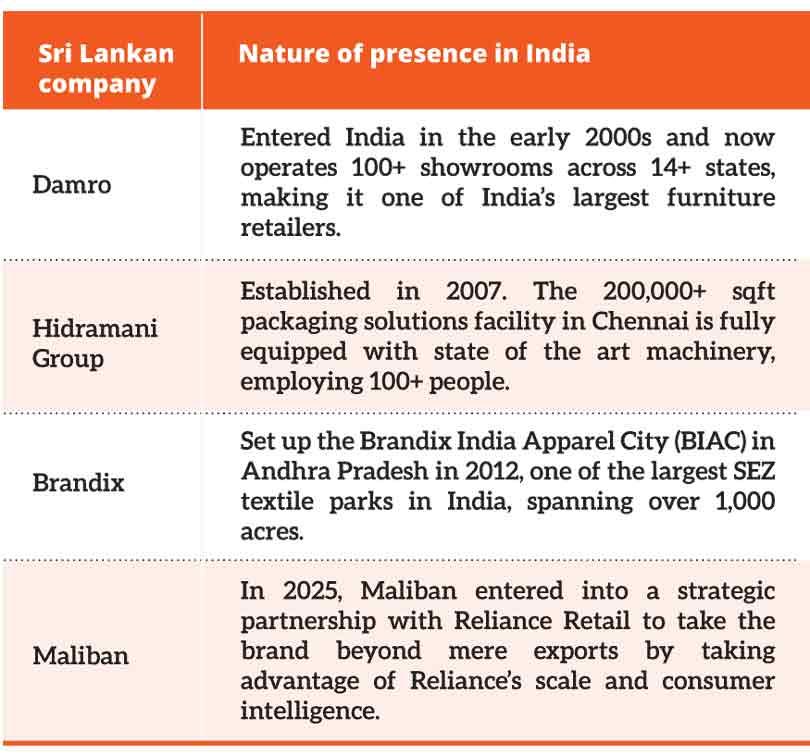
India’s economic boom began in the early 2000s and from there Sri Lanka has been searching for ways to leverage this growth. Progress is slow but there is renewed effort to make good of these favourable developments in our neighbourhood.
A few Sri Lankan companies have realised the promise of ‘Incredible India’ and established strong footholds in the subcontinent, with some choosing to set up manufacturing in India for further export. A low-cost regime, with a workforce exceeding 1.4 billion, plus, favourable tariffs to the EU, UK and now once again the US is attractive to manufacturers.
But India is not just a manufacturing base; it is a marketplace of 1.4 billion consumers. A market that size must hold promise for goods and services made in Sri Lanka. Despite sitting right next door to the world’s largest marketplace, it isn’t any easier to navigate.
The environmental, social and cultural similarities are also mirrored in the goods and services produced. Accordingly, value addition becomes critical to differentiate in the Indian market, where quality and integrated products can become the drivers.
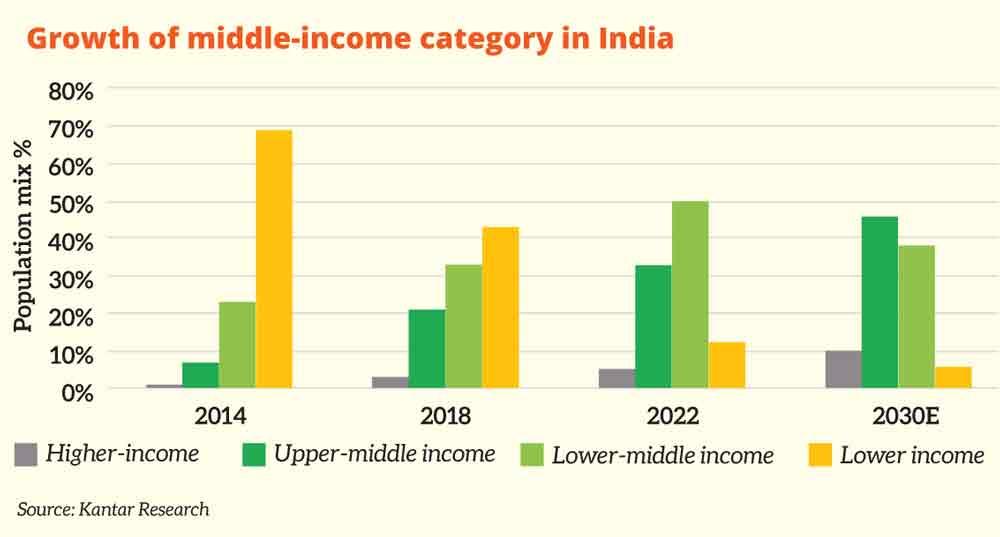
This evolution from being a traditional manufacturing hub towards a destination for value-additions is primarily driven by a rapidly emerging middle-income class that is redefining the country’s economic landscape through a shift from basic survival to aspirational spending. This demographic is demanding specialised services and lifestyle-enhancing products that align with their growing disposable income. For regional partners, this means the true opportunity lies in tapping into this new consumer consciousness, where a focus on differentiation and high-standard offerings can capture the loyalty of a population that is increasingly looking for the best the world - and its neighbours - have to offer.
More Indian businesses have ventured into Sri Lanka, compared to the other way round. The India-Sri Lanka Free Trade Agreement has not quite measured up to bridge the gap. Also, India’s 28 states conjure a massively diverse market where Sri Lankan investors and exporters require guidance and experienced intervention to navigate the localised regulations.
A common mistake, it appears, is that many simply consider India as a marketplace of 1.4 billion. The potential volume and product placement does not translate to automatic profits. Consumer engagement and aspirational positioning is seen as critical.
As alluded to before, the playing field is diverse and a comprehensive data-driven strategy with the correct local partnership is essential to conquer India. It is a complex market and there is room for a comprehensive information desk with adequate incentive to help Sri Lankan businesses explore India.
Whilst India welcomes foreign participation and investment it is – rightly – protective of local interests. Sri Lankan investors must be cognizant of this and learn to think ‘India-first’ to some extent with its strategy.
In drawing up its India strategy, Sri Lankan businesses must also take good note of India’s broader development objectives. For instance, GIFT City in India’s Gujarat aims to become the country’s first smart city and international financial services and IT hub.
GIFT City has currently secured over US $ 100 billion in banking assets and offer over 20,000 jobs through 1,000 entities. How can Sri Lanka connect itself early into what will become a global hub? There will be no space for afterthoughts and our strategy must adopt a long-term view for the business, industry, country and region.