Reply To:
Name - Reply Comment
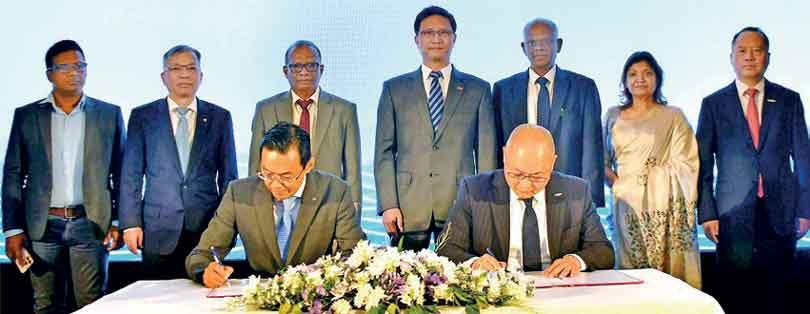
The Hambantota International Port Group (HIPG) will invest US$ 108 million in new container handling equipment, in a move aimed at doubling terminal capacity and positioning the southern port as a stronger alternative logistics hub along the East–West shipping route.
The agreement, signed with China’s Shanghai Zhenhua Heavy Industries Co. (ZPMC), covers six quay cranes, 16 rubber-tyred gantry cranes and 40 trailers under the first phase of the port’s Phase II expansion, which will raise annual container handling capacity to around 2 million twenty-foot equivalent units (TEUs).
The investment comes as global shipping patterns shift amid geopolitical tensions, particularly in the Middle East, prompting carriers to seek alternative, stable ports with minimal deviation. Hambantota’s proximity -just 10 nautical miles from the main shipping lane, has increasingly strengthened its appeal as a transhipment and logistics node.
Ports and Shipping Minister Anura Karunathilaka said Sri Lanka is seeking to move beyond transhipment into a broader marine services offering, including bunkering, repairs and logistics support, positioning Hambantota as part of an integrated industrial and maritime ecosystem. He added that the expansion aligns with efforts to attract supply chain diversification and value-added investments into the country.
The new quay cranes, designed with a 72-metre outreach and 65-ton lifting capacity, will enable the port to handle the world’s largest container vessels, while electrified yard equipment is expected to improve efficiency and reduce emissions in line with national sustainability targets.
Once operational, the equipment will activate Hambantota’s 1,300-metre container berth and extend total quay length for container operations to nearly 2 kilometres, allowing the port to service multiple large vessels simultaneously.
The expansion builds on rapid throughput growth at the port. In 2025, Hambantota handled 8.24 million tonnes of cargo, up sharply from 3.0 million tonnes a year earlier, while container volumes surged to 428,036 TEUs from just over 53,000 TEUs in 2024. Vehicle transhipments also rose to more than 726,000 units.
Chinese Ambassador Qi Zhenhong described the project as a continuation of bilateral cooperation under the Belt and Road Initiative, noting that Hambantota is evolving beyond a standalone port into a broader development platform linked to industrial activity in the southern region.
With Colombo already operating as the country’s primary transhipment hub, Hambantota’s expansion signals a dual-port strategy, aimed at capturing shifting maritime flows while building resilience across Sri Lanka’s logistics sector.