Reply To:
Name - Reply Comment
 A 44 percent Trump tariff could seriously impact Sri Lankan business and thereby foreign direct investment (FDI) and jobs, says Sri Lanka’s garment industry.
Sri Lanka is just stabilising after the economic crisis. Stringently following the International Monetary Fund norms and increasing the tax base, etc. have yielded results and the country is moving towards recovery. Debts have been deferred to 2028, when it needs to be repaid.
And there are two ways to ensure that happens – opening the economy – get valuable FDI and increase the tax base, so more revenue is collected from the people’s earnings.
The garment industry in Sri Lanka has been a key earner of foreign exchange – over the years the garment industry has earned a high of US $ 5.95 billion in 2022 to US $ 5 billion in 2024.
The US market contributes 70 percent of this forex, at around US $ 3.5 billion in 2024. At a 44 percent tariff, Sri Lankan garments may become uncompetitive in the US market and the clients could move to other countries for garments. This could mean a serious impact on jobs, plus a blow to the much-needed FDI. There are still many steps that can be taken to address this. Renegotiate tariffs with the USA, find ways to diversify the garment market (easier said than done) and other market-related strategies. But these are for the future; today the uncertainty in this regard is palpable.
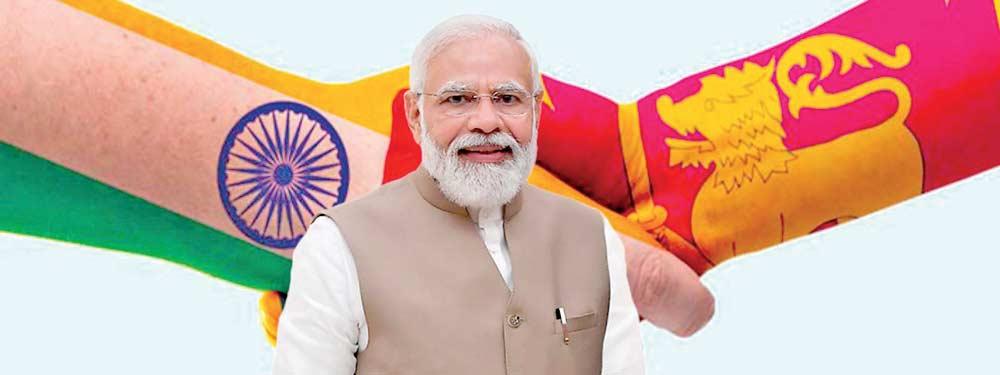
And now Prime Minister of India Narendra Modi visits the island.
Currently, Sri Lanka is allowed to export only eight million pieces of garments into the huge Indian market. Data suggests that the per capita purchase of garments in India is 24, which means the population has a staggering need for 33 million garments. The size of the garment market in India is US $ 100 billion. The broader textile and garment market in India that is valued at US $ 220 billion is expected to be US $ 646 billion in 2033 – a projected growth rate of 12 percent p.a.
A civilisational twin in clear and present danger. An opportunity for its big economic power in the neighbourhood to ease its fears. And offer free access to Indian markets. Genuinely and sincerely. Without non-tariff barriers like specifying which ports it can enter through, etc. A surprise announcement from the PM saying we feel your angst and we will do our utmost to safeguard your economy will not only be well-received but also it would further improve the sentiment for an India-Sri Lanka economic embrace.
A US $ 3 billion export into India will be but a pin prick in India’s giant apparel market but could be a lifeline for Sri Lanka’s ailing economy.
Of course, it’s not a simple exercise of replacing the US market with the India market. But having access to India would help the garment companies strategise on how to make an impact in India. Given some of the big names in garments in Sri Lanka already have some presence in India, having Indian market option available, will ease the tensions and potentially save jobs.
But this serendipitous opportunity to help the neighbour in need comes exactly on the day of the visit of the Indian leader.
Modi is known to make use of such opportunities.
India is a democracy. And a decision like this can’t be taken on a whim. Clearly many interests in India would want to stay protected. But India must be able to strategically employ its economy size for long-term connections, especially with the neighbours. And Modi can be very persuasive.
Now that Modi visits the island, he has an opportunity to ease the situation.
(Santosh Menon, President of the Lanka India Business Association, can be reached at [email protected])