Reply To:
Name - Reply Comment
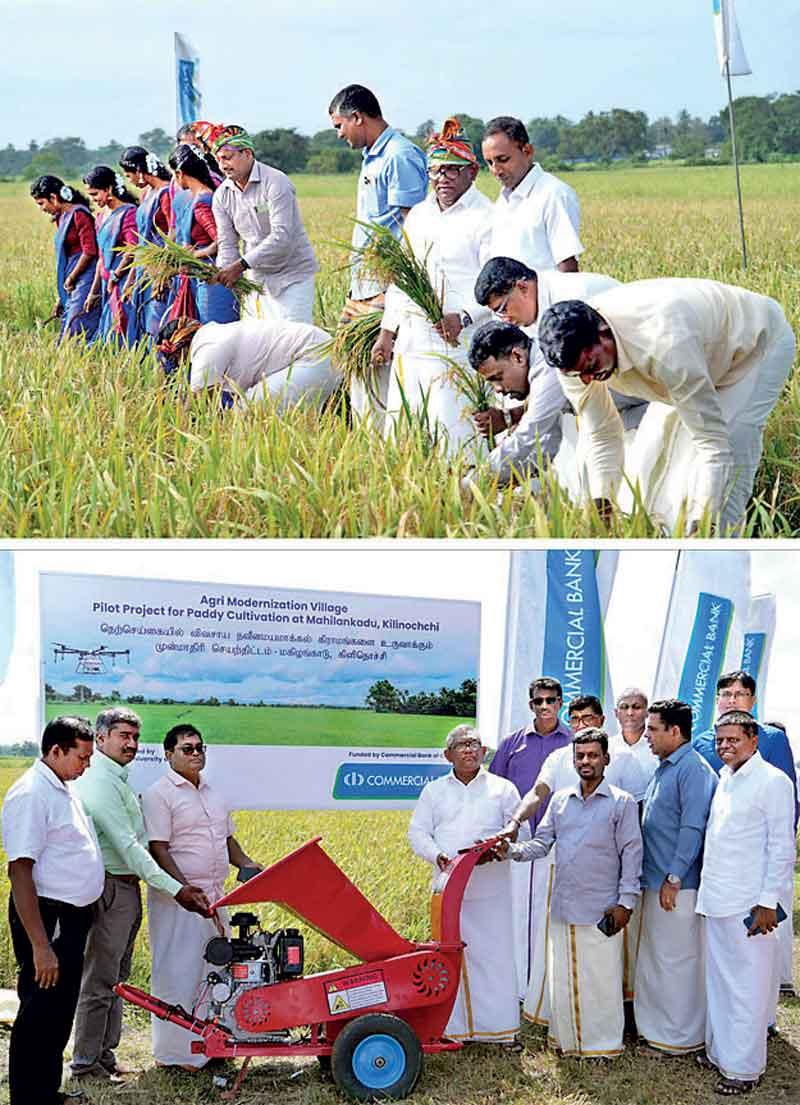 Two of the highlights of the harvest ceremony in Mahilankadu, Kilinochchi
Commercial Bank of Ceylon recently returned to Mahilankadu in Kilinochchi – the bank’s pilot Agri Modernisation Village – to celebrate its success by participating in a harvest ceremony.
Mahilankadu is to be the prototype for an ambitious village-by-village mission launched by the bank to propagate technology in the agriculture sector, encompassing all areas of agricultural potential in the country.
A team led by Commercial Bank Deputy General Manager Personal Banking Delakshan Hettiarachchi participated in the harvest ceremony at Mahilankadu, which was also attended by Kilinochchi Government Agent S. Muralitharan, Jaffna University Agriculture Faculty Dean Prof. K. Pakeerathan, Central Bank Northern Region Regional Manager S. Paheerathy and Agrarian Services Assistant Commissioner B. Thewadaran.
Among the highlights of the event were traditional rituals to honour the spirits for the good harvest, demonstrations of some of the modern harvesting techniques introduced through the programme, speeches by key stakeholders on the progress and potential of the programme as a model for other regions, endorsements from farmers on how the programme has positively changed their practices and incomes and the donation of a Multi Chopping Machine to the Agriculture Faculty of the Jaffna University for use in its community training programmes.
Addressing the ceremony, Commercial Bank DGM Personal Banking Delakshan Hettiarachchi said, “Agriculture is not just an occupation in Sri Lanka; it is the heartbeat of our nation. Through innovation, unity and determination, we can empower our farmers, uplift livelihoods and secure a prosperous future for generations to come.”
He said it is the hope of Commercial Bank that its Agri Modernisation Village programme would revolutionise the agriculture sector and stimulate the next generation to embrace smart agricultural practices.
Prof. Pakeerathan emphasised that the adoption of modern agro-technology has significantly reduced cultivation costs. Farmers no longer need to use weedicides and the seed paddy requirement has decreased by 75 percent compared to traditional methods, he said. Furthermore, he noted that weed growth in paddy fields cultivated with modern agro-technology is minimal, allowing farmers to sell their harvest as seed paddy, thereby earning a comparatively higher income.
The different elements to be addressed by Commercial Bank’s Agri Modernisation Village programme include access to advanced techniques such as transplanting, drone application and climate-resilient crop varieties that lead to increased productivity and profitability, skills development and training, financial inclusion and access to credit via direct engagement with the bank, improved livelihoods though better yields and access to new markets, sustainable practices that ensure the long-term viability of farmer lands and community support and networking. Additionally, the collaboration with academic and agricultural institutions required to implement the programme fosters a valuable knowledge-sharing environment.Participates in harvest ceremony in Mahilankadu, Kilinochchi
Commercial Bank of Ceylon recently returned to Mahilankadu in Kilinochchi – the bank’s pilot Agri Modernisation Village – to celebrate its success by participating in a harvest ceremony.
Mahilankadu is to be the prototype for an ambitious village-by-village mission launched by the bank to propagate technology in the agriculture sector, encompassing all areas of agricultural potential in the country.
A team led by Commercial Bank Deputy General Manager Personal Banking Delakshan Hettiarachchi participated in the harvest ceremony at Mahilankadu, which was also attended by Kilinochchi Government Agent S. Muralitharan, Jaffna University Agriculture Faculty Dean Prof. K. Pakeerathan, Central Bank Northern Region Regional Manager S. Paheerathy and Agrarian Services Assistant Commissioner B. Thewadaran.
Among the highlights of the event were traditional rituals to honour the spirits for the good harvest, demonstrations of some of the modern harvesting techniques introduced through the programme, speeches by key stakeholders on the progress and potential of the programme as a model for other regions, endorsements from farmers on how the programme has positively changed their practices and incomes and the donation of a Multi Chopping Machine to the Agriculture Faculty of the Jaffna University for use in its community training programmes.
Addressing the ceremony, Commercial Bank DGM Personal Banking Delakshan Hettiarachchi said, “Agriculture is not just an occupation in Sri Lanka; it is the heartbeat of our nation. Through innovation, unity and determination, we can empower our farmers, uplift livelihoods and secure a prosperous future for generations to come.”
He said it is the hope of Commercial Bank that its Agri Modernisation Village programme would revolutionise the agriculture sector and stimulate the next generation to embrace smart agricultural practices.
Prof. Pakeerathan emphasised that the adoption of modern agro-technology has significantly reduced cultivation costs. Farmers no longer need to use weedicides and the seed paddy requirement has decreased by 75 percent compared to traditional methods, he said. Furthermore, he noted that weed growth in paddy fields cultivated with modern agro-technology is minimal, allowing farmers to sell their harvest as seed paddy, thereby earning a comparatively higher income.
The different elements to be addressed by Commercial Bank’s Agri Modernisation Village programme include access to advanced techniques such as transplanting, drone application and climate-resilient crop varieties that lead to increased productivity and profitability, skills development and training, financial inclusion and access to credit via direct engagement with the bank, improved livelihoods though better yields and access to new markets, sustainable practices that ensure the long-term viability of farmer lands and community support and networking. Additionally, the collaboration with academic and agricultural institutions required to implement the programme fosters a valuable knowledge-sharing environment.