Reply To:
Name - Reply Comment
 Sri Lanka’s 2025 Budget unveiled by President Anura Kumara Dissanayake in Parliament on 17 February, was an eagerly awaited development, as it set the tone for the country’s current economic trajectory under the new government.
Following an unprecedented economic crisis in 2022, Sri Lanka entered an IMF programme and recently emerged from a default rating status, positioning budget 2025 as a critical indicator of the nation’s recovery.
In light of this, a post-budget forum organized by CMA Sri Lanka last week gathered industry experts to discuss the budget’s implications and its potential impact on the country’s future economic direction.
Several industry leaders and economists offered their perspectives on the budget’s focus areas, including fiscal discipline, digitalization and export growth.
Many praised the government’s initiatives aimed at strengthening the country’s financial foundation. However, concerns were also raised around the challenges of implementing the proposed measures, managing post-IMF debt and controlling capital expenditure.
The forum also delved into the impacts of the proposed tax policies, while also emphasizing the pressing need for international investments in order to reach the mandated revenue targets.
Following are excerpts from their discussion.
 Founder President CMA Sri Lanka Prof. Lakshman R. Watawala
“For the first time, Sri Lanka is following very good objectives and principles and we have to thank the International Monetary Fund (IMF) for instilling this discipline. The benchmarks given
by the IMF have restricted us from spending money as we used to. We now need to be disciplined in generating our income, building our revenues and managing our expenditures.
 As management accountants, we must highlight that the Finance Ministry still lacks a dedicated division to manage costs and expenditures. There should be a system in place to make sure public institutions stick to their budgeted financial frameworks.
Another key area is risk management. Recently, the entire country was left in the dark over a power interruption. I believe government departments should have risk management measures in place. There is a lot of money allocated for them. So, can they show the value creation for this money? Private sector companies take mandatory integrated reporting measures for their employees to show their value creation. The government too can use similar strategies.
We wholeheartedly support the digitalization drive. When the country opened its economy in 1977, the government digitized its state banks. As a result, they are now leading in the banking setup. This is a good way to change the mindset of government servants and their working environment”
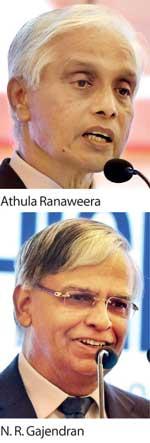
Watawala’s sentiments were reiterated by chartered accountancy experts Managing Partner of Ranaweera Associates Athula Ranaweera and Senior Partner at Gajma Co., N. R. Gajendran. They stressed the urgent need for extensive internal structural reforms within public sector institutions, especially to minimize monopolistic influences primarily inflicted by the private sector.
Shippers Academy Colombo CEO Rohan Maskorale
 “The elephant in the room about the shipping industry in Sri Lanka is that no one says it’s not performing well. Unfortunately, the government doesn’t seem to have understood the big picture. Our regional counterparts are miles ahead of us. Those countries have been open for foreign ship owners to come in and invest. We can keep talking about strategic location and domestic infrastructure, but businesses won’t come. Ship owners should invest and open their own landlord models. But the current numbers tell us a very different story.”
3 Araliya Group of Companies Chairman Dudley Sirisena
 “The true dynamics of local trade today is about consumers looking for quality products for the price they pay. But the debate has always remained on pricing. The government’s approach to paddy trade has always involved undermining rice millers and producers to provide subsidies for the general public. Their pricing has never been based on a proper cost analysis. Farmers of this country work hard to cultivate quality products for consumers. Therefore, the government’s cost analysis should be more transparent. Why not establish a committee of chartered accountants to handle these estimations? Why not make such a committee’s work public?”
Aitken Spence Travels (Sri Lanka, Maldives Bangladesh & Myanmar) COO - Suranga Ratnayake
 “Initiatives like developing phase 2 of the Bandaranaike International Airport (BIA)t, saving the national carrier (Sri Lankan Airlines) and the focus on upskilling the tourism workforce are truly commendable.
But the direct allocation of Rs.500 million for tourism infrastructure is not adequate given that tourism is identified as a key sector for revenue. Infrastructure is important. In Sri Lanka, the accommodation tax structure rates at 34.4 percent, while the maximum average across Africa and Asia is below 20 percent. So in reality ,we are heavily overpricing ourselves while failing to position our facilities to be competitive.”
LOLC Finance PLC Chairman and LOLC Holdings Director Conrad Dias
 “One contradictory step I think they have taken for the service sector is introducing taxes for foreign services. There are various ways to conduct foreign services and earn money, especially through IT. So imposing this tax could discourage those already generating revenue. Instead, the focus should be on encouraging the creation of intellectual property through digital means. These innovators often move to other countries to attract foreign digital service investors, who bring grants and support. If not addressed, this could lead to further brain drain.”
Advocata CEO Dhananath Fernando
 “Overall, the budget covers a lot of ground, and the direction is positive. It has embraced the idea that we are going ahead with market-oriented reforms. The emphasis on export production and policy reforms, such as the new Customs Ordinance, shows that we are taking an outward-oriented approach.”
“But the elephant in the room is debt sustainability. We are currently in an interim period. In the context of our debt, if the expenditure of this budget is allocated to 7 units, our expected income is only 5 units, where 3 units will have to be solely allocated to debt interest.”
Women’s Chamber of Industry and Commerce (WCIC) Board Member Ashanthi Fernando

“This budget, similar to previous ones, has not focused much on women. But two good things we saw are the proposed Statistics Act and the Microfinance and Regulatory Act, which could highlight key areas for the government to promote women entrepreneurs and encourage their participation in the economy.”
Brandix Group Managing Director Hasitha Premaratne
 “Very encouraging to see a drive in the budget for FTAs, unlike what the governments’ notion was towards them in the pre-election stage. To elevate exports, we surely need to find new markets and improve duty-free efforts. We already have several GSP benefits to leverage. With India, we have an FTA, but there is a lot of potential for expansion, especially in apparel. For example, we have a eight million piece limitation that allows us to send duty-free garments to India. This means we could export US$ 40 million annually. However, today, the Indian market consists of over 300 million people, primarily in the middle and higher income brackets. That means the market is there, and there is a growing need for apparel, which Sri Lanka can definitely cater to.”
 MAS Holdings Group Finance Director Surath Chandrasena
“In 2022, merchandise exports in Sri Lanka actually went up significantly, even though we were in an economic crisis. This shows that the export sector is not driven solely by what’s happening inside the country. The government must recognize that exports rely on more factors than political stability. Bold moves are needed beyond organic growth. While private zones are mentioned in the budget, competing for investment requires improving local sourcing and a lot of supply chain investments.”
 National Enterprise Development Authority (NEDA) Chairman Lakshman Abeysekera
“The Ministry of Industries will launch nationwide SME incubator systems with the Rs. 1 billion R&D allocation. Additionally, we will start operations at the National Credit Guarantee Institution (NCGI) and establish the SME Development Bank.”
 DSI Samson Group of Companies Emeritus Chairman Kulatunga Rajapaksa
“The increment for the private sector minimum wage hike was much needed. But much more should have been done for manufacturers. More focus should be given to remove barriers in increasing exports for existing industries. The clarification on the SVAT abolition and the complications in applying VAT and the SSC, should be more clear. They have not been addressed. Authorities should recognize local businesses for their reporting, as they add a lot of value to the economy.”
 Ernst & Young Partner and Head of Tax (Sri Lanka and Maldives) Sulaiman Nisthar
“The government is expecting a revenue close to Rs. 800 billion with the latest tax reforms. I believe this is possible if the correct technology is integrated and an appropriate audit system is put in place.
The new phenomenon of introducing VAT on digital services is a question, considering its impact on the national digitization strategy. Since we are digitizing our economy, we will need a lot of investment for outsourced digital products. Also the impact of this tax in creating a level playing field for other industries should also be closely assessed”.
Pix by Nisal Baduge