Reply To:
Name - Reply Comment
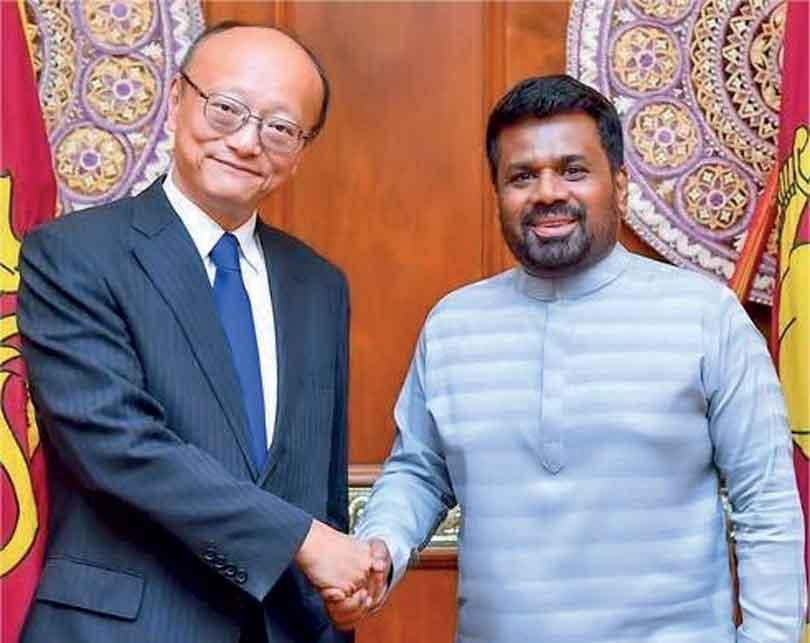 ADB President Masato Kanda during his meeting with President Anura Kumara Dissanayake
Visiting ADB President Kanda commends govt.’s handling of economic stability amid domestic recovery challenges and broader external uncertainty, including geopolitical tensions in the Middle East
The Asian Development Bank (ADB) has raised its financial commitment to Sri Lanka and moved to accelerate disbursements, affirming stepped-up multilateral backing as the country navigates post-disaster recovery pressures alongside rising external risks.
The ADB has increased its allocation for Sri Lanka to US$ 480 million for the year, from US$ 380 million earlier, and will fast-track US$ 200 million in immediate funding following talks between President Anura Kumara Dissanayake and ADB President Masato Kanda yesterday in Colombo.
The funding boost comes at a time when Sri Lanka is balancing fiscal consolidation with reconstruction spending after Cyclone Ditwah, while also contending with higher energy costs and supply-side pressures linked to global disruptions.
In parallel, the ADB outlined a broader support framework for its developing member countries (DMCs) to cushion the economic fallout from escalating geopolitical tensions in the Middle East.
Kanda said the ADB would deliver “rapid, flexible and scalable assistance” to help countries manage immediate pressures and build long-term resilience, including fast-disbursing budget support and expanded trade and supply chain financing to secure essential imports, “now including oil”.
For Sri Lanka, this widens the scope of support beyond project financing to include countercyclical budget support and private sector trade facilitation—critical for maintaining fuel and food supply lines as external conditions tighten.
The ADB said it has sufficient resources to safeguard existing operations while scaling up emergency support using instruments such as its countercyclical lending buffer. It is also closely monitoring global market conditions, particularly energy price volatility, inflationary pressures and external balances, key stress points for Sri Lanka’s fragile recovery.
Latest ADB analysis shows supply chain disruptions are already pushing up shipping costs and delivery times. Risks are also extending beyond energy to inputs such as fertiliser and petrochemicals, with implications for agriculture and food production. Economies reliant on tourism and remittances, including Sri Lanka, face compounded vulnerabilities, while tighter global financial conditions are exerting pressure on currencies and capital flows.
In response, the bank is preparing a two-pronged intervention: fast-disbursing budget support to ease fiscal strain—potentially through its Countercyclical Support Facility—and expanded Trade and Supply Chain Finance Program (TSCFP) operations to ensure the continued flow of critical imports. The ADB has, on an exceptional basis, reactivated financing support for oil imports under the programme.
The accelerated US$ 200 million disbursement is expected to ease near-term financing pressures, while broader ADB instruments could help stabilise external balances and cushion the impact of imported inflation.
In the meeting with President Dissanayake, Kanda also commended the government’s efforts to maintain macroeconomic stability despite domestic and external shocks, reaffirming the ADB’s readiness to support infrastructure rehabilitation and long-term resilience initiatives.
Sri Lanka, for its part, reiterated its priority of sustaining stability while reviving growth, signalling continued reliance on multilateral financing to navigate a complex and still-fragile recovery path. (SAA)