Reply To:
Name - Reply Comment
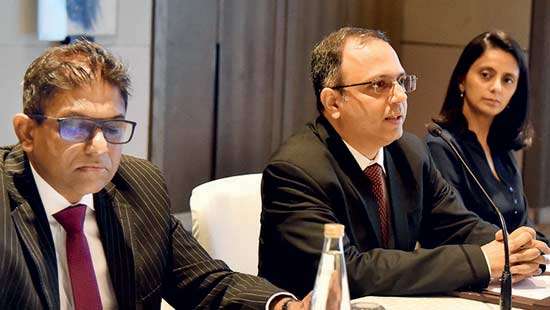

Standard Chartered Economist for South Asia, Saurav Anand speaking to the media, while Standard Chartered Sri Lanka CEO Bingumal Thewarathanthri (extreme left), Standard Chartered Global Economist & Head, Thematic Research Madhur Jha (second from right, and Standard Chartered Co- Head of FX Research ASEAN and South Asia Divya Devesh look on.
Pic by Kithsiri De Mel
By Nishel Fernando
Sri Lanka is likely to see its sovereign rating outlook upgraded from ‘Stable’ to ‘Positive’ later this year, setting the stage for a potential full credit rating upgrade in 2027 as the island nation continues to outperform key fiscal and debt targets set by the International Monetary Fund (IMF), Standard Chartered Bank said.
Speaking at a media briefing in Colombo, Standard Chartered Economist for South Asia, Saurav Anand noted that while the rating itself might remain unchanged in 2026, the shift in outlook is a strong probability. He indicated that if the country maintains its current fiscal trajectory, specifically bringing debt and interest metrics down to 2027 targets, a rating upgrade could follow in 2027.
“Our view is that we will see a change in rating outlook this year. It’s a strong probability that we might see the same rating but the outlook is changed from stable to positive this year,” Anand told journalists in Colombo yesterday.
This optimism is driven by a sharper-than-expected reduction in the country’s debt-to-GDP ratio. While the IMF initially forecasted Sri Lanka would reach a 100 percent debt-to-GDP ratio by 2028, Standard Chartered expects this milestone to be achieved a full year earlier.
“We have already seen debt-to-GDP numbers from around 125, 126 percent of GDP in 2022. That number has now come down closer to 103,104 percent by 2025. And we are expecting a number to drift below 100 percent in 2027,” Anand said.
The bank also highlighted a dramatic improvement in the interest-to-revenue ratio, which is projected to fall to around 45 percent in 2026 and drift closer to 40 percent in 2027, another key metric supporting the case for a 2027 upgrade.
Addressing concerns about the relaxation of the vehicle import ban, Anand revealed that the bank has factored in a significant outflow for 2026 but remains confident in the country’s external stability.
“We have explicitly factored in an additional import bill of roughly US$ 800 million to US$ 1 billion for 2026 specifically attributed to vehicle imports,” Anand said.
Despite this, the bank projects the Current Account to remain in surplus by approximately US$ 600 million for the year. Anand explained that high taxation and prevailing interest rates would likely cap excessive demand, preventing a “floodgates” scenario. “We don’t think it will derail the reserve accumulation story. We are still comfortable with our US$ 7.5 to 8 billion reserve forecast for end-2026, even with the vehicle imports coming in,” he added.
On the growth front, Standard Chartered has maintained a conservative forecast of 3.5 percent for 2026 due to the impact of the late-2025 cyclone, though it sees upside risks of up to 4 percent if reconstruction accelerates.
Standard Chartered Sri Lanka CEO Bingumal Thewarathanthri emphasised the resilience of the economy, pointing to a sustained tourism recovery and opportunities in trade logistics and renewable energy. He highlighted the immense potential of the Indian outbound tourism market.
“It’s a US$ 40 billion economy. And we should be able to at least tap 10 percent of that market. That alone will be US$ 4 billion for Sri Lanka,” Thewarathanthri noted.
He also stressed the strategic importance of the Port City and logistics sector, urging Sri Lanka to capitalise on its location to capture a share of the growing South-South trade corridor.
The bank also flagged the energy sector as a potential export pillar, citing Sri Lanka’s capacity to generate surplus renewable energy from wind and solar power in the Northern and North-Western regions. To unlock this potential, Thewarathanthri called for the finalisation of a solid Public-Private Partnership (PPP) law to attract the necessary large-scale foreign investment.
“As an enabler again PPP laws are critical. I think we have seen a draft of PPP law. We would like to see an end and a final product of the PPP law. Because these are large projects running up to billions of dollars,” he added.