 CHATURANGA PRADEEP SAMARAWICKRAMA
 Reply To:
Name - Reply Comment
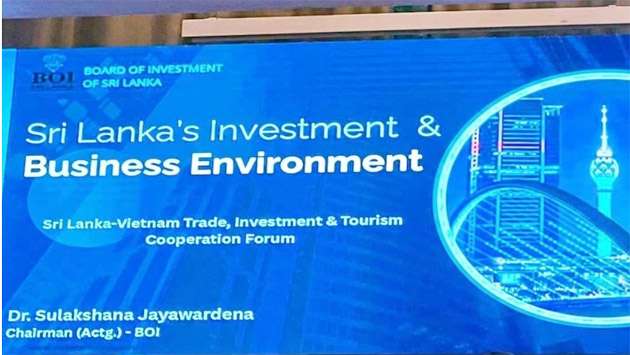
Colombo, May 22 (Daily Mirror) - Sri Lanka has declared itself open for investment, highlighting a reformed and stabilised economy with strong growth prospects and a structured pipeline of investment opportunities across multiple sectors. The message was delivered by Dr. Sulakshana Jayawardena, Acting Chairman of the Board of Investment (BOI) of Sri Lanka, at the Sri Lanka–Vietnam Trade, Investment & Tourism Cooperation Forum held on 8 May 2026.
Addressing Vietnamese business leaders and officials, Dr. Jayawardena said Sri Lanka has emerged from one of the most severe economic crises in its post-independence history with renewed macroeconomic stability, restored investor confidence, and a clear strategy for long-term growth. He said the country now offers a compelling case for international investors, particularly from Vietnam and the wider Southeast Asian region, backed by data-driven recovery and policy reforms.
He noted that Sri Lanka’s economy has rebounded strongly after contracting by 2.3% in 2023, recording GDP growth of 5.0% in both 2024 and 2025, with a further expansion of around 4.0% projected for 2026. Merchandise exports rose from US$ 11.9 billion in 2023 to US$ 13.6 billion in 2025, with a target of US$ 15.7 billion set for 2026, while tourism earnings climbed to US$ 3.22 billion, supported by more than 2.3 million arrivals in 2025.
Dr. Jayawardena also pointed to a sharp recovery in foreign direct investment, which increased to US$ 1.063 billion in 2025 from US$ 614 million in 2024, with a target of US$ 1.5 billion in 2026. “Sri Lanka has arrested its crisis and is firmly on a growth curve,” he said, emphasising that investor confidence has been steadily restored.
Positioning Vietnam as a strategic partner rather than just a trading counterpart, he highlighted the existing imbalance in bilateral trade as an opportunity for expansion. Sri Lanka exports around US$ 40 million worth of goods annually to Vietnam, mainly apparel, tea, seafood, gemstones, and footwear, while importing approximately US$ 238 million in textiles, machinery, iron and steel, and plastics.
He said Vietnam’s experience in manufacturing and export processing, particularly its industrial zone model, offers valuable lessons for Sri Lanka, while Sri Lanka’s preferential access to markets in the EU, UK, India, and Pakistan provides a strong export platform for Vietnamese producers. Both countries, he added, are well placed to benefit from ongoing global supply chain diversification, with Vietnam’s ASEAN integration offering Sri Lanka a gateway to Southeast Asia.
Highlighting Sri Lanka’s strategic location, Dr. Jayawardena pointed to the Colombo Port, ranked among the world’s leading container transshipment hubs and situated along a major East–West shipping lane traversed by over 300 vessels daily. He noted that maritime routes south of Sri Lanka carry around 70% of global oil shipments and 50% of container traffic, reinforcing the island’s position as a key logistics hub. The country’s aviation sector, he added, handles over 64,000 aircraft movements and around 10 million passengers annually.
He also underscored Sri Lanka’s human capital advantages, citing high literacy rates, strong English proficiency, and a large pool of skilled professionals, including the world’s second-largest number of CIMA-qualified professionals. Around 44,000 graduates enter the workforce annually from universities and higher education institutes, supported by extensive vocational training networks producing hundreds of thousands of skilled trainees each year.
On trade and investment access, Dr. Jayawardena said Sri Lanka offers zero-duty access to over 6,000 product categories across 27 EU countries under GSP+, alongside preferential access to the UK, India, Pakistan, and selected Asian markets through FTAs and regional agreements. He said this trade connectivity significantly enhances Sri Lanka’s value as a production and export base.
He further outlined a strong investment protection framework, including 100% foreign ownership in most sectors, full repatriation of capital and profits, constitutional guarantees, strong intellectual property protection aligned with WIPO standards, and international agreements including membership of MIGA, bilateral investment protection treaties with 26 countries, and double taxation avoidance agreements with 46 countries.
Dr. Jayawardena also unveiled a pipeline of 30 structured, investment-ready projects across manufacturing, logistics, tourism, and infrastructure sectors. These include dairy processing plants, an Active Pharmaceutical Ingredient facility, textile manufacturing in the Eravur zone, and an electric vehicle assembly plant in the Southern Province. Logistics projects include a multi-storey hub in Colombo, port-based logistics centres, warehousing facilities, and aviation maintenance operations at Mattala Airport.
In tourism and hospitality, opportunities include heritage hotels in Kandy, a theme park in Nuwara Eliya, recreational developments in the Western Province, and cruise tourism initiatives. Infrastructure projects range from techno parks and cinema cities to mixed development schemes and residential apartment complexes.
Concluding his address, Dr. Jayawardena said Sri Lanka has entered a new phase of economic recovery and reform, supported by stability, investor-friendly policies, and a structured project pipeline. “Macroeconomic stability has been restored, and we now offer ready-to-engage opportunities across high-growth sectors,” he said, adding that the BOI stands ready to facilitate Vietnamese and international investment into Sri Lanka’s next growth phase.