Reply To:
Name - Reply Comment

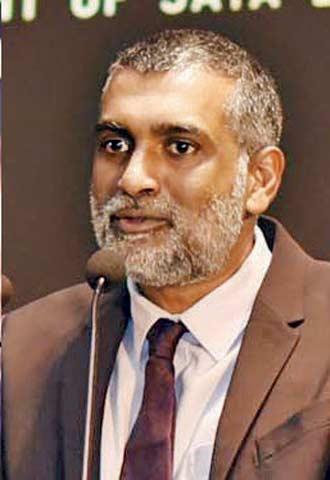
Abdulla Ghiyas Buddhika Hewawasam PIX BY NISAL BADUGE 
By Nishel Fernando
Sri Lanka yesterday announced the revision of its ambitious tourist arrival forecast for 2025.
It is now aiming for a minimum of 2.6 million visitors, down from the original target of three million.
The announcement came from Sri Lanka Tourism Development Authority (SLTDA) Chairman Buddhika Hewawasam.
Speaking at the Connect and Conversations forum, a key component of South Asian Travel Awards 2025, held in Colombo yesterday, Hewawasam expressed confidence despite the adjustment.
He noted that achieving 2.6 million arrivals would “still be a historical high” for the nation, signalling a robust recovery and growth in the tourism sector.
However, Hewawasam did not comment on the status of the country’s tourism earnings forecast. The government originally set its sights on generating US $ 5 billion from the industry this year.
As of 17th of this month, Sri Lanka has welcomed approximately 1.66 million tourists. The cumulative earnings from tourism for the first eight months of the year stand at an estimated US $ 3.4 billion. While the arrivals show a steady momentum, the current trajectory suggests that achieving the initial three million target would be a significant challenge, prompting the revised, more pragmatic forecast.
In his address, Hewawasam pointed towards a strategic pivot, emphasising the immense, untapped opportunities for collaborative tourism within the South Asian region.
“We see a future built on partnership, not just competition,” he stated.
“For example, Sri Lanka and the Maldives could complement each other wonderfully.”
This sentiment was strongly echoed by Visit Maldives Corporation Chairman Abdulla Ghiyas, who also addressed the event. Ghiyas called for a paradigm shift in how regional tourism boards operate. He highlighted the deep-rooted relationship between the two island nations, noting that the Maldives is already among the top 10 source countries for tourist arrivals in Sri Lanka.
Referencing a decline in the resident Maldivian population from a peak of around 15,000 to approximately 3,000 as of now, he emphasised the importance of strengthening these community ties.
“We must stop seeing each other as competitors and instead act as partners, sharing best practices and even case studies that can benefit us all,” Ghiyas remarked, framing the strong bilateral ties as a foundation for broader regional cooperation.
He highlighted the shifting global dynamics, pointing to Asia’s rising economic power.
“With 60 percent of the world’s population in Asia ... this is not just a trend; it’s a shift in the global balance of demand.”
Ghiyas advocated for tangible collaborative efforts to capitalise on this shift.
“We see other regions working together through regional visas ... and even joint marketing platforms. I strongly believe we can do this in South Asia,” he urged, asserting that such partnerships would ensure the region remains a global leader in tourism.