 DARSHANA SANJEEWA BALASURIYA
Reply To:
Name - Reply Comment
Colombo, August 11 (Daily Mirror) - While many countries continue to enhance their maritime and aerial capabilities, Sri Lanka is gradually losing ground in these critical areas.
The country increasingly relies on its existing ageing fleet, without giving adequate attention to strengthening the air capabilities of the Sri Lanka Air Force (SLAF).
As several aircraft in the SLAF fleet have suffered tragic crashes in recent years, others have been decommissioned due to technical issues or having reached the end of their flying hours.
Meanwhile, plans to acquire new aircraft have been repeatedly delayed, primarily due to financial constraints.
In a recent development, the SLAF decommissioned the Dornier 228 Maritime Reconnaissance Aircraft, which had been gifted by India in August 2022.
The aircraft, stationed at the No. 3 Maritime Squadron based at SLAF Academy China Bay, had played a vital role in maritime and coastal surveillance, monitoring Sri Lanka’s Exclusive Economic Zone, and conducting search and rescue operations.
The Daily Mirror learns that the Dornier was provided by India for a limited time period and was officially decommissioned on Thursday (07) following the expiration of the agreement, which had already been extended by several months.
Following the acquisition of the Dornier 228, there were plans to purchase two additional Dornier aircraft from India.
However, those plans were stalled due to a lack of funding.
Sources said that at least USD 20 million would be required to procure the two aircraft, an amount the government is currently unable to allocate.
Currently, the No. 3 Maritime Squadron operates a mixed fleet of surveillance aircraft, including the Beechcraft King Air B-200, US-gifted Beechcraft King Air 360ER, Australia-gifted Beechcraft King Air 350, and the now-decommissioned Dornier 228.
These aircraft have been essential in maritime reconnaissance, search and rescue, and disaster relief operations.
Meanwhile, the SLAF has been in discussions to acquire eight Bell 206 helicopters from the United States, along with an FT-7 trainer aircraft from Pakistan.
During his tenure as SLAF Commander, Air Marshal Udeni Rajapaksa said that the US would provide eight TH-57 Sea Ranger helicopters, a military variant of the Bell 206, in the first quarter of 2025.
This move followed extensive bilateral discussions and is intended to enhance training and operational capability. The FT-7 aircraft was reportedly agreed upon as a grant from Pakistan, secured during Air Marshal Rajapaksa’s official visit.
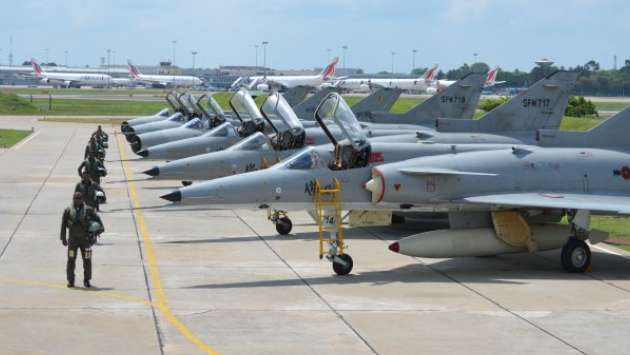
In addition, efforts are underway to modernize the SLAF’s aging fleet of Kfir fighter jets. An agreement signed with Israel Aerospace Industries (IAI) in 2021 will see five Kfir jets upgraded to the newer C12 variant, replacing the outdated C2 and C3 models.
The upgraded jets are expected to be integrated into the fleet this year, with the aim of enhancing long-range surveillance operations over the Indian Ocean.
Despite these developments, the SLAF has yet to finalize or receive any new aircraft in recent months.
When contacted, SLAF Spokesman Group Captain Eranda Geeganage said that discussions regarding the US helicopters are ongoing and that a cabinet paper would be submitted soon.
He also said that the agreement with Pakistan for the FT-7 trainer was “almost finalized,” but certain matters have caused delays in its implementation.
In 2025, the SLAF experienced two major aircraft accidents that raised concerns about operational safety and reliability. The first occurred on May 9, 2025, when a Bell 212 helicopter from the No. 7 Squadron crashed into the Maduru Oya Reservoir during a heli-rappelling demonstration involving Special Forces. Six military personnel died, and six others were injured. A nine-member Board of Investigation was appointed by the SLAF to probe the crash. Preliminary investigations point to a possible tail rotor malfunction as the cause.
The second crash involved a Chinese-manufactured K-8 trainer jet, which went down on March 21, 2025, near Minuwangete Vidyalaya in Wariyapola, during a routine training flight. Both the instructor and trainee ejected safely. The SLAF formed a seven-member committee to investigate the incident, but no official findings have been published to date.
When asked about the delay in releasing the final reports of both crashes, SLAF spokesman Geeganage said that a team of foreign experts had arrived in Sri Lanka to assist with the technical analysis of the Bell 212 crash. Their observations and assessments are currently underway, with a final report expected to be submitted to the Commander of the Air Force upon completion.
The prolonged delay in publishing these reports has drawn criticism, especially when compared with the swift actions of neighboring countries. India has already released the findings of its Air India Express crash, which occurred a month after the Bell 212 incident.
This comparison has led to questions regarding transparency and efficiency in Sri Lanka’s aviation investigative processes.
“The final reports for both crashes are nearly complete,” the SLAF spokesman said.
“There is a due process involved in finalizing and validating the technical assessments. Once completed and submitted to the Air Force Commander, the reports will be forwarded to the Ministry of Defence for recommendations,” he said.