Reply To:
Name - Reply Comment
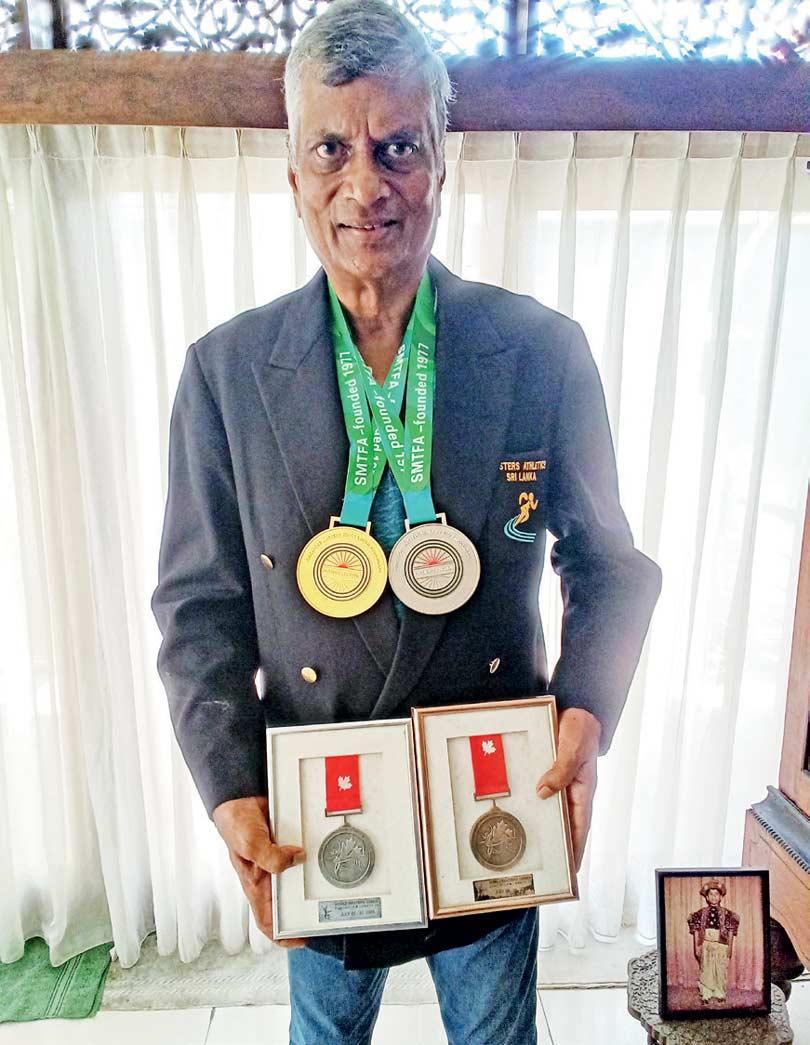 Rajiva with his gold and silver
By Allaam Ousman
|
Rajiva the Royal College sportsman |
Ivor Manik Rajiva Wijetunge, known simply as Rajiva to friends and family, marks a rare sporting milestone in June — 25 years as a Sri Lanka Masters double international in athletics and table tennis. With 32 international medals and a lifetime devoted to sports, his journey reflects not just personal glory but the enduring legacy of a family steeped in cricketing excellence.
Born on June 8, 1959, in Matara, Rajiva grew up the only son among five siblings, surrounded by affection and discipline in equal measure. His father, Ivor Malcolm Reginald Wijetunge, a respected President’s Counsel, and his mother, Lois Irangani Wijetunge, fostered a nurturing environment that balanced academic focus with a love for sport.
Rajiva says he was doted on by both parents and his four sisters. “Being the only boy in the family, my parents gave me a lot of attention. My sisters too were very close to me.”
His early passion for sport, particularly cricket, came from his mother’s side. “From my small days, I was very much interested in sports. I think that must be because most of my mother’s side were top sportsmen.”
At the heart of that sporting tradition is former All Ceylon great Sargo Jayawickrame, Rajiva’s maternal grandmother’s brother – a legendary figure who played for Royal College in the Jubilee Royal–Thomian encounter (50th edition) in 1929. “He was the first from our family to play in the Royal–Thomian,” Rajiva notes. “Since then, ten members of our extended family, all from the Jayawickrame lineage, have worn the Royal cap in the Royal–Thomian. That’s something not even a single Thomian can claim!” he laughs.
Rajiva emphasises that it is his mother’s side – the Jayawickrama clan – that produced the cricketers. “My grandmother was a Jayawickrama who married into the de Silva family. That’s how I’m connected. So I’m a grand-nephew of Sargo Jayawickrame.”
His cousin Rajiv de Silva is part of the second generation, while Dimitri Siriwardena belongs to the third generation, making him a great-grandnephew of Sargo. “That makes ten Royal–Thomian players from one family – a unique record.”
There’s even an honorary 12th man: Nirmal de Silva, a cousin of Rajiva, and Tissa Wickramasuriya, who were part of the Royal-Thomian squad but didn’t make the playing XI.
Among this elite group were cricketers like Mahes Rodrigo, Sunil Wickramasuriya, and Ranjith de Silva, whose grandson Dimitri Siriwardena captained Royal in the mid-2000s. Rajiva himself played First XI cricket for Royal from 1977 to 1979, part of the record-breaking 1979 side that won nine matches under Ranjan Madugalle. He shared the new ball with Ashantha de Mel, who would go on to represent Sri Lanka.
In fact, this Royalist cricket dynasty was once highlighted in a special Royal–Thomian souvenir by Rajiva’s uncle, titled ‘Sargo and His Clan’. “It captured the whole story of our family’s contribution to Royal cricket,” he says, beaming with pride.
Rajiva’s own journey to Royal College was almost destined. “I began schooling at Matara Convent for Montessori. But my father was determined to have all his children educated in Colombo. All my sisters went to Ladies’ College. My father and grandfather were Royalists, so it was natural for me to go to Royal.”
Today, the Royal legacy continues into a fourth generation with his son, Rajinda, also an alumnus of Royal College.
On his paternal side, the legacy is just as illustrious. His grandfather, Edmund Perera Wijetunge, was the Basnayake Nilame of the Devundara Devalaya in Matara and a Crown Proctor. “He wasn’t a Queen’s Counsel like my father, but he was a respected lawyer and community leader.”
Royal Junior School
Rajiva entered Royal Junior School in 1965, at the age of six. “I started with softball cricket and then graduated to hardball cricket once I joined Royal Junior,” he recalls. “We had an Under-12 team — no Under-10 at that time — so I began playing there.”
His team was filled with future stars. “We were led by Arjun Fernando, a superb cricketer and one of the best captains I’ve ever played under,” he recalls fondly. “Guys like Ranjan Madugalle, Ramesh de Silva, Haroon Musafer, and Pradeepa Kariyawasam were all in the team.”
Rajiva’s cricketing journey continued through Royal’s age groups. “I played under Arjun, and later played under Ashok Jayawickrema and Ranjan Madugalle in college. In club cricket, I had the honour of playing under Michael Tissera at CCC, and later under Patrick Van Dort at Nomads. At Ceylon Tobacco, I played under giants like Bandula Warnapura, Anura Tennekoon, Jayantha Kudahetti, and Ajith Abeygunawardena.”
As for his role? “I was an opening bowler, and a bowling all-rounder. I could bat up the order too, but at Royal, competition was so high, I focussed more on my bowling.”
Athletics
Alongside cricket, Rajiva excelled in athletics. “I competed in shot put, discus, and long jump, and was part of the relay team,” he recalls. “My best events were shot put and discus.”
A turning point came through an unexpected mentor. “I was practicing the discus one day at Royal Junior when a bald-headed man got off a double-decker bus, came onto the ground and said, ‘Young man, you’re making so many mistakes.’ I didn’t know who he was. He turned out to be Anthony Abeysinghe, national coach and the St. Joseph’s College athletics coach.”
Thanks to Abeysinghe’s impromptu guidance, Rajiva’s technique blossomed. “To this day, even without a full turn my discus throw is technically strong — just with arm movement. People still talk about it.”
That same year, he was placed third in discus at the All-Island Under-12 meet, held at Royal Junior. “In the 1972 Royal College house meet, during the Munich Olympics year, I won first place in both discus and shot put, and came third in long jump.
“Like cricket favours batsmen, athletics favours runners,” he smiles. “But I was proud — I never lost a shot put or discus event at Royal Junior.”
At Royal College, he continued his dominance: “I won all three years in both shot put and discus at Under-15, 16, and 17 levels. I was consistently placed top two in Colombo South Zonal meets, and was runner-up in shot put at Public Schools Athletics Championships three years running — losing once to A.S.D. Perera of Ananda and twice to Shammi Silva, who later became Sri Lanka Cricket President.”
Rajiva coached by K.L.F. Wijedasa is the Under-14 Shot Put record holder in 1973.
Table tennis
Rajiva faced disappointment when he was dropped from the Under-16 cricket pool at Royal College. “I don’t know why. I was in the top 20, practiced a few days, then I was left out. It upset my family — and me.”
But he turned adversity into an opportunity. “Thank God for that,” he says. “I focussed on my studies and passed my O/Ls. It was a blessing in disguise.”
Another sport soon caught his attention — table tennis. “There was no TT at Royal Junior, but once I got to college in 1973, I started playing. It was in my blood — my mother played for Ceylon, and my sister Sharmini played for Sri Lanka.”
He continues: “Both my mother and Sharmini lost national finals to Belle Weerakoon, a dominant champion at the time. My mother would’ve lost in the 1950s, and my sister in the 1970s.”
In parallel, Rajiva carved a niche in table tennis, following in the footsteps of his mother and sister, both of whom were national finalists. He was part of the Royal Junior team that won the Junior Inter-School title in 1974, eventually captaining the Royal senior team in 1976.
All four of his sisters — Krisanthi, Samathi, Sharmini, and Newaree — captained Ladies’ College at table tennis, making it a family sport in every sense.
Rajiva was part of the Royal Junior table tennis team that won the Junior Boys’ title in 1974, alongside Tiran Peiris and Sujith Fernando (brother of Arjun). He was a member of the team that won the Junior Boys Championship in 1974, vice-captain in 1975 when they won the senior inter-school meet and captain in 1976, when they were National Junior Doubles runner-up, losing to Shabbar and Shabbir Hussain, who later became Sri Lanka champions.
The Captains
“I’ve played under some amazing captains, but Arjun Fernando stands out,” he says with admiration. “He handled us young boys with such maturity.”
He revealed a touching detail: “I have a small WhatsApp group with Arjun and another classmate, Nissanka Weerasekera — he’s not a sportsman but incredibly fit. They both constantly support me.”
Nissanka also advises him on diet and fitness. “He checks what foods and workouts suit a shot putter or discus thrower. Sends me videos, tips, and routines. I follow most of it.”
Rajiva never had a coach after school. “I train myself to this day,” he says. “But I’ve been lucky — the right people appeared at the right times, like Anthony Abeysinghe or friends like Arjun and Nissanka.”
Cricket Career
He started playing for Royal’s Second XI in 1975, and continued until 1977. “In 1977, under Ashok’s captaincy, I played a few matches in the First XI, though I didn’t make the Royal–Thomian team; I was a reserve,” he recalls.
“In 1978, under Ranjan Madugalle, I played First XI cricket and continued through 1979, which was our Centenary Year. That 1979 team made history — we won nine matches out of 13, breaking the previous record held by Nalanda (eight wins). We would’ve made it 10 wins if we had won the Royal–Thomian,” he equipped.
“We had nine coloursmen from the 1978 team playing again in 1979, and we added Ashantha de Mel, who transferred from Isipatana. He and I opened the bowling. The previous year, I had opened with Sudath Pasqual. In 1979, Pasqual came in as first change,” he points out.
“That season (1978–79), both Ashantha and I took over 50 wickets each. Our leg-spinner Kesara de Costa also got over 50 wickets. We won all the major trophies, including the Exide Trophy and the Mustangs Trophy. In the Mustangs final, I won the Best Bowler award, taking 3 for 32 in 10 overs, bowled at a stretch by Ranjan,” he relates.
Bowling Style
Inherited with a gangly physique, Rajiva had a slightly different bowling action. “A lot of people commented on it. When asked who I modelled myself on, I always say Ashantha de Mel. Even before we played together, while he was at Isipatana, my coach Gamini Salgado used to tell me, ‘Wijetunge, watch Ashantha’s run-up, jump and arm action’.
Even when we played together, I still admired him greatly. Among international players, I liked Dennis Lillee, Richard Hadlee, Michael Holding and Imran Khan — especially for their rhythm and run-ups. But Ashantha was my top inspiration,” he shares.
“Interestingly, Ashantha also admired me. He once said I was one of the few who could move the ball both ways. I wasn’t as quick as him, but my strength was swing — both in and out,” he says.
Club Cricket
Rajiva’s club career saw him represent CCC, Nomads, and Matara SC, winning or finishing runner-up in major domestic trophies. Notably, he captained Nomads in the Honda Trophy Under-23 Tournament in 1982 and played under iconic leaders like Michael Tissera and Bandula Warnapura.
However, he couldn’t break into the regular side at CCC. “I switched clubs and joined Nomads, where I got a full season. That was around 1980–81. I also played in Division II, and one year I took over 60 wickets. I remember the Donovan Andree Trophy that year: The leading wicket-takers were Rajiv Benedict (St. Joseph’s), Sudath Munaweera, and myself. I was in the top three of the bowling averages,” he says.
Teetotalism and Discipline
At Nomads, he played alongside legends like Daya Sahabandu, Jayantha Amarasinghe, Patrick Van Dort, Leslie Piyasena, Granville Harmer and Bernard Wijetunge.
More significantly he was a teetotaller. “I never smoked or drank. I credit that discipline for helping me stay grounded. Even during difficult times, I never gave in to depression. My father and grandfather were also teetotallers, and now my son too is,” he says.
“That mindset has been the basis of everything — being punctual, committed, and leading by example in family life. When I travel to places like Singapore, I appreciate the discipline and systems there. It’s something we struggle with in Sri Lanka.”
Mercantile Career
After college, he played cricket for Ceylon Tobacco in the Mercantile ‘C’ Division. “We were runners-up two years in a row — first under Ajith Abeygunawardena, then under my captaincy. I also represented Royal–Thomian Over-40 in three matches. But by 1983, I stopped playing active cricket,” he shares.
From 1979 to 2018, he played Mercantile table tennis and athletics. He represented Ceylon Tobacco, Ceylinco, and MAS in A Division table tennis for 40 years, and was part of winning teams for nearly 20 years across the three companies. Both the Table Tennis and Athletics Associations presented me with long-service awards for sustained contributions.
Masters career
Rajiva joined Sri Lanka Masters Athletics and Table Tennis only in 1999, after completing two decades in Mercantile sports. Although he never got the chance to don the national jersey during his school years, many of his classmates did. “Ranjan Madugalle, Ashanta de Mel, Rohantha Peiris, Palitha Siriwardena, Chrishantha Ferdinando, and Arjun Fernando —all of them represented Ceylon while in school,” he says. “They were close friends and excellent sportsmen, some of them excelling in more than one sport.”
Inspired by their achievements and driven by his own ambition, Rajiva didn’t give up. Once eligible for the Masters category, he competed in table tennis and athletics at the national level — and excelled in both.
“I was the first Sri Lankan to win a medal at the World Masters Games in table tennis, held in Vancouver, Canada in 2005,” he proudly says. “I won a bronze in the men’s singles and a silver in the men’s doubles with my partner Sarath Wijesuriya, a former nationalised services champion.”
Though he applied for athletics at the same World Masters Games, he admits: “I didn’t stand a chance. The world standard was just too high. But table tennis? I managed to break through.”
Indeed, he is perhaps the only Sri Lankan to have competed and won medals internationally in both athletics and table tennis at Masters level.
Since 1999, Rajiva has won 32 international medals across several countries including Canada, New Zealand, South Africa, Brunei and Singapore.
That includes five Gold Medals, four in the Singapore Masters (Athletics – Shot Put, Discus) and one in the New Zealand Masters (Shot Put). Silver and Bronze Medals (27) across both table tennis and athletics, in competitions like World Masters Games (2005), New Zealand Masters (2006), South African Masters, Brunei Masters, and Singapore Masters (2004–2008, 2023–2024).
“Out of the 32 medals, only five are gold. But winning a bronze in Masters-level table tennis or athletics is a huge achievement — especially at international level,” he says.
Nationals
At home, Rajiva has clinched the Sri Lanka Masters national singles title in table tennis twice — first in 2002 and again in 2024. He also won the Mercantile Table Tennis Masters title three times.
In athletics, his exploits are equally impressive: Best Athlete at Sri Lanka Masters Championships (2016) and Best Athlete at Mercantile Championships (2015).
He has maintained a detailed handwritten log of every event and certificate.
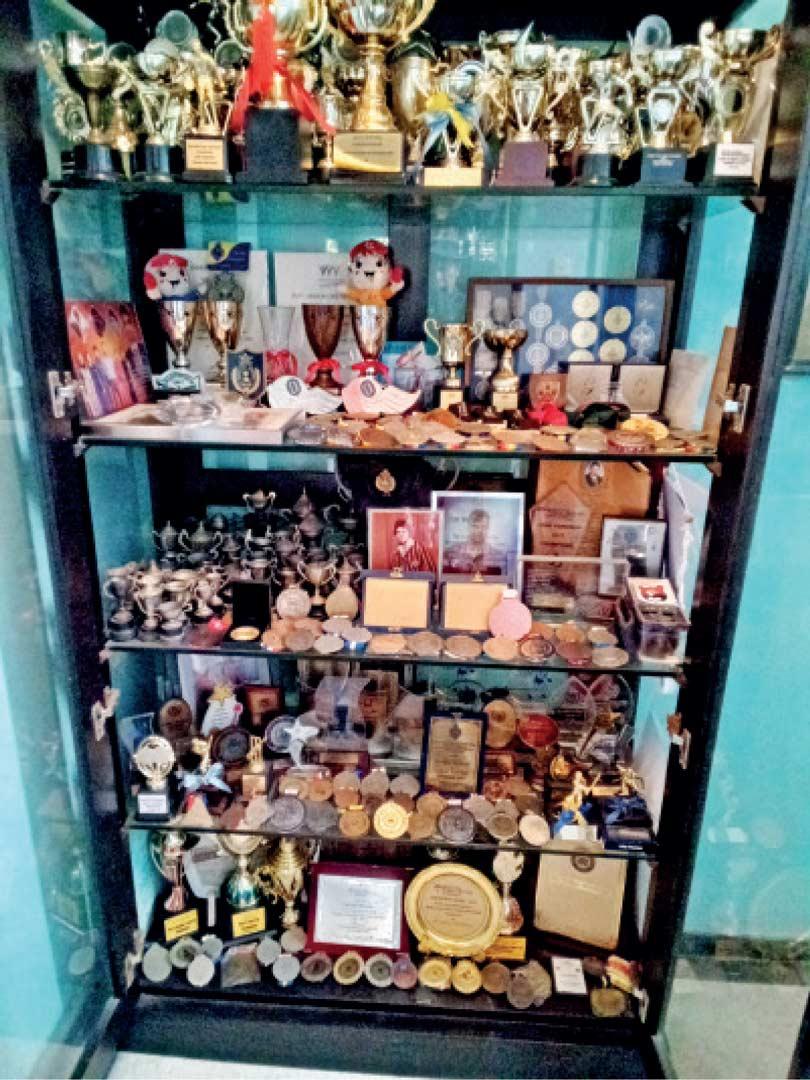
Rajiva’s cabinet