18 Sep 2025 - {{hitsCtrl.values.hits}}
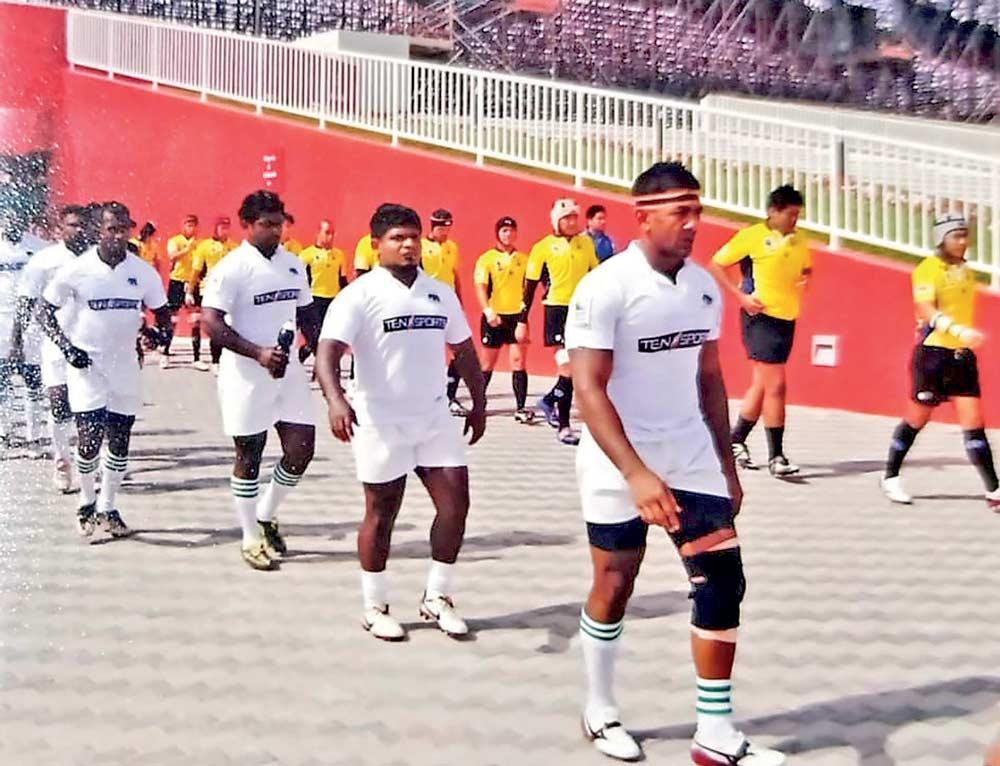
A born leader, Pavithra Fernando leading the Sri Lanka team at the Asian Five Nations tournament in Dubai
By Allaam Ousman
|
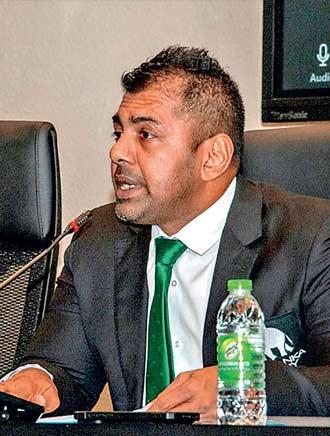
Pavithra Fernando is founder president of the Sri Lanka Rugby Players Association |
Sri Lanka Rugby (SLR) is set for a decisive election on October 8, with nominations now officially closed. Among the contenders is Pavithra Fernando, 45, a former national captain who brings both a fresh perspective and a clean slate to the top job. In contrast to his main rival, former president Lasitha Gunarathne, Pavithra positions himself as a reformist — an outsider to the entrenched system but one with a rich pedigree in sport, education, and administration.
Armed with a BBA, advanced sports management credentials, and strength & conditioning certification, he combines academic knowledge with experience as a player and administrator. His vision for Sri Lanka Rugby is bold yet pragmatic: an Asian Games medal in 2026 as the immediate target, and World Cup qualification by 2035 as the long-term goal.
At the heart of his campaign are pledges to restore good governance, transparency, and accountability — ensuring no club is favoured, funds are used strictly for development, and player selection is based purely on merit. He seeks to expand rugby beyond its traditional strongholds by establishing academies in all nine provinces, contracting separate national squads for 7s and XVs, and introducing a draft system for foreign players to balance domestic competition.
Equally critical is his plan to rebuild trust with World Rugby and Asia Rugby by adhering to due process and the constitution, while actively lobbying to host more international tournaments on home soil to reignite public enthusiasm. “Fixing Sri Lanka Rugby,” he says, “is my prime objective — without fear or favour.”
Confident of having the backing of key stakeholders, Pavithra projects himself as the candidate best placed to unite divergent voices and usher in a new era for Sri Lanka Rugby. Free of past baggage but full of drive, he is emerging as the favourite to lead the sport forward.
Q What made you decide to run for the presidency of Sri Lanka Rugby at this time?
At the national level, our boys have shown they can compete. With just one month of training, our U20s finished second in Asia and even beat the eventual champions. But at club and senior national level, we haven’t carried that success through, because the structures and support simply aren’t there. I felt I could make a real difference because of my education and experience. Plus, people have been asking for a fresh face — not the same old people who’ve been running things for years and getting us nowhere. That’s why I came forward.
Q When you talk about reviving rugby’s glory, what does that mean in practical terms?
Look at this year’s World Cup qualifiers — we lost to Korea and the UAE by very small margins, and mainly because of the scrum. If we put the right plan in place, we can fix that. Once we do, we beat those two teams, we become second in Asia, and then it’s just one more game against Hong Kong for us to qualify. They’re quite a bit ahead right now, which is why I’ve set the target not for four years but for eight. The gap has to be bridged step by step. If the next person after me follows through, we can definitely get there.
Q What are the key pillars of your short-term two-year plan, and your long-term eight-year roadmap?
In the short term, it’s all about the Asian Games. We’ll separate the 7s and XVs squads — right now we have only one squad, and players are overworked, which leads to injuries. Other countries have two squads and specialise. We need to contract the 7s boys, put them on a specific programme, and target a medal next year.
At the same time, we must fix the scrum. That means bringing down foreign scrum coaches, training our local coaches, and investing in a hydraulic scrum machine — the same type New Zealand and England use, with 1,600kg pushback power. With two years of training on that, when Korea and UAE come back to Colombo, we’ll be ready to beat them. If we secure second in Asia, sponsorships will increase massively, which will then allow us to contract XVs players as well. The long-term roadmap is clear: aim for World Cup qualifiers in 2033, and qualify for the 2035 Rugby World Cup.
Q How does grassroots and provincial rugby development fit into your plan?
One of the main pillars is developing provincial rugby. There are untapped players in Jaffna, Anuradhapura, and other regions — big boys who just need opportunity. We’ll set up academies in all nine provinces. Colombo already has a few, but the other eight don’t. The Tri-Forces have grounds and facilities all over the country, so we’ll partner with them. And with World Rugby’s development funding, plus additional sponsorships, we can grow the player base through provincial tournaments. That’s how we build a proper national pipeline.
Q Who are the key people on your team, and what do they bring?
My deputy, Shanitha Fernando, is a former CR & FC captain and Sri Lanka player. He’s a top corporate leader who can attract sponsorships. He resigned from the National Sports Council because he believed more in this vision. Vice president nominee SP Chintaka Perera is a former Police captain and national player. Our secretary, Subhash Jayathilake, is from Air Force — he played for them and now chairs their rugby.
We also have Stephan Gregory, a former Navy captain who played for Sri Lanka just last year, as the athlete representative under the new constitution. That brings in the younger players’ perspective.
For female representation, we’ve got Apsara Gunarathne from Sri Lions who holds a MBA and Thilini from the Army, who represented Sri Lanka for 11 years. It’s a balanced mix of experience, new thinking, and gender representation. This is not something one person can do — we need the whole team.
Q Critics say you risk turning SLR into an extension of CR & FC politics. How do you respond?
If I favour CR or any other club, the whole system breaks down. People aren’t fools — they’ll see the favouritism, and everything collapses. Then we are back to square one. The only way this works is if the right person is put in the right place, regardless of where they come from.
Q What makes you uniquely qualified compared to other candidates?
What sets me apart is the breadth of my experience. I’ve lived the game on the field, studied it through sports science, and managed it at an administrative level. I bring not just passion, but also the academic knowledge and leadership skills needed to modernise rugby in Sri Lanka. Few candidates can offer that full spectrum — player, scholar, and administrator.
Q How will you ensure transparency and good governance?
Development funds will be used for development, not to pay salaries like in recent years. Coaches and players will be selected through panels and interviews — not because ‘I know him better.’ Governance and accountability will be strict. When sponsors and stakeholders see that, their confidence returns. Without trust, we’ll just fall back into the same mess.
Q Sri Lanka’s relationship with World Rugby and Asia Rugby has been fragile. How will you manage this?
It’s not rocket science. We need to follow their requirements, meet standards, and maintain good governance. By doing so, and ensuring full transparency in our operations, we can rebuild trust, renegotiate funding, and establish a strong, respectful relationship with World Rugby and Asia Rugby.
I’ll also push to bring more tournaments to Sri Lanka — youth, women’s, Sevens. For example, we’re hosting a leg of the Asia Rugby Sevens Series in October, which is excellent work by the current team. Hosting brings back the crowds and raises our profile. That’s the kind of direction we need.
Q What role do you see for corporate sponsorship and private sector involvement?
We need sponsors back. A stronger, more competitive league attracts them. That’s why I propose a draft system for foreign players — like the NBA — where the best players go to lower-ranked clubs. It balances the competition, makes matches exciting, and attracts fans and sponsors. I’m not saying this as a CR man — if I wanted to favour CR, I wouldn’t push for a draft. But I know an even competition helps everyone, including my club as this would lead to better sponsorships.
Some people get into rugby administration for the perks—tickets, tours, connections. I don’t need that. I’ve already been to four World Cups as a fan, with my friends and family. I’m here because I love the game. I watch all the club rugby games. What I can’t stand is one-sided 60-point hammerings. An even competition is great for the game — it excites fans, fills stadiums, and lifts the whole ecosystem. That’s what I want to bring back.
06 Jun 2026 13 minute ago
06 Jun 2026 1 hours ago
06 Jun 2026 1 hours ago
06 Jun 2026 2 hours ago
06 Jun 2026 3 hours ago