16 Jul 2025 - {{hitsCtrl.values.hits}}
 Almost $2.2 trillion were invested in clean energy in the world, which for the first time was higher than the investment in fossil fuels. It’s now economics
To absorb large scale solar and renewable energy, a lot of other things have to be in place, including transmission investments on interconnections that were responsible
You can reduce the cost of supply to faraway areas by complementing decentralised renewable energy to grid-based supply
India is now the world’s third largest solar market... I think Sri Lanka can take that example- how to attract a lot of private sector investment
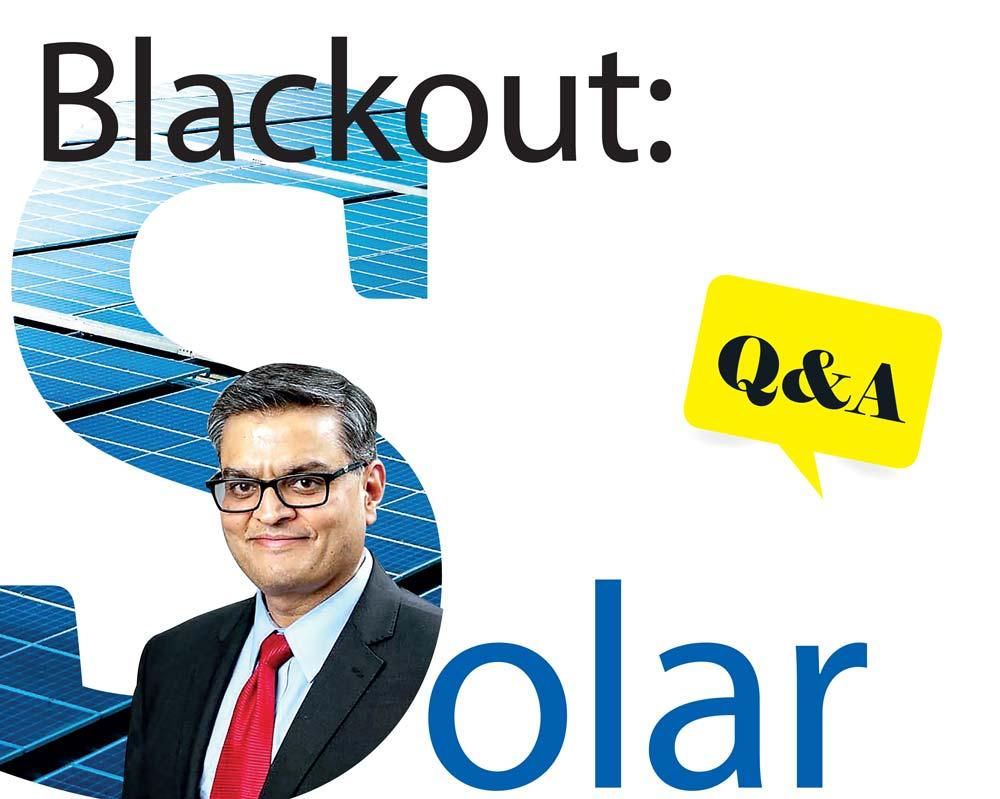
Director General of International Solar Alliance Ashish Khanna who is in Sri Lanka speaks to Daily Mirror on the importance of solar energy for the future. He has over twenty-six years of experience leading energy sector development in the private and public sectors in more than fifteen developing countries in South Asia, the Middle East and North Africa, and Sub-Saharan Africa. He has unique experience working in the solar sector across the entire value chain, ranging from project conceptualisation to resource mobilisation, financing, bid process management, and project implementation. As the former Head of the World Bank’s West and Central Africa Programme, he led the Mission 300 for energy access to 300 million people in Africa by 2030. The International Solar Alliance is an action-oriented, member-driven, intergovernmental organisation for increased deployment of solar energy technologies as a means for bringing energy access, ensuring energy security, and driving energy transition in its Member Countries.
Excerpts:
Q In the wake of climate change, the future of renewable energy sources is uncertain as argued by some. How do you look at the future of solar energy?
The important point is to look at what happened last year. Almost $ 2.2 trillion were invested in clean energy in the world, which for the first time was higher than the investment in fossil fuels. It’s now economics.
There has been a 70% reduction in the price of solar over the last 10 years. Most countries, when they’re doing competitive bids for solar, are finding that the price for solar energy is substantially lower than new coal or new gas.
So it is the economics of making your industries more competitive, giving lower tariff and bills to households that are driving the solar energy in the world.
As far as your question about storage, there is a limit on what solar can do? What is happening is that the battery costs are also coming down substantially. Countries are also looking at energy storage, including pumped storage, in a holistic way.
Now, Sri Lanka is a very interesting case of hydropower- just as neighbouring countries like Nepal and India and Bhutan - thinking of pumped storage projects.
Q What is pumped storage?
You have a reservoir above and a reservoir below. You get energy by the water, but then during the peak hours with the sun, you pump it back.
And then at night, you use the hydropower. So the solar power in the day is used to pump the water back so that when sun is not there in the evening, you have hydro. So there is a mix of battery storage, pumped storage, and other solutions that can potentially take care of even the evening peak.
In the total context, solar is making a lot more sense for the world for meeting its energy needs beyond climate change.
Q You are trying to unlock the $ 2 trillion potential for investment in the sector. In that sense, how do you look at Sri Lanka’s potential?
I think that’s a great question. What I feel is very interesting. A great potential for Sri Lanka is that there is enormous potential of a combination of solar, hydro and wind in Sri Lanka.
This combination can bring down the cost of energy for households, and make industries of Sri Lanka more competitive. In addition, India is also looking at an undersea connection with Sri Lanka, and that will make sure that energy from a very large market like India is also available to meet its evening peak and other needs here. We are also looking forward to signing the country partnership framework with Sri Lanka. We will be looking at a three to five year window of a very integrated strategy for solar, batteries and electric mobility. We also look at new technologies like green hydrogen and storage for integrated aspects of how we can help Sri Lanka achieve its goals over the next three to five years.
Q In Sri Lanka, we experienced a blackout. Then, people concerned started blaming this unregulated addition of solar energy to the national grid. So how can we overcome such problems?
I’m just coming back from Europe. There was a blackout in Spain and Portugal. For a long time, people were blaming solar, but the results have come out that it was the lack of transmission investments on interconnections that were responsible.
What that experience shows is that, to absorb large scale solar and renewable energy, a lot of other things have to be in place, including transmission investments to make sure power can be evacuated and safety mechanisms are in place for reactive power. There are now new solutions by which a lot of solar rooftop power can be supplied back to the grid. If the grid is well designed, it can be much cheaper than actually investing in large scale solar programmes.
So let me give you an example. You can do a large scale solar rooftop programme as Sri Lanka is doing. You can also do decentralised renewable energy for small mini grids. Farms can have solar pumps to get better agriculture supply. You can have cold storage. Then you can have utility scale solar.
All of them can come together through digital enablement without any problem of outages and concerns.
Q When we talk about solar energy, we talk about rooftop solar panels. But solar energy can be used for different other sectors like in the agriculture sector. How do you look at that experience in India to be related to Sri Lanka?
What a great potential there is for Sri Lanka! The first part is what is called productive use appliances. Diesel pumps that cost 30 cents to operate, but solar pumps can bring that cost to as low as six and seven cents.
So instead of diesel pumps for getting water out of ground wells, you can use solar pumps. Then the thing should not stop with the solar pumps. You have equipment and cold storage so that you don’t waste. Sri Lanka unfortunately has a huge wastage of almost 30 percent of food.
Using solar power, you can actually have cold storage. This whole range of solar irrigation pumps, harvesting, and cold storage, can actually be a holistic solution for improving agricultural productivity and creating jobs for people.
Let me mention something else, which is a big initiative in India! Rather than having the grid reach all the faraway places, you can have a good amount of small mini grids that can do healthy electrification of schools and hospitals, and that can also provide electricity for local SMEs (Small, Medium Enterprises).
Now the technology is so good that you can have solar batteries that provide electrification to faraway villages without interruptions.
In India, the farmers get power from the grid. Now the cost of energy in India is roughly about six US cents.
Then you transmit and distribute it all the way to farmers. The cost is 9 US cents. But if you have some land to give 100-200 kilowatt next to the distribution substation of agriculture, through a competitive tender, that price is coming as low as four US cents.
It means those who had grid-based connection can actually now have the same supply at half the price, by decentralised renewable energy. As India is experiencing, you can reduce the cost of supply to faraway areas by complementing decentralised renewable energy to grid-based supply.
Q How do you look at the potential for cooperation between India and Sri Lanka in the development of solar energy in that context?
India is now the world’s third largest solar market. It has gone from almost zero to 110 gigawatts in 10 years. That’s almost $150 billion of investment if we include transmission.
I think Sri Lanka can take that example- how to attract a lot of private sector investment. Secondly, since you have variable renewable energy of wind and solar, the India-Sri Lanka interconnection should be expedited. Then, Sri Lanka’s ability to tap Indian markets will ensure energy security for Sri Lanka. Thirdly, as we were discussing agriculture and jobs, the experiences of providing quality solar supply and batteries from India can help have jobs and improve farmer productivity in Sri Lanka.
Finally, on electric mobility. If you go to small towns in India today, almost everyone has electric three-wheelers and electric two-wheelers. They are cheap and much better ways of urban mobility. I think Sri Lanka can take that experience as well.
Q What is the modality for the attraction of Indian investments into the sector?
That is exactly what we will pursue in the country partnership framework that we intend to sign today. We will look at what are the policies and regulations that will help attract a lot of private sector investment in Sri Lanka.
Plus we also want to set up local capability in Sri Lanka. We believe that every country must develop its own capability of figuring out their own solutions. We also intend to start what is called STAR-C, Solar Technology Application Resource Centre, in which the government of Sri Lanka has identified a university. We will create a centre of excellence for solar, batteries and e-mobility there.
That is the way to build the talent among the youth, the women of this country to take forward their own solutions.
Q What do you suggest for Sri Lanka to improve transparency in the tender process, bidding process, management, etc.?
This would again be a subject matter of discussion during the country partnership framework. The experience the world over, including from neighbouring India, is the power of digital tendering. You will hear over the next three days that we want to bring countries together in having digital tendering.
When I did this digital tendering in Africa, even countries such as Chad, Liberia, Sierra Leone and Togo got a tender competitive tariff of four US cents including battery storage. That is the power of transparent tendering. So this is something that we will offer because we have a lot of experience of doing that all over the globe.
This would also be discussed with the government if they are keen to have this service as part of the country partnership framework.
Q How do you see the proposed interconnection of two power grids of the two countries?
I see that as a very viable economic alternative for the future. As Sri Lanka expands, and in 10-20 years, the power demands will continue to increase. Sri Lanka would like to have less dependence on importing fuel, whether it is gas or coal.
It is much better to have domestic production and then get interconnected by a neighbouring market, which will bring down the cost. For example, my preliminary sense of understanding is that the new power of thermal, which is diesel or coal, can cost up to 17-18 US cents per unit in Sri Lanka. But the neighbouring trade from India can be under possibly 10 US cents.
So it makes economic sense to get an assured power supply from a very large market. The next steps are to agree on the final project estimate, the financing plan and the institutional framework for how this will be managed once it is constructed.
We are very hopeful. We are going to discuss it with both governments that this should be expedited because the timing for that is right.
Q Ours is a country that gets a fair share of sunshine right throughout the year. How do you look at our capacity for solar energy production?
That’s exactly what my point is. If you receive sunshine throughout the year that means your ability to use solar is very high compared with a lot of other countries. Therefore, if you do a good competitive tender, the cost per unit will be low.
Imagine the same set of panels can generate more electricity in Sri Lanka than a lot of countries because of the quality of radiation throughout the year!
Q You find something unique in Sri Lanka in that sense?
In fact, all countries close to the equator have a huge ability to generate a lot of energy from the sun. In fact, I was just in a panel recently. They were saying that just two days of sunlight is probably enough to meet the energy needs of most of the world - just two days of sun if we can tap the entire energy.
That is the power of what solar energy is. We have to figure out a way of storage because we need that supply in the night. We have to set our policies and regulations and competitive tendering process to bring us the cost down.
21 Jul 2026 4 hours ago
21 Jul 2026 5 hours ago
21 Jul 2026 6 hours ago
21 Jul 2026 6 hours ago
21 Jul 2026 7 hours ago