30 Jun 2025 - {{hitsCtrl.values.hits}}
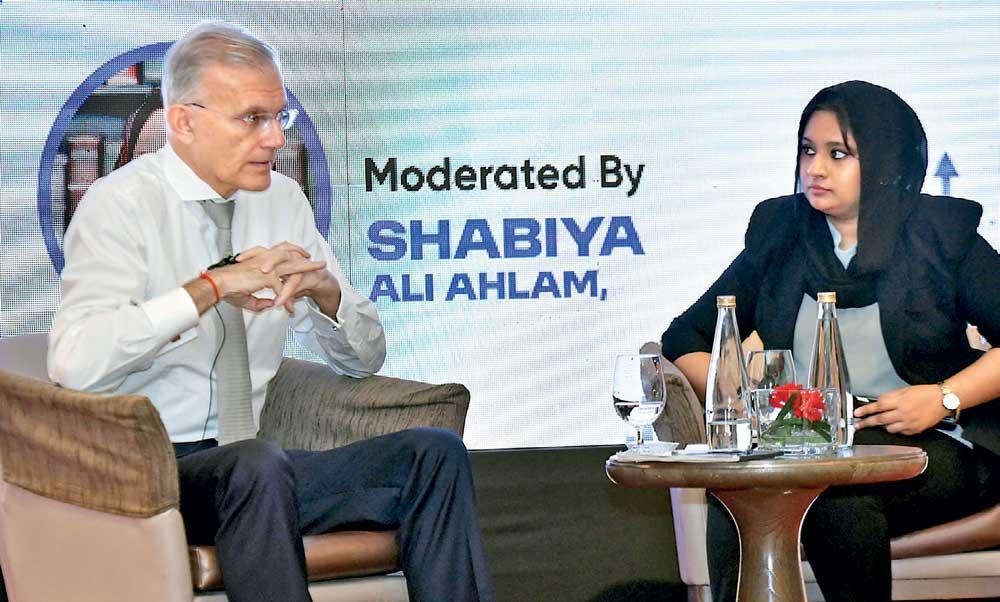
Senior economist and writer Prof. Razeen Sally (left) in conversation with Daily Mirror Business Editor Shabiya Ali Ahlam during a one-on-one session at the Capital Market Conference 2025, held in Colombo - Pic by Nisal Baduge
As the global order undergoes sweeping shifts, with geopolitics, trade tensions, and macroeconomic uncertainty converging, small economies such as Sri Lanka find themselves at a critical crossroads. The rules are changing, and passive observation is no longer an option. To unpack these complex global developments, Daily Mirror Business Editor Shabiya Ali Ahlam sat down with internationally renowned economist Prof. Razeen Sally at the Capital Market Conference 2025 for a one-on-one discussion. Prof. Sally, a former Associate Professor at the Lee Kuan Yew School of Public Policy, Singapore, past Chair of the Institute of Policy Studies (IPS), and policy advisor, offered insights into the forces reshaping the world, and what they mean for the island nation. Following are the excerpts:
 Q We are at a turning point in global affairs, with the Middle East on fire, trade tensions between major powers reigniting, and multilateralism continuing to erode. The post-war world order, as we knew it, appears increasingly fragmented. How would you assess the current state of geopolitics? How have the fault lines shifted in recent times, and what broad implications is this having on the global economy?
Geopolitics has always been important to the world economy, but I think it is more important now than ever before. I would describe the current state as a structural shift from relative order and stability to increasing disorder.
To put this in historical context, from 1945 until fairly recently, the world operated under an American-led order. After World War II, the United States provided key international public goods, first and foremost, security. It acted as the global policeman, much like Britain did in the 19th century. The U.S. also shaped the architecture of open trade, capital flows, and financial safety nets, acting as a lender of last resort during crises. Stable exchange rates and a functioning global economy depended on this leadership.
Until 1989–1990, the U.S. maintained this order in a bipolar contest with the Soviet Union. After the Cold War, the bipolar tension disappeared, but the U.S. continued to lead by building alliances and investing in institutions like the UN, NATO, IMF, World Bank and WTO.
What we have seen since the global financial crisis is a reduced American willingness and capacity to provide these global public goods. That has weakened international cooperation and institutions, paralleling the rise of China.
I think we are now entering a new world order, marked by growing disorder. Perhaps the election of Donald Trump symbolised the end of the old order. With “America First,” the U.S. adopted a narrower, more isolationist approach, engaging with the world in transactional, zero-sum terms rather than through the positive-sum logic that previously guided its leadership.
That shift is evident across areas: security, trade, finance. And it is being matched by China, whose multilateral rhetoric belies its mercantilist reality. China seeks to extend its global reach militarily via the PLA, and through bilateral arrangements that resemble the old tributary system of the Chinese empire.
Meanwhile, other players, the EU and the UK, are internally divided and externally weak. They lack hard military power, unlike the U.S. and China. Soft power alone is not enough.
So now we face a multipolar world, with the U.S. turning inward, China pursuing mercantilist expansion, and middle powers squeezed between the two. Some argue this is positive, that the end of the American-led order creates a more balanced, multipolar system. But I am not convinced.
History shows that for the world to function, it needs a leader, one country that takes the initiative to build alliances and invest in institutions that provide public goods, especially security. When power is fragmented among several actors, coordination is difficult and conflict becomes more likely
To put this concretely, in the old American-led system, regional conflicts like the war in Ukraine or the latest war in the Middle East were more easily contained. In today’s multipolar world, with a receding America, such containment is harder, raising the risk of regional conflicts spilling over into global ones with serious economic repercussions.
The historical parallel is the interwar period between 1914 and 1945. Britain was declining, America was rising, but neither stepped up to lead. That vacuum led to the Great Depression and eventually to world war. We are not there yet, but that is certainly one of the darker scenarios we should worry about.
Q How do you see the global economic trajectory playing out in the medium term, particularly for developed versus developing nations?
Bearing in mind what I just said about the geopolitical situation, let me translate that into prospects for the global economy. The shift is from relative predictability of policies to unpredictability, volatility, and a loss of confidence.
One historical truth is that a market economy needs rules, and reasonably stable rules, to function well. Markets do not operate effectively under a law-of-the-jungle scenario, in an environment of disorder, anarchy or chaos. There is a serious danger that we are shifting into this kind of world.
The IMF’s Global Economic Prospects, the latest edition came out just a month or two ago, in April, is concerned about this scenario, describing it as a structural shift toward something far more unpredictable, with a corresponding loss of confidence.
In terms of basic numbers, the IMF predicts global growth this year will fall to about 2.3 percent, possibly rising to 2.5 percent next year and the year after. That is significantly lower than the pre-pandemic decadal average, which itself was lower than in the previous decade, leading up to the global financial crisis. So we are already looking at a downturn in predicted global growth. And that is assuming we do not have further shocks. If the war in the Middle East escalates, or if the Russia–Ukraine war worsens, then we could see those predictions downgraded even further.
How does this play out between developed and developing countries? The recent record shows that the COVID shock hit developing countries much harder than developed ones. Coming out of COVID, the developing world is weaker, whereas the rich world is relatively more resilient. These new shocks are likely to exacerbate that trend.
That is what the IMF predictions suggest. Trend growth in the developed world is broadly in line with what was forecast pre-pandemic. But in the developing world, it is about six percentage points lower, excluding China. So we are seeing a significantly greater impact on developing economies.
Lower growth means that social, political, and fiscal institutions worldwide, particularly in developing countries, will become even more fragile. There is a serious risk that rising financing costs, driven by increased risk, could create a downward spiral—lower growth leading to debt distress, defaults, and further crises in some parts of the developing world.
All of this comes on top of a series of shocks the world economy has already faced. Since the global financial crisis, we have had the pandemic, then post-pandemic inflation, then the Russia–Ukraine war, now conflict in the Middle East. In addition to that, there is the whole Trump phenomenon. Taken together, this is not good news, to put it mildly, for the world economy.
QWe are seeing a new era of protectionism emerge, with reciprocal tariffs, reshoring, and industrial policy becoming the norm. Countries with fragile governance or inconsistent policy frameworks face an uphill battle.In the face of intensifying global trade wars, such as Trump’s proposed tariff escalation, what should countries do to remain resilient and competitive? What risks and opportunities lie ahead?
On the trade front, I see another structural shift. The era of modern globalization, which began at the end of the Second World War, probably ended with the election of Donald Trump and his inauguration on 20 January this year.
The last major phase of globalization ran roughly from the early 1980s until the global financial crisis. During that period the developing world and, later, the post‑communist world liberalised, and in the West we witnessed rapid integration in trade, capital flows and, to a lesser extent, the movement of people. Global supply chains emerged within a US‑led order that relied on strong international cooperation.
From the global financial crisis onwards, that momentum slowed. The Economist called it “slowbalisation” because integration decelerated, liberalisation stalled, and protectionism increased.
I believe we have now entered a new trade era that mirrors today’s economic and geopolitical climate, an era of economic nationalism, or mercantilism. The emblematic figure of this turn is Donald Trump. He views trade through a narrow mercantilist lens: a zero‑sum world in which America wins only if others lose. In his view imports are bad, exports good, and bilateral trade balances are the scorecard.
The first Trump administration was relatively mild because stronger constraints surrounded him. Yet the United States was already drifting toward inward‑looking protectionism before Trump, and under the Biden administration that trend has been turbo charged. America’s average tariff protection is now higher than at any time since the 1940s and 1950s, in some cases surpassing levels seen in parts of the developing world.
China, for its part, turned decisively toward protectionism more than fifteen years ago and has pursued an aggressive industrial policy in strategic sectors. That approach has been copied by the United States and by others, including the European Union and India with its production‑linked subsidies. This slide into protectionism and renewed faith in industrial policy is bad news for the world economy, especially for developing countries that want to open up and integrate.
What can countries do? There is a temptation for every government, rich or poor, to copy Washington or Beijing. That would only worsen the situation. Instead, I would like to see the European Union, Japan, Canada, Australia, Singapore and other middle powers launch collaborative initiatives, through free‑trade agreements such as the CPTPP, to keep markets open and to revitalise institutions like the WTO as a counterweight to the United States and China. As for emerging and frontier markets, the prescription is simple in theory: liberalise as much as possible. In practice it is politically much harder today.
QThe current global environment demands more than passive adaptation. For small economies, the ability to read the global playbook and respond decisively has never been more critical. Given the shifting global order, geopolitically and economically. what impact do you foresee on Sri Lanka over the next few years? Are we adequately equipped to respond? And if not, where should the focus be?
If we think of Sri Lanka from 1977 until about 2005, when Mahinda Rajapaksa became president, that was an era of liberalisation, which took place in a benign global environment. This was the era of globalisation I spoke about earlier.
Sri Lanka gradually liberalised and developed an export-oriented garments industry as its main outcome. But unlike our East Asian peers, the country did not go much further. From there, we moved into roughly 15 years of post-global financial crisis conditions marked by global easy money. During this period, successive Rajapaksa governments embarked on a debt-fuelled spending spree. That ultimately led to the worst economic crisis Sri Lanka has faced since the Great Depression of the 1930s.
Today, we are in a more malign global environment, just as Sri Lanka is recovering from that crisis in a halting and vulnerable manner. We do not have the benefit of a benign global backdrop. That is the big-picture context.
The danger now is that external shocks, Trump’s trade wars, potential new US tariffs targeting Sri Lankan exports like garments, or a surge in oil prices triggered by an escalating Middle East war, could tip Sri Lanka into another recession. This would bring higher inflation and reduced government revenue, which could lead to another debt default and a renewed economic crisis. That, in turn, could provoke a populist political backlash against the current government, with familiar political figures waiting to capitalise. There is a real risk of a downward spiral, driven by adverse global conditions and weak domestic fundamentals.
Almost ten years ago, I gave a lecture, sponsored by Advocata, in which I outlined three scenarios for Sri Lanka. I think those scenarios remain relevant, so let me use the same labels.
The first is drift, which I believe is the most likely political outcome. In this scenario, the government sticks with the IMF programme but does not go beyond it. This government, like the Yahapalana administration before it, came to power without a clear economic policy agenda, aside from its anti-corruption stance. It inherited the IMF programme. But if the government fails to implement the deeper structural reforms we all know are necessary, it will remain vulnerable to external shocks, and the country could fall back into recession.
The IMF programme alone is not enough. It does not deliver the productivity gains and growth needed for macroeconomic survival, starting with debt servicing. Nor is it sufficient for putting Sri Lanka on a sustainable growth path. Without that, the country will not be able to withstand the external shocks that are bound to come.
The second scenario is relapse. This differs from the Rajapaksa era. By relapse now, I mean the possibility that the core of the government, particularly its JVP-led faction, becomes more dominant and shifts policy in a direction reminiscent of the 1970s. That would accelerate the slide into recession and default and likely provoke a populist political backlash.
The third scenario is what I would like to see. In my Advocata lecture, I called it take-off, but let’s now describe it as the sustainable growth path. Here, the government uses the pressure of adverse global conditions as a catalyst to go beyond the IMF programme, implementing trade liberalisation, FDI liberalisation, and regulatory simplification. These are essential for creating a better environment for both domestic and foreign investors and, crucially, for integrating Sri Lanka into global value chains. That means going beyond garments and especially developing services sectors.
Within that, Sri Lanka must link itself to the Indian growth bandwagon. Over the past two to three years, I have spent a great deal of time in India for other work. I have travelled across the country and spent nearly two months there earlier this year. Whatever the shortcomings of the Modi government, and the economic picture is mixed, it is clear that India has changed over the past decade.
This transformation is visible on the ground in terms of hard infrastructure, but also digital infrastructure. And it is not limited to the usual growth poles in the south and west, but is now spreading more broadly.
It is vital that Sri Lanka links itself to this momentum, particularly through the value chains of southern India. But that will not happen unless there are structural reforms that go beyond the IMF’s requirements. Politically, that is unlikely, given the realities of domestic politics. I am not saying it is impossible, but that is the scenario Sri Lanka needs to aim for in this increasingly difficult global environment.
QWe have seen how situations have played out over the past decades, and now we are talking about revival and sustainable growth among other goals. Is Sri Lanka actively doing anything different this time round to achieve these renewed aspirations?
The answer is clearly, not enough. If I try to identify positives since the change of government, and particularly the change in political leadership we saw in the last quarter of last year, I would say this. In the President and the Prime Minister, we have individuals who appear to have the right intentions. They are not burdened with the same baggage of corruption and sleaze we witnessed in earlier administrations. I think they are pragmatic.
They have appointed some competent professionals to key positions, and at least some members of the government appear genuinely committed to tackling corruption. Things are moving forward slowly. And, importantly, we are no longer dealing with the kind of daily corruption scandals that dominated the news cycle for 15 to 20 years prior. That is good news.
But, of course, it is nowhere near enough.
On other fronts, we do not see significant change. The public does not perceive significant change. And I do not think the government has a clear understanding of what structural reforms are required or how to respond strategically to emerging global threats. Take, for example, the possibility of a punitive tariff from the United States. We are talking about an average tariff rate of over 44 percent on Sri Lankan exports. That would be a devastating blow.
A strategic government would recognise this as an inflection point. Here is a giant truck roaring down the American highway, and Sri Lanka is the deer caught in the headlights.
What do we do? That should be seen as an opportunity to push comprehensive reforms, on trade, on foreign investment, and to bring in serious foreign investors. It should be a moment to embed Sri Lanka more deeply into global supply chains, including with credible Indian investors.
But that is not the response we are seeing. Instead, the response is to assemble a delegation, send it to Washington, and attempt bilateral negotiations. That is not strategy. That is tactics.
21 Jul 2026 8 hours ago
21 Jul 2026 8 hours ago
21 Jul 2026 9 hours ago
21 Jul 2026 9 hours ago
21 Jul 2026 21 Jul 2026