09 Nov 2015 - {{hitsCtrl.values.hits}}
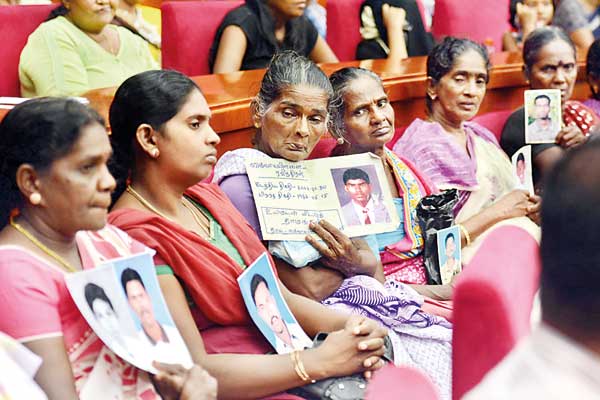
.jpg) A quarter century since it began, the issue of missing persons is still a problem, that has left more questions than answers. As the website of the Presidential Commission to Investigate into Complaints Regarding Missing Persons itself states, 23,249 complaints have been made regarding disappearances as at October 23, 2015; 18,249 by civilians and 5,000 by security forces. That’s a minimum of 0.11% of the total population of Sri Lanka having disappeared. Take a minute and think of the fact that a minimum of 23,249 people have disappeared in Sri Lanka; disappeared from their homes without a trace. The scarier fact is that since June 10, 1990 no solution has been found to the problem.
A quarter century since it began, the issue of missing persons is still a problem, that has left more questions than answers. As the website of the Presidential Commission to Investigate into Complaints Regarding Missing Persons itself states, 23,249 complaints have been made regarding disappearances as at October 23, 2015; 18,249 by civilians and 5,000 by security forces. That’s a minimum of 0.11% of the total population of Sri Lanka having disappeared. Take a minute and think of the fact that a minimum of 23,249 people have disappeared in Sri Lanka; disappeared from their homes without a trace. The scarier fact is that since June 10, 1990 no solution has been found to the problem..jpg) “We are all your children, we are worshipping at your feet, please release these sons so that the sufferings of their mothers can be mitigated. Release our husbands so that we wives can live in peace”, pleads Mrs. S. Selvarani from Ampara directing her requests at the Government.
“We are all your children, we are worshipping at your feet, please release these sons so that the sufferings of their mothers can be mitigated. Release our husbands so that we wives can live in peace”, pleads Mrs. S. Selvarani from Ampara directing her requests at the Government..jpg) Dr. T. Jayasingham, who was in charge of a refugee camp in 1990 said that it was not only the families of the disappeared that were traumatized, but all those who worked around them as well.
Dr. T. Jayasingham, who was in charge of a refugee camp in 1990 said that it was not only the families of the disappeared that were traumatized, but all those who worked around them as well.  This was just a handful of the stories. As Human Rights activist Brito Fernando said.
 .jpg) Dr. Mahesan Ganesan is a practising psychiatrist who has worked in Batticaloa and has seen the damage done during the war including the disappearances.
Dr. Mahesan Ganesan is a practising psychiatrist who has worked in Batticaloa and has seen the damage done during the war including the disappearances.|
What the Commission says... The primary institution tasked with the duty of investigating into the cases of missing persons is the Presidential Commission Investigating Cases of Missing Persons (PCICMP). Under this mandate the Commission had published an interim report titled as the ‘First Mandate’ which focuses on these enforced disappearances. The Dailymirror contacted the Commission with regards to a few questions regarding the process. What is the status of the report and the process so far? The report has been given to Parliament, which has debated on it. However, nothing has been said so far regarding what the debate resulted in. The Commission is planning to travel next month to Jaffna to continue the inquiries. The deadline for the application regarding missing persons was the 31st of December 2013 but new applications continue to come and the Commission accepts. Other than the report is there any support that the Commission has given to the families? The mandate of the Commission instructs the Commission to provide assistance to the families of the disappeared and this has been followed up by the Commission. One example of this is the issuing of death certificates to families so that they can claim specific rights. Another example is the releasing of all lands to the people in Jaffna. Further assistance has been given in terms of those who were unable to claim pensions. A highlight of the Commission in terms of assistance has been the counselling services it has implemented. Together with the ICRC, the UN and the Health Ministry a comprehensive programme has been formulated with the Embassy of Japan agreeing to sponsor it. This has further been recommended in the interim report. What is the Commission’s response to the issues that have been raised with regard to effectiveness of the Commission? There were critics when the report was finalised. However this is a balanced report and even the people who criticised it are admitting that it is comprehensive now. All the allegations of the LLRC were looked into but none of these allegations were accepted at face value. Many people are construing this report in wrong ways without reading the full contents of it. |
02 Jul 2026 10 minute ago
02 Jul 2026 12 minute ago
02 Jul 2026 1 hours ago
02 Jul 2026 2 hours ago
02 Jul 2026 2 hours ago