29 Feb 2016 - {{hitsCtrl.values.hits}}
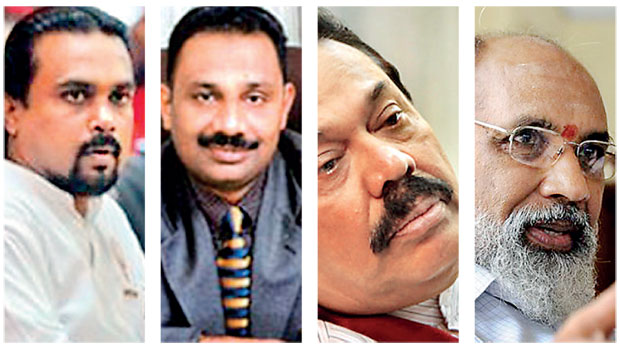

ri Lanka Muslim Congress Chairman Basheer Segu Dawood in a discussion held in the predominantly Muslim town of Kattankuddy last week called for a separate province for the Muslims. Soon, he was booed and criticized by the Muslim community themselves. The son of the founder of the SLMC described Dawood as ‘immature’ and the Muslim commentators viewed the latter as an opportunistic troublemaker.
Interestingly, the reaction to Segu Dawood’s remarks was so swift that it prevented rabble rousers from the other end, ultra-nationalist bigots in the Sinhala Buddhist hardline exploiting those remarks in their divisive campaign. In fact, the real immediate danger of political opportunism of Dawood or the baloney of Northern Chief Minister C.V.Wigneswaran in the recent past is not that their utterances drive their receptive audience to give practical expression to those myopic ends (though their potential in radicalising communities cannot be discounted if they continue to spew the  same garbage), rather they embolden the hardliners of the other end of the ethnic divide. Since the Sinhala Buddhist political discourse regularly gets hijacked by a minority of loud mouthed bigots, that danger is real. (Also the demands such as a separate Muslim province, if promoted and granted, face another not so distant threat of morphing into a Jihadist undertone since no place on the planet is any longer immune from penetration by invasive political Islam).
Therefore, the swift repudiation of Dawood was good riddance. It also prevented the folks in the BBS and those like Wimal Weerawansa from going for another zombie frenzy. So Weerawansa for the time being had to be content with protesting against an innocuous plan to launch an ambulance service by an Indian company in Colombo and the South; he alleges that it would help Indian intelligence agents to roam Down South. Those claims are not only ludicrous, they also reveal the kind of buffoons masquerading as politicians and winning votes too. That political status quo, though sad, is a result of long term deterioration of the standard of politics in this country. And the least the sensible politicians can do is not give those divisive elements an opportunity to exploit and advance their self-interested campaign.
In retrospect, one would wonder how our destinies could have changed for better if the Tamils repudiated the divisive demand for a separate state in the North East. The separatist militancy which over the time morphed into terrorism was partly an offshoot of the Vaddukkottai-resolution, which was a miscalculated election gimmick adopted just before the General election in 1977, and went awfully wrong.
Of course, the hardening of the Tamil position over the time was a reaction to the Sinhalese Buddhist majoritarianism, which refused to accommodate legitimate Tamil demands. However, none of that warrants the self-destructive trajectory that the secessionist struggle took and dragged the rest of the country with it.
However, one positive after effect of LTTE’s nihilistic campaign is that its destruction of the country in general and Tamil community in particular has now encouraged the mainstream of each community to positively affirm to the Sri Lankan identity. That post- war triumphalism has now subsided and the other destructive manifestations such as the BBS have been tackled through judiciary means should give confidence to minority communities for a more inclusive Sri Lanka. That inclusive polity cannot be built by carving out ethnic enclaves for each community.
However, if a country strives to be ethnically inclusive, it should project its multiethnic identity through all means. There are some simple means to embolden that diversity. Take the British Broadcaster BBC, which perhaps wields more soft power worldwide than all material power the British does right now. BBC has people of all colour and ethnic identities in their line of news presenters, that itself is a celebration of diversity Britain is. How many Tamil or Muslim newscasters do read Sinhala news on the National Television in Sri Lanka. Sadly, none. (Several years back, Riyaz Mohammed read Sinhala news on Swarnavahini). Those are simple but effective means of reaffirming our diversity, they also serve as a bridge between communities.
And in some other areas where such a representation would have a major national bonding effect, such as Sri Lanka Cricket, that may not happen soon. But, that would happen one day. Instead of building a cricket stadium in some forsaken land in Suriyawewa, if Rajapaksas built a cricket ground in Jaffna or at least a couple of turf wickets for schools in the North and the East that could have been made quicker.
However, there is still a residue of ethnic discrimination. Last week, the Supreme Court ordered the Colombo University to recruit an applicant as a faculty member after it emerged that the university administration had rejected her on the grounds of her being a Muslim even after she had scored the highest marks in the admission process. To believe that this level of bigotry existed at the highest level of academia is mind boggling. When that happens, it threatens the entire nation-building project. As a nation, we have suffered enough from the repercussions of such actions in the past.
The ethnicity or the religion should not be the grounds for special privileges (unless it is meant as a kind of affirmative actions). But when nincompoops masquerading as patriots hijack the high-posts of the State, like it happened under the former regime, they turn the State itself to become a reflection of their ugly psyche. Then, there is a convincing case for some communities wanting to be left to their own devises.
Now that the majoritarian triumphalism is discredited and bigots are out of power, no one needs a separate State for anyone.
01 Jul 2026 37 minute ago
01 Jul 2026 1 hours ago
01 Jul 2026 1 hours ago
01 Jul 2026 1 hours ago
01 Jul 2026 2 hours ago