29 May 2026 - {{hitsCtrl.values.hits}}
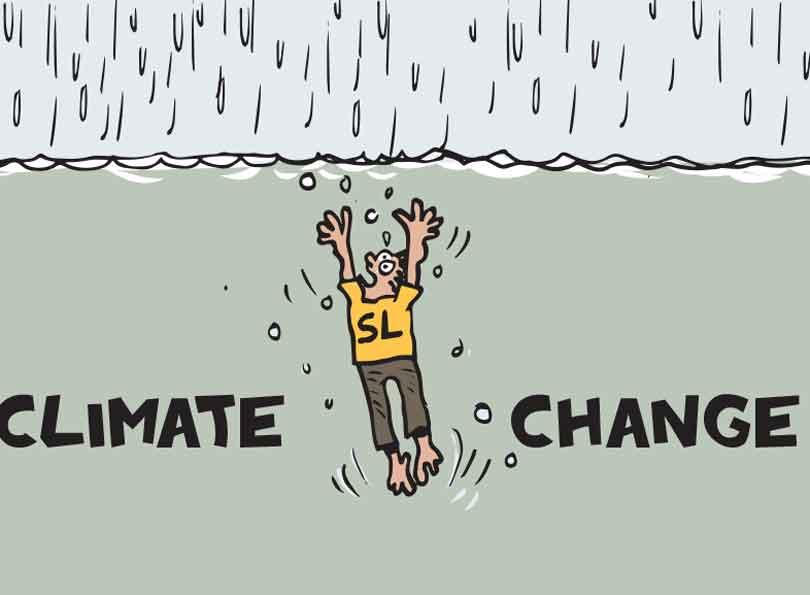
If there is one lesson Sri Lanka should have learnt from the catastrophic economic collapse of recent years, it is that shallow development gains are easily erased by sudden, external shocks. Yet, as the government tries to deal with the complex conditionalities of fiscal restructuring, an existential, parallel threat continues to be relegated to the margins of state planning: the macroeconomic devastation of climate change. The country is currently experiencing monsoon rain. The climate change and environmental vulnerabilities are rapidly emerging as the new face of poverty in Sri Lanka. For too long, successive administrations have treated climate change as an isolated environmental issue—a portfolio trotted out for international donor conferences or symbolic tree-planting ceremonies ahead of World Environment Day. Meanwhile, the real-world consequences are battering our primary economic sectors. The recent trail of destruction left behind by Cyclonic Ditwah, coupled with severe warnings of a prolonged El Niño drought threatening the current southwest monsoon, underscores our baseline fragility. When a drought hits, it does not just hurt the farmer; it cripples our national grid, forcing the treasury to bleed precious foreign reserves to import expensive fossil fuels or burn lowgrade coal. When unpredictable monsoons trigger flash floods, it disrupts supply chains, spikes food inflation, and burdens our highly taxed small and medium enterprises (SMEs). Sri Lanka can no longer afford a twofaced policy that champions climate justice at United Nations General Assembly votes while allowing short-sighted, climate-blind economic planning at home.
True economic recovery cannot happen in a vacuum. If the government’s target of achieving a sustainable growth trajectory is to survive the decade, climate-resilient economic activities must be legally and structurally hardwired into national policy. Our agricultural policy must shift away from volatile, reactive relief and focus squarely on climatesmart practices. This means active state investment in d r o u g h t - r e s i s t a n t crop varieties, modernising minor irrigation tanks to serve as defensive buffers, and utilising localised, tech-driven weather forecasting. No public infrastructure project should receive budgetary approval without a stringent climate-vulnerability assessment. Building roads, bridges, and urban drainage networks to old tolerances is akin to throwing taxpayer money directly into the next floodwaters. The economic policy must aggressively incentivise the private sector toward green investments. Sri Lanka’s newly updated Nationally Determined Contributions (NDCs) create a framework for a circular economy, but this must be backed by fiscal carrots and sticks—such as concessionary credit lines for SMEs adopting renewable energy or ecotourism models. We stand at a critical juncture. The path to long-term solvency does not merely run through tax compliance and IMF-mandated spending cuts; it relies heavily on ensuring our economic foundations can withstand a warming planet.
01 Jul 2026 39 minute ago
01 Jul 2026 1 hours ago
01 Jul 2026 1 hours ago
01 Jul 2026 1 hours ago
01 Jul 2026 2 hours ago