26 Jul 2025 - {{hitsCtrl.values.hits}}
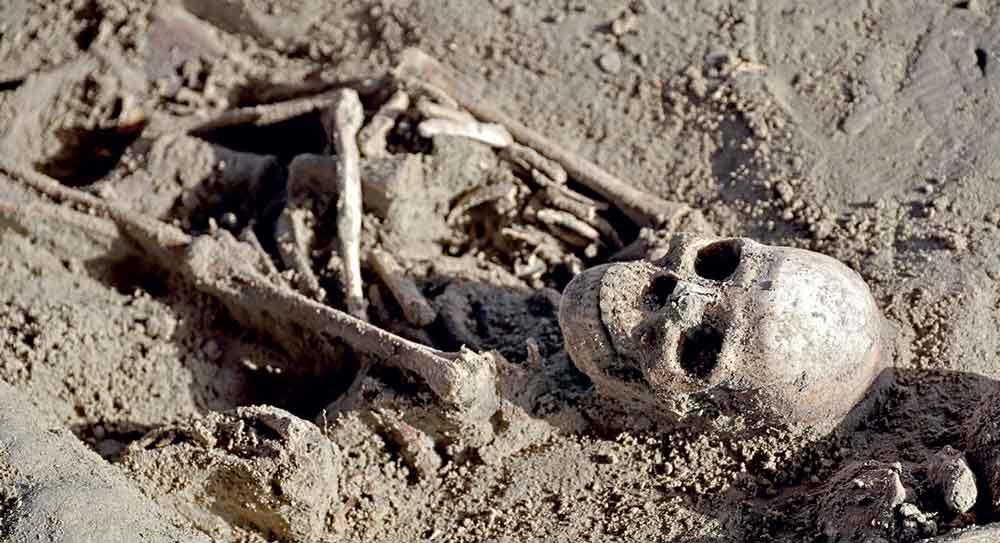
Underneath Jaffna’s soil lies not just death, but decades of deliberate erasure. Image courtesy - Sakuna M. Gamage
Skeletons of over 40 people have now been unearthed from the site at Chemmani, where excavation has been carried out since February
The reports about finding skeletal remains of children from what now seems to be a mass grave at Chemmani, the entrance to Jaffna city, inevitably remind the writer of a similar scenario that occurred some forty years ago, in 1984.
It was a time when the Liberation Tigers of Tamil Eelam (LTTE) did not monopolise the armed struggle against the Sri Lankan security forces. The Tamil Eelam Liberation Organisation (TELO), one of the several Tamil groups that were then attempting to outshine each other, had launched a massive attack on the Chavakachcheri police station and captured the whole armoury.
Not experienced with such a humiliating defeat at the hands of a Tamil armed group before, the Sri Lankan government’s response was unprecedentedly brutal; the armed forces rampaged in Jaffna with indiscriminate firing and deaths of hundreds of civilians resulting in. However, with strict censorship in place, newspapers were struggling to tell the world what was going on in Jaffna. It was a time when the internet had not even heard of and the state-owned radio and a TV station related to a government minister were the only media outlets functioning in the country, apart from the newspapers.
One Tamil newspaper carried a long list of “terrorists” who were killed during the military operation, with their age, and there were ‘individuals’ who were less than five years old in the list.
Skeletons of over 40 people have now been unearthed from the site at Chemmani, where excavation has been carried out since February. It was a child’s skeleton with a school bag and another smaller one with a toy, which were found among the findings of the excavation that reminded the writer of this story of young “terrorists” of 1984.
The United Nations High Commissioner for Human Rights, Volker Türk, who visited Sri Lanka last month, also visited Chemmani and met relatives of people who disappeared during the war between the armed forces and the LTTE. However, many southern politicians were not happy with the excavation nor with the visit by the UN human rights chief to the site. Only small leftist political parties seem to be keen about the findings of the mass grave at Chemmani.
Leader of the National Freedom Front (NFF), Wimal Weerawansa and former Public Security Minister Sarath Weerasekara attempted to suggest that the remains unearthed from the Chemmani mass grave were those of the people, including the armed forces personnel killed by the LTTE, which cannot be ruled out legally, until a forensic examination is carried out. However, nobody would accept their suggestion until such a forensic examination proves it. On the other hand, if at least they believed what they suggest, their opposition to the UN High Commissioner’s visit to the site is pointless.
As many people already know, Chemmani had been a talking point some thirty years ago as well, after the bodies of Krishanthi Kumaraswami, an 18-year-old schoolgirl, her mother, her brother and a neighbour were found buried there in 1996. The girl had been gang raped and killed by army soldiers, and the others who had gone in search of her had also been murdered later. Six soldiers were found guilty of the brutal crime in 1998 and sentenced to death. One soldier, Somaratne Rajapakse, had told the court after his conviction that he did not kill anybody, but only buried the bodies.
In a statement from the dock, he had stated that “300 to 400 bodies” lay in mass graves near Chemmani and offered to identify the sites if investigators took him there. His statement corroborated the reports that were circulating those days that around 600 people had gone missing during “Operation Riviresa”, launched by the armed forces in 1995 to recapture the Jaffna Peninsula, then held by the LTTE. With Rajapaksa’s assistance, 15 bodies were later found buried in the area, but legal actions were discontinued subsequently due to
administrative snags.
Mass graves were not confined to Chemmani nor to Northern and Eastern Provinces, nor to the ethnic conflict. They were obviously a result of mass killings or massacres for which all armed entities, Sri Lankan armed forces, the police, Indian forces (Indian Peace Keeping Force - IPKF), pro-government paramilitary groups, the LTTE, as well as other Tamil groups and Muslim Home Guards were blamed.
Sri Lanka, after its Independence, first saw mass killings by the armed forces during the first insurrection of the Janatha Vimukthi Peramuna (JVP) in 1971. Those violations were, in a way, legalised by the permission granted to the armed forces to dispose of dead bodies
without an inquest.
With the Tamil Armed struggle intensifying, President J.R. Jayewardene sent Brigadier Tissa Weeratunga to Jaffna in 1979, directing him to “finish it off” before the end of the year, and Tamil media reported heavy casualties. The outcome, in fact, was totally opposite to what Jayewardene expected.
The unprovoked first massacre in the country took place on September 10, 1984, when a passenger bus plying from Colombo to Jaffna was waylaid at Rambewa and taken to Poovarasamkulam in Vavuniya, where 15 out of 47 passengers were shot dead. The army was blamed for the crime. The LTTE retaliated two months later by attacking two rehabilitation colonies for prisoners, Dollar Farm and Kent Farm in Mullaitivu District, in which 82 people were killed. They attacked two fishing villages, Kokkilai and Nayaru, on the following day, killing 11 people.
These attacks were avenged in the same month in various places in the area, and both the belligerent parties took turns attacking civilians in Sinhalese and Tamil villages, killing hundreds of people in subsequent years. Since 1990, Muslim villages have also come under attack by the LTTE, where hundreds were murdered. Wikipedia, the online encyclopedia, has documented hundreds of Sinhalese, Tamil and Muslim villages where massacres of civilians took place during three decades of war.
The death toll at the hands of the armed forces and the pro-government vigilante groups during the second insurrection of the JVP in the late eighties exceeded 60,000, according to unofficial reports. Mass graves were found in many places in the country, such as Hokandara, Sooriyakanda and Wanawasala.
Although people of all ethnicities lie in these mass graves, only what happened to “us” is always highlighted, ignoring or denying the similar plights undergone by “others.” Also, hundreds of such incidents have been forgotten, while only a few are being commemorated or at least rarely talked about. Justice is being sought only for a few incidents that occurred during the separatist war, but responses to those demands are tightly tied to the very political survival of those in power.
11 Jul 2026 44 minute ago
11 Jul 2026 58 minute ago
11 Jul 2026 4 hours ago
10 Jul 2026 5 hours ago
10 Jul 2026 5 hours ago